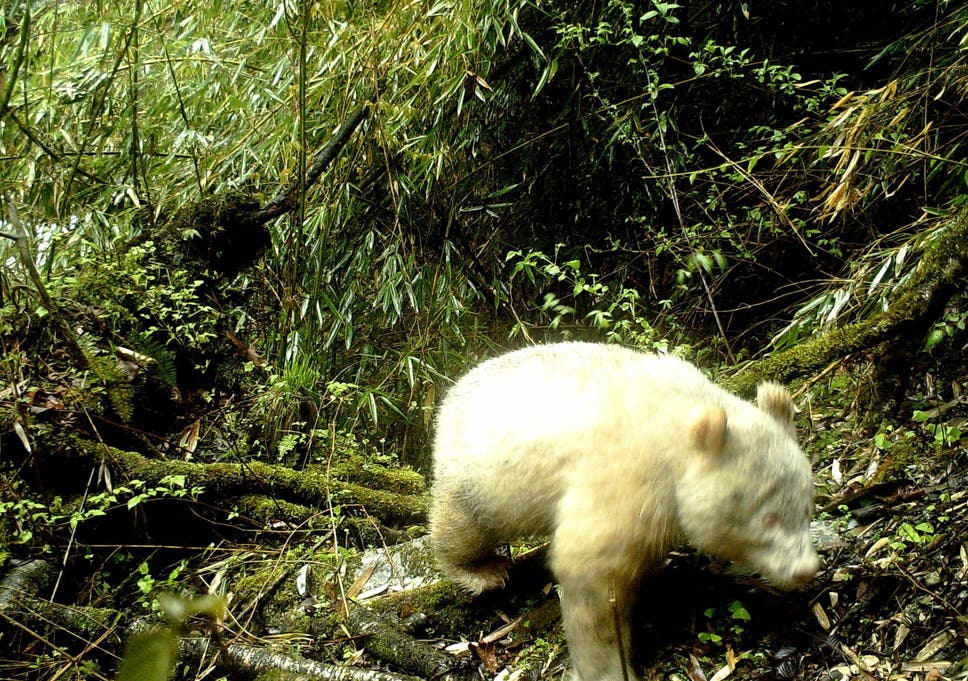
A fully albino giant panda has been caught on camera at a Chinese nature reserve in what is believed to be a world first.
Researchers released an image of the all-white bear walking through a forest in Wolong National Nature Reserve in Sichuan province.
It was photographed in mid-April by an infrared motion-triggered camera installed 2,000 metres above sea level by scientists in December last year.
Researchers who studied the picture later concluded the adolescent bear’s white hair, white claws and red eyes were hallmarks of albinism, a rare genetic mutation that causes a lack of the skin pigment melanin.
It is thought to be the first documented sighting of an albino giant panda.
The bear appeared to be “physically strong with a steady gait”, indicating the condition “is not affecting its normal life”, said the Wolong National Natural Reserve Administration in a statement.
Scientists were unable to establish the panda’s sex from the photo but believe it to be between one and two years old.
The discovery of the young bear “indicates that there is a ‘whitening’ mutant gene in the giant panda population in Wolong” that could lead to more albino cubs in the reserve in southwest China, according to a researcher.
The genetic mutation “usually has no significant effect on animal activity and reproduction”, said Li Sheng, a bear specialist at Peking University School of Life Sciences.
But the albino cub photographed is extremely rare as the mutation is recessive – meaning it can only be inherited if both parents carry the gene – and there are fewer than 2,000 giant pandas remaining in the world.
Researchers are to install more cameras in the area in the hope of capturing further footage and tracking the bear’s development.
"It we can photograph its offspring, it will have even greater researcher value," Wolong nature reserve's statement added.
Rare brown pandas – whose unusual coloration is also believed to be caused by a genetic mutation – have previously been spotted in the Qinling mountain range in China's southern Shaanxi province.