Lateness, of various kinds, was the theme running through this absorbing chamber concert, which began with Mozart’s final string quintet and concluded with Brahms’. Mozart had little idea the piece would be his last chamber work, while Brahms fully intended his to stand as his final musical essay, until a clarinettist changed his mind.
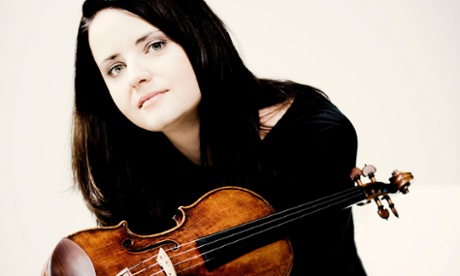
Teeming with spirit, Brahms’ second quintet opens like an explosion of late-afternoon light that illuminates everything – from the slow movement’s fond reminiscences to the fourth movement’s cajoling peasant dance – with a kind of impossible richness. It was superbly played by the scratch ensemble here, brought together by the German cellist Alban Gerhardt and led by the superb Latvian violinist Baiba Skride, also comprising the violinist Gergana Gergova (Gerhardt’s wife) and the violists Nils Mönkemeyer and Brett Dean. Largely unconcerned with polish and poise, the group gave everything to the music, an investment repaid with interest.
The lateness of others occupies Brett Dean’s 2010 work, Epitaphs, whose five movements are dedicated to deceased friends and colleagues. The first movement, for the Australian poet Dorothy Porter, has a somewhat Shostakovichian flavour, with a garish melody succumbing to a ghoulish choir of harmonics, while the second, to Lyndal Holt, conjures a splintered colloquy growing unexpectedly to fullness. The third, to the cellist Jan Diesselhorst, a colleague of Dean’s from the Berlin Philharmonic, is the most openly tragic, while the final movements, to Betty Freeman and Richard Hickcox, draw a little on the Brahms in their combination of serenity and irrepressibility.
The playing was splendidly committed throughout, as it was in the preceding Mozart, which I caught enough of (a more mundane kind of lateness led to my missing the first movement) to be lifted by its chattering brilliance and to gain a general sense of the concert which, for all its morbid binding, was music-making at its most invigorating.