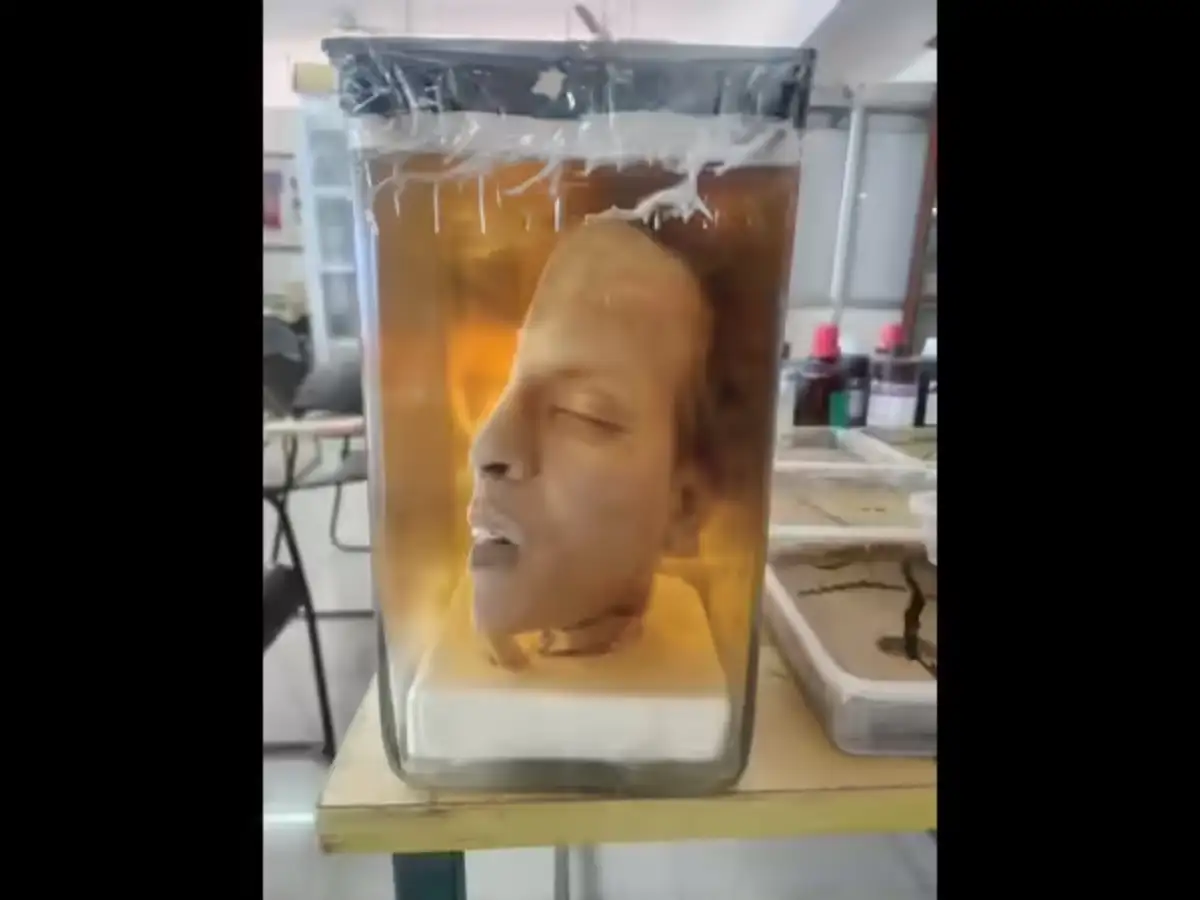
In a quiet corner of the forensic museum at Madras Medical College, an unusual exhibit continues to attract the attention of medical students.
Inside an old wooden cupboard with glass doors sits a jar containing half of a human head preserved in formalin. A small label simply reads "M 11".
While there are no surviving records attached to the specimen, generations of forensic experts have identified it as belonging to C Alavandar, a salesman whose brutal murder in 1952 became one of the most famous criminal investigations in Indian forensic history.
More than seven decades later, the preserved remains continue to serve as a teaching tool for future doctors and forensic specialists.
Who was C Alavandar?
C Alavandar was a pen salesman working for Gem & Co in Parrys, Madras (now Chennai). Before that, he had served in the Army during the Second World War.
Apart from his job, he reportedly ran a small sari business and was known to maintain relationships with several women.
His life came to a tragic end in August 1952 when he became the victim of a murder that shocked the country and tested the limits of forensic science at the time.
How was Alavandar's body discovered?
The case began on August 29, 1952, when railway officials detected a foul smell coming from a green steel trunk aboard the Indo-Ceylon Express, popularly known as the Boat Mail.
The trunk was traced to Manamadurai, where police discovered a headless male torso inside.
A few days later, investigators made another chilling discovery.
A severed human head was found buried on Royapuram beach in Madras.
The head and torso were subsequently sent to Madras Medical College for examination.
At first glance, identifying the victim appeared almost impossible.
How forensic experts identified the victim without DNA
Today, investigators would rely heavily on DNA testing and genetic profiling.
However, in 1952, such technology did not exist.
The responsibility of identifying the victim fell on Assistant Professor of Forensic Medicine Dr C B Gopalakrishnan.
Using detailed anatomical examination, he carefully compared the neck vertebrae of the severed head and torso.
The bones matched perfectly.
Once satisfied that both body parts belonged to the same individual, he turned to other identifying features.
These included:
- Age and physical build
- Facial characteristics
- Distinctive ear-piercing patterns
- Personal identifying marks
According to forensic experts, Alavandar had an unusual ear-piercing pattern, with two holes on his right earlobe and one on the left.
He also had a distinctive mark on one of his legs.
These details helped investigators narrow down the identification.
Wife's identification and fingerprints helped solve the mystery
The victim's wife was able to identify the face.
However, forensic experts wanted stronger evidence.
Investigators therefore obtained fingerprints from the body and compared them with Alavandar's service records from the British Indian Army.
The fingerprints matched.
Without the benefit of DNA analysis, the combination of anatomical matching, physical characteristics, family identification and fingerprint evidence left little doubt about the victim's identity.
The mystery of the severed head had been solved.
The investigation that led police to the killers
Once Alavandar was identified, investigators began reconstructing his final movements.
Police relied on witness statements and a missing-person complaint filed by his wife.
Their enquiries eventually led them to a small house on Cemetery Road.
Evidence pointed towards Devaki Menon, a woman with whom Alavandar had reportedly been involved, and her husband, Prabhakara Menon.
Both were arrested and charged with murder.
What happened on August 28, 1952?
According to court proceedings and later accounts of the case, Alavandar had continued pursuing Devaki Menon even after her marriage.
Prosecutors argued that tensions surrounding the relationship eventually led to the fatal incident.
On August 28, 1952, Devaki allegedly invited Alavandar to her home.
It was there that he was killed.
The murder was followed by an attempt to dispose of the body, resulting in the severed head and torso being discovered in different locations.
The shocking nature of the crime captivated newspapers and the public alike.
Court verdict and sentencing
The case eventually reached trial before Justice A S Panchapakesa Aiyar.
After examining the evidence, the court convicted both accused.
Prabhakara Menon received a sentence of seven years' rigorous imprisonment.
Devaki Menon was sentenced to three years in prison.
The verdict brought one of the era's most sensational murder cases to a close.
Why the preserved head is still important today
Although the criminal case ended decades ago, its forensic significance continues.
The preserved head became a valuable teaching specimen for medical students studying forensic medicine.
The case demonstrates how careful observation, anatomy and documentation can solve complex crimes even without modern scientific tools.
Forensic lecturers frequently cite the Alavandar case when discussing:
- Human identification
- Decapitation investigations
- Forensic anatomy
- Fingerprint analysis
- Historical criminal investigations
The story has appeared in forensic textbooks, lecture presentations and academic discussions for generations.
Why only half the head remains in Chennai
One of the more unusual aspects of the exhibit is that only half of the original head remains at Madras Medical College.
According to professors familiar with the museum's history, the specimen was divided at some point in later years.
Half remained in Chennai.
The other half was reportedly sent to Madurai, where the torso had been transferred, allowing another medical college to use the specimen for teaching purposes.
Exactly when this occurred remains unclear, as no official records appear to survive.
A remarkable lesson from India's forensic history
The Alavandar murder case stands as a reminder of the skill and ingenuity of forensic investigators long before the arrival of DNA technology.
Using little more than anatomy, observation and meticulous documentation, doctors were able to identify a victim whose body had been deliberately dismembered.
Today, as students walk through the forensic museum at Madras Medical College and glance at the specimen marked "M 11", they are looking at more than a preserved exhibit.
They are looking at a piece of Indian forensic history that continues to teach valuable lessons more than 70 years after the crime shocked the nation.
Inputs from agencies