I refuse to clamber on to the bandwagon that says that Alastair Cook should not be playing limited-overs cricket. This, though, is exclusively because I have been riding that particular vehicle consistently for a good number of years now, although the reasoning differs, or at least it did, to most.
He should not be playing not because of his talents as a batsman (he is not the best but his record is by no means the worst, particularly when it comes to England captains) but because of the manner in which I believed, and still do, that the technical demands of one-day cricket are at such variance with his true strengths as a Test-match batsman that they impact negatively on that part of his cricket. Ignoring the captaincy issue, both forms of the game are suffering and possibly contingent.
The rationale was, and is, simple. Cook’s greatest assets are his monumental strength of character and powers of concentration that allow him to occupy the crease. At his best, time is of little consequence. His scoring areas are limited: as a left-hander he likes width on the ball, with it going across him, but needs it to be back of a length in order to score. He cuts witheringly, but drives with less certainty and no great power, and only infrequently down the ground.
On the leg-side he is efficient, as cack-handers tend to be, good through midwicket, accumulative off his hips and pulls as he cuts, with a flourish and willingly. So far, so good: exactly that armoury brought Allan Border more than 11,000 Test runs.
Bowlers are canny though: they tend not to feed his cut or pull, and, right-armers anyway, either challenge him to a fuller length just outside off stump and going across, or target his pads. The point is that in a Test match he has, in the past, been able to ignore anything not in his scoring range, his judgement of the location of his off stump impeccable, knowing that eventually something will come his way and he will take advantage. It has brought him more than 8,000 Test runs and 25 hundreds.
But place him in a limited-overs environment and the necessity is there to go looking for the ball, particularly in a form of the game that has become increasingly high-octane. Those areas he would avoid in a Test match as scoring opportunities – anything from first slip to point – need to be exploited when there are few or no fielders, and my fear for him specifically was that the shot that angles the ball to third man would become so ingrained in his game that it would become instinctive and destructive in the longest form.
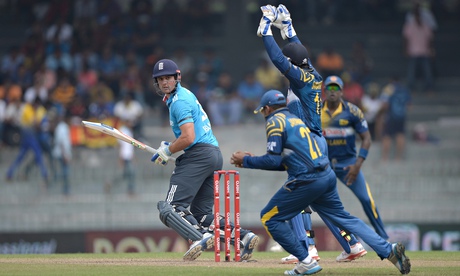
Nothing that is happening now disabuses me of that notion, and in the first ODI in Sri Lanka he played a shot as abject (if inconsequential) as any I have ever seen from him, bat dangling in the breeze a good foot away from his body, with, fortunately, no contact. It showed a confused batsman who has clearly lost his way.
Now, though, it has rather gone beyond a case of someone who might profit himself by committing to the single format (mindful of the contractual consequence) and is now in the realms of what is best for the progress of the team. When, perhaps four years ago, I first ran my thoughts across the England management I was told that whatever challenge Cook had been given he had risen to it and there was no doubt in their mind that he would do so in ODI cricket. Further, why did my reasoning not apply to other batsmen?
It was not easy to argue the second point, except that Cook’s patience and judgement were so obviously absolute strengths. For a good while he made a decent fist of things, and of seven England captains of any durability – Graham Gooch, Michael Atherton, Nasser Hussain, Michael Vaughan, Andrew Strauss and Alec Stewart the others – he has the best average as captain, a strike-rate of 80, only marginally less than that of Strauss, while he and Strauss have four apiece of the 12 centuries scored by the group in a total of 377 matches in charge (although this tells as much about the inadvisability of England Test-match captains trying to be something they are not in the interest of continuity).
But Cook is ill at ease with his game in general (eight half-centuries in 41 innings since he made his last hundred) and his team are floundering. The support from Ravi Bopara and James Tredwell is touching but predictable and it defies belief that there are not mutterings in the camp while Alex Hales and James Taylor are waiting on an opportunity.
Cook is not alone in his travails: Eoin Morgan is currently the iceman who is melting and Bopara, despite his recent runs, remains the finisher who rarely seems able to finish. But neither could be stood down if Cook is not willing to do the same. He could yet make fools of everyone, and what happens in Sri Lanka is no real yardstick for the sort of conditions they will meet at the World Cup. But if there is to be any value in this tour it has to be in making assessment and taking stock.
England have five more games and even if Cook is adamant that he will lead them into the tournament (and he is allowed to do so) the real strength in his captaincy would be seen were he to step aside, sit back and see what is what, even if it should prove to his disadvantage. It might give him a vision to the future.