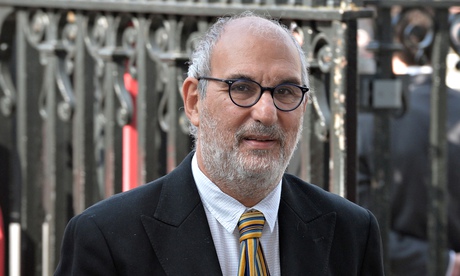
At the BBC, some things do not change. As certain as the hourly weather forecast from the Met Office, or, as it turns out, more certain, is the presence of Alan Yentob. A BBC lifer, he has been in a prominent position since 1985, when he was moved to the top job in BBC arts. So, for at least 30 years now, he has been available as a visible target for external critics of the BBC – and also for rivals and colleagues inside the corporation.
Operating as a kind of high-salaried, licensed lone ranger, Yentob, 68, who has the official title of creative director, has galloped into his freshest patch of ordure this month in the aftermath of the closure of the charity Kids Company, of which he was chairman.
It is never great to be featured on a BBC news bulletin wordlessly dodging away from a reporter’s microphone, no matter how unfair the ambush. But worse still was the subsequent suggestion, since confirmed by Yentob, that he attempted to persuade Newsnight editors to hold back on a story about the financial difficulties of the charity, led by Camila Batmanghelidjh, until it was ready to respond.
“The only contact I had with the news operation was on that day,” he said to the Channel 4 News presenter Matt Frei earlier this month. “If you are told that there are significant allegations against an organisation that you are the chairman of, and if the welfare of those children is at stake, the idea that you would not say, ‘Excuse me, what’s happening?’ And then say, ‘Can you give us time to respond?’”
This is perhaps a question of judgment. The dual roles – BBC executive and chair of the chair – offered, Yentob might have recognised, a potential conflict of interest.
An impassioned Yentob told Frei he was not “remotely considering” resignation from the BBC. He was also clear that he had not been alerted to the abuse claims that finally toppled the Kids Company edifice three weeks ago. He vigorously defended the charity’s record, pointing out it had raised £165m and cared for 36,000 vulnerable children. The problem was, he said, simply that “we don’t fit into the statutory model”.
For Yentob’s enemies, this also happens to be the problem with him. He appears to operate at the BBC without the restrictions and accountabilities that limit other commissioning executives, to the extent of putting himself on screen as the presenter of BBC1’s flagship arts interview show, Imagine, in 2003.
“A man in a full-time job like that, with a whopping salary, should be developing new talent, not presenting shows about people he admires. There is a real conflict of interest,” said one former BBC creative executive this weekend. (On top of his £180,000 salary, he is estimated to earn about another £150,000 in presenting fees.) Fresh complaints were voiced yesterday when it was confirmed that Yentob devoted an entire episode of Imagine to one of the charity’s art shows without fully declaring the level of his involvement with the charity. He is now due to face a parliamentary committee over his role in the Kids Company crisis.
The furore over Kids Company is only the latest high-profile media rumpus to surround Yentob. Five years ago, there were angry reactions to his claim he could not do his job without flying business class, and in 2004 there was a difficult period when his personal expenses were internally audited by the corporation’s chief operating officer. It had been claimed he had used his chauffeured BBC car to drop his children at school and that his lavish stay in Cannes during the annual film festival had been financed by the licence-fee payer. Yentob clarified that he had paid for his own apartment on the Côte d’Azur, although much of the entertaining he did there was part of his working life.
A non-identical twin, Yentob and his brother, Robert, were born in 1947 in London to a family of Sephardic Jews from Iraq. They moved to Manchester, where his father set up a successful textile firm, when he was young. By the time Alan was 12, he was back in London, living in a Park Lane apartment. After school in Ely, he went to study at the Sorbonne and then spent a year at Grenoble University before going to Leeds, studying law, but getting very involved in student drama.
To stand out among all the Oxbridge graduates and so win a coveted place as a BBC trainee in 1968 he emphasised his theatrical talents on the application form. By the 1970s, he was working for the Omnibus arts strand and then making a name for himself as editor of the influential arts show, Arena.
“Joining the Arena team at the point when Alan took it over is still the high point of my career,” said Anthony Wall, the award-winning documentary maker. “We were all given incredibly free rein and he had a unifying moral sensibility and an aesthetic that meant you could look for the value in high and low culture. He provided a space for that to happen.”
The success of Arena was built on a series of postmodern investigations into design and popular music, including shows on the Chelsea hotel in New York and the history of the song My Way. Bafta awards showered down and notable directors such as Mike Leigh, Julian Temple and Ingmar Bergman all made films for him. In the late 1980s, Yentob took over BBC2 and commissioned the long-running hits Have I Got News For You and Absolutely Fabulous. In 1993, he was put in charge of BBC1, giving screen time to art-loving nun Sister Wendy among others, and he was talked of as a possible successor to the director general John Birt, though he lost out to Greg Dyke.
With his name reversed to “Botney” in the pages of Private Eye, Yentob has been the regular butt of media mirth. Ever since he started turning up to public events with David Bowie, or Orson Welles, or Mel Brooks as his “plus one”, he has been accused of socially competitive pretension. And he likes a nice trip. One TV executive recounts a tale of Yentob being called when Princess Diana died: “The only thing they heard down the phone was, ‘Get me off this fucking gondola.”’
He is capable of self-parody, however. A brief comic cameo in the BBC satire W1A saw him inexplicably arm-wrestling with Salman Rushdie. The implied name-drop was part of the joke, yet it also handily communicated his friendship with the illustrious writer.
A rumbling rivalry with another Titan of television culture, Melvyn Bragg, has gone on for at least 20 years. Bragg was always quick to defend ITV and his own South Bank Show whenever it was suggested that the BBC was the sole purveyor of high-quality arts programming.
When the Observer ran a flattering profile of Yentob in 1995, Bragg wrote in to argue with its contention that running BBC1 was harder than working in the independent television sector, where shareholders and advertisers called the tune.
Nearly a decade later, it was revealed that Yentob was now to appear in front of the camera as the presenter of Imagine, its new arts show. Imagine has since been attacked for its clubby atmosphere and even dubbed “Al’s pals” by some pundits because it has featured a few of Yentob’s celebratory friends, including the late Arthur Miller. (“The Al’s Pals thing sits around my neck but, actually, I have done 21 programmes and I only knew two of them,” Yentob once said.)
But for Wall there is no shame in this. In the golden days of BBC arts programming, he recalls, any arts editor who not only knew but socialised with the big names would have been prized, rather than ridiculed.
“Why Alan remains a very big asset to the BBC is that he retains close connections with culture. He is not distant or frightened of it, like so many editors. He has helped transform television by engaging energetically with it,” he said.
Whether or not Yentob mishandled his involvement with Kids Company, he was evidently not motivated by personal financial gain and it should also probably be noted that the only time he is on record as conceding that he let his personal life influence a programming decision was one Christmas Day.
As BBC1 controller, he screened Nick Park’s animation The Wrong Trousers, the favourite film of his son Jacob, one of his two children with his wife, television documentary-maker, Philippa Walker. Appropriately for a man who has made the BBC his life, they met in the office canteen.
THE YENTOB FILE
Born with twin brother, Robert, on 11 March 1947, London. Family moved to Didsbury, Manchester. Boarded at the King’s school in Ely, Cambridgeshire, before studying law at Leeds and becoming the only non-Oxbridge trainee to win a place at the BBC in 1968.
Best of times His regime at Arena, overseeing groundbreaking popular arts documentaries on the Ford Cortina, the Chelsea hotel and the song My Way. Since 2000 Revealing Imagine interviews, including those with Mike Leigh, Philip Roth and Lynn Barber.
Worst of times 2004 Having his expenses examined. Losing his temper when interviewed by Channel 4’s Matt Frei over his attempts to get more favourable coverage for Kids Company.
What he says “I’ve always been a bit of a girl and still am. In many ways, my foray into the arts was an extension of my girlishness. People used to quake at the thought of me heading all these BBC departments, being the sort of person I am, thinking, ‘Does he really know what he’s talking about?’”
What others say “I’ve always had a bit of time for Yentob – as at least he is not one of those relentlessly proliferating middle managers.” Rod Liddle, the Spectator, August 2015.