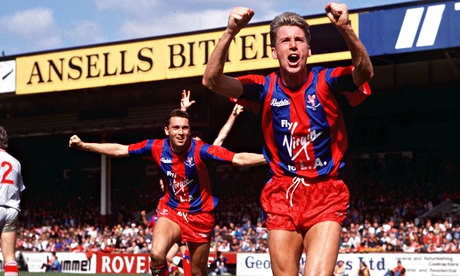
It is the making of the myth that endures, whether in the commentary delivered by John Motson and Terry Venables or those photographs of a cluttered penalty area at Villa Park with Bruce Grobbelaar helplessly craning his neck as he turns to witness the worst. It was Sunday, 8 April 1990 and, as the BBC’s correspondent exclaimed at the time, “somewhere out the crowd came Pardew”. In an instant a Crystal Palace cult figure had been born.
Alan Pardew had been a player at Selhurst Park for three years by then, with the “Super, Super Al” chants which greeted his every touch having long since been chorused by Palace fans. The difference was that moniker became a positive only after the midfielder met that Andy Thorn near-post flick in extra-time to win the FA Cup semi-final against Liverpool.
Up to then it had been an ironic appreciation of his talents. There is a certain romance in the return to his first professional club of a figure Steve Coppell always considered to be made for management but it should not be forgotten that Palace’s relationship with Pardew has always been complicated.
He might admit as much himself. A player who had been signed from non-league Yeovil Town for £7,500 in 1987, when he was already approaching 26, ended up making 168 appearances for the club, yet it was only over the last 15 months of his career at Palace that he was truly appreciated by those on the terraces. Pardew was the worker with the snazzy blond highlights at the heart of the team. His value rarely caught the eye of anyone but his team-mates and the management.
He was booed at times – not as vociferously as he has been during his darker days at Newcastle, but mockingly nevertheless – with his inclusion in the line-up invariably signifying the absence of Andy Gray or Geoff Thomas or even the talented Dave Madden. They were all favourites, the first pair the embodiment of the strength in Coppell’s team. The stand-in was neither particularly quick nor that skilful. His passing could be erratic. Hairstyle aside, there was little flamboyance to his game. Yet his team-mates always cherished his qualities and, in hindsight, he was always the heartbeat of that side. Coppell recalled a player who was “more energetic than anyone else in the squad”.
“He wasn’t a great passer but, given the way we played back then, it was very much: ’Get it up to the front two, or get it wide,’” he said. “Within the system he knew exactly what he was doing.”
Palace were pragmatic and Pardew’s role was to disrupt the opposition’s play and distribute to the more gifted players around him. The team had Ian Wright and Mark Bright up front and, eventually, wingers of pace and invention in John Salako and Eddie McGoldrick. When injury denied the manager his first-choice central midfield for much of the 1988-89 campaign, the combination of Pardew and Madden, not long out of the reserves, stepped into the breach and excelled. The team rose into the top flight.
The former missed only one game of that promotion-winning season, his delivery from wide left with the outside of his right boot for Wright to open the scoring in the second leg of the play-off final an indication that his talents extended beyond mere energy. He scored six times in his first campaign in the First Division, including a winner at Tottenham, and was tripped by Glenn Hysen to earn Palace a penalty – missed by Thomas – on the night they lost 9-0 at Liverpool.
“He was a real grafter,” said Thomas. “He used to be good when thing were against you. He’d really come out fighting.” He gave the ball away for Liverpool’s opening goal in the FA Cup semi-final before scoring the winner in the 109th minute. That contest rather summed up his unlikely career at Palace.
The management appreciated him for other reasons, too. Pardew was the self-appointed social secretary of that squad, a man who succeeded in uniting a disparate group of players and a vocal, confident figure in the dressing room even when his influence was less obvious on the pitch. He coached a Sunday league team, the Nomads, in Surrey in his spare time with their fixture cancelled while the manager played in midfield at Villa Park. “He was a leader,” Coppell said. “Even though he came from that non-league background, he had a seniority about him which gave him a presence.”
The majority of Palace fans will welcome his return to Selhurst Park. They will even forgive him those “More than a football team” T-shirts when his West Ham confronted Iain Dowie’s Eagles in the 2004 play-off final at the Millennium Stadium. They bellowed his name in appreciation when Newcastle visited in the League Cup in September while those visiting supporters merely cursed his presence. The Super Al song had started out in jest but Villa Park 1990 changed that.
The club’s main fanzine, Eagle Eye, offered free badges in its first post-semi-final edition, with Pardew mocked up as Superman.
“The fans used to give him stick, and for what?” said Wright recently. “Because his shorts were too high? Because his hair was bleached? He was great for us, Super Al.”