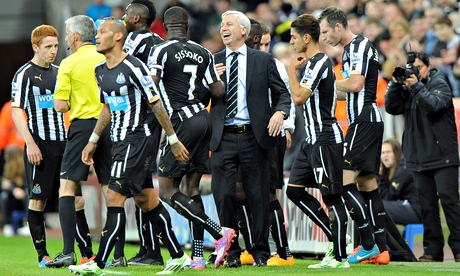
Alan Pardew spent much of his early adulthood working as a glazier installing windows in some of the tallest buildings adorning London and Abu Dhabi. “We called it curtain-walling,” says a man whose head for heights and nerves of steel have recently served him extremely well in a very different context.
Three decades on from those days spent dizzily high in the skies above assorted city and desert construction sites, Pardew has astounded the football world by rebuilding not only a badly faltering Newcastle United but a raft of relationships on Tyneside.
Two months ago the consensus was that “situation vacant” signs would be soon be posted at St James’ Park. Dubbed “a dead man limping”, Newcastle’s manager could barely pick up a newspaper, switch on the television or, worst of all, log on to the internet without stumbling across yet another analysis of his shortcomings.
With defeat in 11 of the final 15 games of last season compounded by a woeful start to the new Premier League campaign, debate raged as to which precise match would signal the expiry of his strictly limited shelf life. There were moments, particularly after a 4-0 September thrashing at Southampton, when even Pardew and his loyal staff braced themselves for career-changing phone calls. “I didn’t know what would happen,” he says. “You have a run of disappointments and you start questioning your own eyes and experience.”
He did hear from Mike Ashley after the St Mary’s debacle but, rather than issuing a P45, Newcastle’s owner listened to his manager’s side of the story. Deep down Ashley probably already knew last season’s disastrous appointment of the swiftly sacked Joe Kinnear as director of football had needlessly undermined Pardew, while the failure to replace Yohan Cabaye after he was sold to Paris Saint-Germain last January proved highly damaging in the dressing room and on the pitch.
The sports retail tycoon was also aware that despite the arrival of seven new faces at St James’ Park during the summer, only one – Jack Colback – came with previous Premier League experience under his belt.
If the case for patience remained persuasive, Ashley was possibly also influenced by sheer bloody-mindedness. Why should he bow to the demands of those fans whose jeers had turned the final home game of last season – a win against relegated Cardiff City – so toxic that Pardew dared not venture out of his dugout for the entire 90 minutes? Why should he take any notice of the white noise generated by Twitter, Facebook and an anonymous website called sackpardew.com? And what on earth did the print and broadcast media really know?
What mattered were the messages relayed by Fabricio Coloccini – Newcastle’s captain and a centre-half who reputedly has the owner’s ear – and Lee Charnley, the chief executive. They emphasised the dressing room was still firmly behind the manager and his assistants.
Yet if it helped that Ashley and Pardew have a strong mutual friend in Keith Bishop, a London-based PR executive responsible for representing both men, ultimately only results could prevent regime change.
Happily for all concerned long-elusive victories arrived right on cue. Newcastle’s first league win of the season – 1-0 at home to Leicester on 18 October – marked the first of six straight triumphs in all competitions, leaving them travelling to Pardew’s old Upton Park habitat on Saturday seeking a seventh at West Ham’s expense.
His acquaintances have long said that the 53-year-old is at his best when backed into corners and once again he has proved it courtesy of a startling tactical makeover, aided by some fortunate timing. Significantly his hour of desperate need coincided with the emergence of a crop of gifted, hungry and largely pacy youngsters from a development squad which has gone from strength to strength since being taken over by Peter Beardsley earlier this year.
The honing of, among others, Rolando Aarons, Mehdi Abeid, Sammy Ameobi and Paul Dummett by Beardsley and the former England midfielder Steve Stone, the first-team coach, has not only helped Newcastle’s manager surmount a series of injuries to senior players but created vital competition for places.
The resulting dilution of a once predominantly Francophone squad also created a much healthier and far better calibrated locker room. “We’re seeing real buds of success from our academy,” says Pardew. “We’ve a few boys with a chance of playing for England and it’s something we’re very proud of. We’re no longer just a French team.”
This Anglo-Gallic fusion appears to be bringing the best out in all parties. Suddenly previously under-achieving individuals, including most notably the France midfielder Moussa Sissoko, seem reborn. These days Sissoko is seen as Newcastle’s Yaya Touré with the final unlocking of his latent talent proving catalytic in the extraordinary rise to fifth place in the Premier League table.
It came with Pardew’s recent switch from a somewhat rigid 4-2-3-1 formation to 4-3-3. This enabled Sissoko to show off his full dynamic repertoire from a frequently deeper, more central position than a previously rather less effective wide-right attacking role.
Not only did Newcastle now possess a more fluid, flexible framework in which to perform but players began buying into a new, clearly identifiable philosophy. For far too many months the team had lacked a distinguishable “brand” but now no one could mistake their hallmark: pace-propelled counterattacking.
After months spent oscillating between an aimlessly direct approach and forlorn attempts at replicating the controlled passing game once inspired by Cabaye, power and precision were finally blended in a gameplan in which Pardew’s players are sometimes eager to force a high tempo, but at others are equally content to cede possession to opponents in safe areas before hitting the accelerator and undoing them on the break.
With technically gifted individuals including Ayoze Pérez, Rémy Cabella, Aarons and Ameobi big on skilful improvisation, these devastating counterattacks have assumed the sort of three-dimensional aspect absent during much of 2014.
This renaissance has dawned during a period when Newcastle have topped the Premier League injury charts but, undeterred by assorted changes of defensive personnel, they have now kept four consecutive clean sheets. “We’ve had a terrible run of injuries,” says their manager. “So it’s a testament to the squad. It’s phenomenal. They’re on fire.”
Pardew is not quite the stranger to humility certain critics imagine, but confidence has always been a key element of his character and, gradually, the old swagger is returning. When the suggestion was put to him that his chances of coaching England one day must now have been extinguished, it was swiftly shot down last week. “Why?” he inquired. “Why?”