Every major story in science is interwoven with millions of threads, each thread a little story in its own right. In the news, you read about the big breakthrough in terms of individual endeavours: “Professor X and his team at Y University found Z”. But what you can never truly appreciate is the vast network of other people that Professor X met, trained, influenced, taught, shared a pint with, dropped a crucial hint to. All the nameless scientists in the darkened symposium rooms of hundreds of faceless conference centres around the world, being wowed by his killer talk, his potent PowerPoint.
And further afield, all the thousands of people who have met Professor X only through his printed words, who have scoured his carefully circumscribed technical paragraphs, trying to extract as much truth as possible from the formalised scientific lingua franca. I can see her now, the exhausted grad student, slurping coffee illegally in the lab at 3 AM, scribbling in the margins, waiting for inspiration to strike, for the magic of X to leap off the page. We will never know how many people X really touched.
Last week, cell biology lost a very important and integral Professor X. His name was Alan Hall.
If you’re not a scientist, you won’t have heard of him. Even some of my biomedical scientist friends drew a blank when I mentioned his untimely death at the age of 62. A few of the scientific presses and societies have published obituaries, but I haven’t seen any in the major broadsheets.
Maybe it’s because the area that he studied – the cell cytoskeleton – is literally under the radar, beneath the skin. Skeletons as a rule are meant to be neither seen nor heard; we sometimes recoil from elderly faces when the skull beneath it is especially apparent; most of the time we forget it is there. But try living without one. The cytoskeleton has a similar reputation. Yet like our bony skeleton, it is just as crucial.
The trillions of cells that make up our body are not the rigid ‘building blocks’ that the traditional school metaphor would have us believe. Instead, they are flexible and highly dynamic living entities.
Watch a cell in time-lapse and you will see it writhe, twitch, ruffle, extract and retract threadlike or sheetlike protrusions. Some cells are motile and will crawl right out of the video frame in a matter of minutes, with no regard for the scientist’s agenda; this is achieved with a complicated inchworm-like manoeuvre in which the front end slaps forward and sticks down, while its rear-end detaches and is dragged forward to catch up.
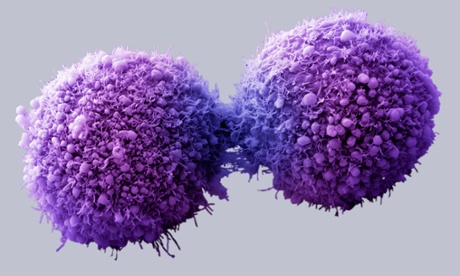
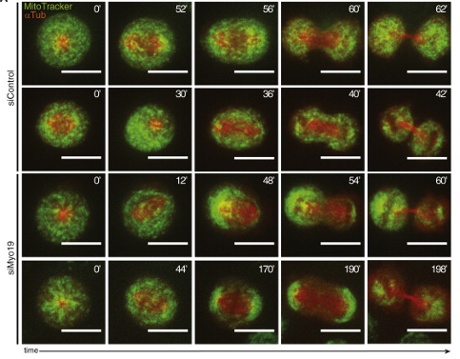
And of course, about once a day, many cells will divide in a carefully orchestrated shape-shift that involves detaching from the surface on which they’re spread, rounding up into a near-perfect sphere, stretching apart into a graceful barbell shape and then cleaving in two before calmly re-spreading again as if nothing had ever happened.
All of this movement is made possible by the cytoskeleton, a system of fibres and motor proteins that ripple, wrestle and tug within the cell. A system so exquisitely sensitive to environmental cues that they can inspire cell motion in fractions of a second.
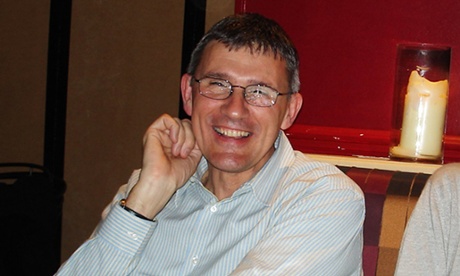
Back in the 1980s and early 1990s, Alan Hall, a quiet, focussed and generous Yorkshireman, led a team of researchers in London that worked out a lot about some of this system. Writing it like that, it doesn’t sound very important. But it was. His findings have wide implications for health and disease, especially cancer. Some of the key genes whose modus operandi he and his team (especially Anne Ridley) worked out are absolutely fundamental.
My own brush with Alan Hall was about as indirect as you can get. When the lab I had joined in 2007 moved into new digs at University College London, we were taking over a space that the Hall lab had recently vacated when he took a prestigious position at Memorial Sloan Kettering Cancer Center in New York.
All that was left was a few old pieces of equipment and a cheerful colleague who’d stayed behind to finish up her research. But maybe some of the glamour remained? My new project was all about cell shape and the cytoskeleton, and I was fired up when I found out who the previous occupants had been. When I chose a bench at random to call my own, someone informed me that it was lucky: everyone who’d had that bench before had got a prestigious paper in the top journal Cell.
No pressure, then.
I didn’t get the Cell paper. But my various research publications did advance the field, and set into motion a chain of events leading to me getting my own lab.
But when that moment arrived, I was between grants and broke. The cheerful colleague suggested I borrow some of the second-hand kit that Hall had left behind, kit so old that it was still packed in dusty boxes, untouched for probably a decade or more. So old that half of it, once unpacked and plugged in my new lab, was completely defunct. But a few pieces still ran, and they saved my life. For example, check out this beauty: an early 90s PCR machine.

Aficionados will note that it has room for only 20 full-sized tubes (not the sexy strips of mini-tubes we use nowadays); that there is (gasp) no heated lid or ability to heat as a gradient. For the non-aficionados, think of it as the Brick Phone of PCR machines. But rudimentary or not, this little machine has done us proud these past few years.
Every time I use it, I think of Alan Hall. And wonder about all the amazing findings that this machine must have enabled before it was finally put out to pasture. We have a modern machine now, but I’m not getting rid of the older one any time soon. I want to be reminded of what the cell biology community has lost – all those threads, recoiling almost imperceptibly from an untimely cut.