
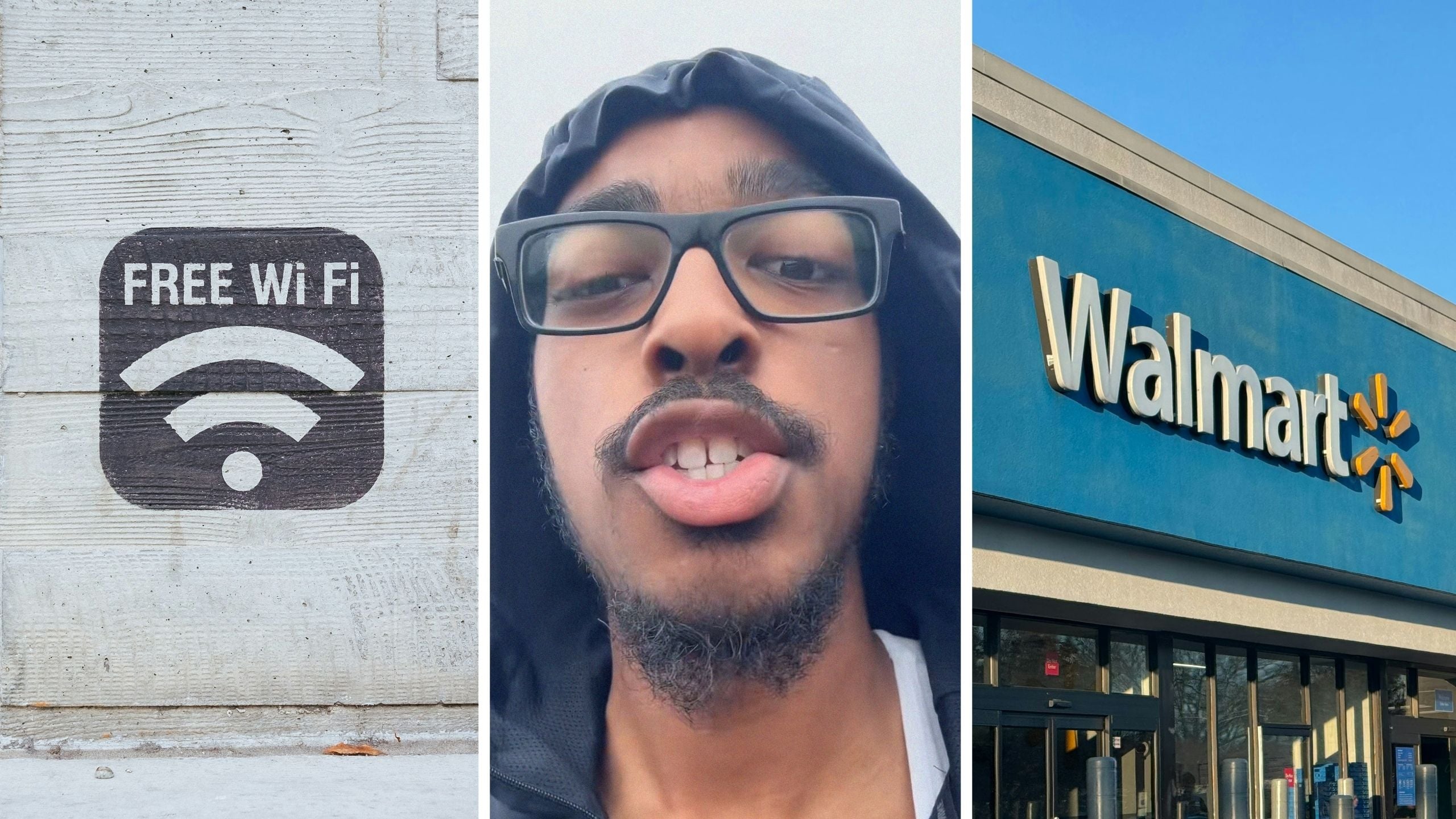
Public Wi-Fi is convenient, especially when you’re in an area with limited service and still need to search for something online, send a text, or be reachable.
Recommended Videos
Many people connect to public servers without thinking too much about it. Even if they’re aware of the risks, the convenience sometimes outweighs the logic.
This man is realizing just how risky it is to be on public Wi-Fi, and now he’s warning others.
Walmart Wi-Fi Worries
In a trending video with more than 93,000 views, content creator Jahlil (@jahlilthedeal)shared something that caught him off guard mid-trip at Walmart.
Jahlil explains that he’d opened the Walmart app to navigate the store. Then, he noticed his phone had automatically connected to the store’s Wi-Fi. He went into his settings, hit “forget network,” and made sure auto-join was turned off.
But when he looked back down at his phone, he noticed something strange.
“Why is the Wi-Fi loading and then it connects again,” he says.
He scrolled through his settings and found no other way to block the reconnect. So he took the whole network off entirely.
“Walmart is trying to track you and watch you when you enter their store,” he says. “You need to turn off their network. Because if you look up personal information on your phone, they will see it and it will be breached.”
“BE AWARE of your network when you enter public places! Do NOT use public wifi if you can help it!!!!” he adds in the caption.
Yes, Stores Like Walmart Really Do Track You Through Wi-Fi
Jahlil’s suspicion isn’t paranoia—retail Wi-Fi tracking is a real and widely used business practice.
According to Conscia, Wi-Fi tracking works by measuring the signal strength of nearby Wi-Fi access points to pinpoint the location of any Wi-Fi-enabled device—including your phone—in real time. Retailers like Nordstrom and Macy’s have used the technology to monitor customer traffic patterns, analyze where shoppers spend the most time, and optimize store layouts accordingly. The data collected can include movement paths, dwell time in specific sections, and return visit frequency.
The technology has been around in various forms since the early 2000s and has grown significantly more sophisticated. Modern systems can track devices using techniques like trilateration (calculating position based on distance from multiple access points) and beacon-based tracking, which is especially precise in enclosed indoor spaces, like a big box store.
Conscia notes that companies are supposed to follow guidelines around user consent, data anonymization, and transparency. However, those guidelines aren’t always prominently disclosed to shoppers walking through the door.
What Public Wi-Fi Can Expose
The tracking angle is one concern, and the security angle is another. According to NordLayer, many public Wi-Fi networks lack basic security measures—no encryption, weak or default passwords, and no authentication. This leaves everything you do on that network potentially visible to anyone with the right tools.
Researchers monitoring 11 unsecured Wi-Fi hotspots over 150 hours collected unencrypted photos, documents, emails, and login credentials in plain text. The most common attack is a Man-in-the-Middle (MitM) attack. This is where someone intercepts the data flowing between your device and the network. They can grab login credentials, monitor browsing activity, or redirect you to fake websites.
There’s also the “Evil Twin” threat, where criminals create a fake hotspot with a name nearly identical to a legitimate one. Your phone connects automatically, and the attacker controls everything you send and receive.
How About Other Wi-Fis?
NordLayer reports that 25% of people using cafe Wi-Fi networks have reported identity compromise attacks, and 45% admitted to making financial transactions over public Wi-Fi.
Verizon recommends treating any public network as untrusted by default. The most effective protection is a VPN, which encrypts all traffic and prevents the network provider from seeing which sites you’re visiting.
Turning off auto-join for public networks is also a key step, since attackers can spoof common network names and your phone may connect silently in your pocket. When in doubt, Verizon’s guidance is simple: if you’re accessing anything sensitive like financial apps, work email, and healthcare portals, stick to your cellular connection instead.
@jahlilthedeal BE AWARE of your network when you enter public places! Do NOT use public wifi if you can help it!!!! #awarness #walmart #tracking #privacymatters ♬ original sound – Jahlil
People Largely Agree
“We’re tracked everywhere you go. No matter what network you’re connected to,” a top comment read.
“Sadly it’s the only way I can txt or call anyone while I’m in there bc my service is sh–,” a person said.
“They do track you. everytime I go to Walmart and buy something i get an email to do a survey later that day. I’m not using that walmart plus check out either,” another wrote.
The Mary Sue reached out to Jahlil for comment via TikTok direct message and comment.