Closing summary: al-Shabaab kill 147 in Kenya university attack
An attack on a university in north east Kenya by al-Shabaab Islamist militants has left at least 147 people dead and 79 injured, Kenyan officials said.
The attackers also took hostages as Kenyan security forces moved in. The Kenyan government said that all four of the al-Shabaab militants who carried out the attack were killed.
This liveblog is now closing. Read our latest news story here.
Reuters reports that the White House is offering US assistance to Kenya in taking on the Al-Shabaab militant group.
In a statement, the White House strongly condemned today’s attack.
Updated
'All students accounted for' - Kenyan authorities
The Kenyan national disaster operation centre says all students are now accounted for.
587 students have been evacuated from Garissa University College, 79 injured. All students have been accounted for.
— Disaster Operations (@NDOCKenya) April 2, 2015
The authorities have said 147 people have been killed and 79 wounded in total.
Death toll reaches 147
My colleague in Nairobi Murithi Mutiga reports that the Kenyan interior minister has just confirmed the death toll as 147 people.
The attackers strapped explosives belts on to themselves. There were four of them and all have been killed, he says.
The surviving students will be taken home tomorrow.
UPDATE: 147 fatalities confirmed in the Garissa Attack. Plans are underway to evacuate students and other affected persons.
— Disaster Operations (@NDOCKenya) April 2, 2015
#GarissaAttack update: Alshabab siege ends, 587 evacuated, 79 injured.
— InteriorCNG Ministry (@InteriorKE) April 2, 2015
Updated
Kenya’s national disaster operation centre is making plans to help family members affected by the attacks trace each other.
For those looking for loved ones affected in the #GarissaAttack, The Red Cross has tracing hotlines on 0715820219 / 0729094864 / 0729094786
— Disaster Operations (@NDOCKenya) April 2, 2015
Despite the reports that the security operation has concluded, Reuters says that Al-Shabaab militants are claiming to still hold many hostages inside the campus.
“We still control the scene and have many hostages,” the militant group’s military operations spokesman Abdiasis Abu Musab told the agency, without giving exact figures.
“Lying around us are also dead bodies, many more than the dead bodies that were carried out,” Musab added.
The Associated Press reports Kenyan officials as declaring the security operation to be over, with four attackers having been killed.
They reportedly said the final death toll could be as many as 150 people.
Updated
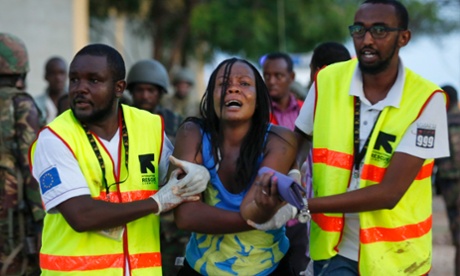
Some of the hostages are rescued.
Updated
#evacs #GarissaAttack. AFD aircraft arrive Wilson in the rain. 17 patients on 4 aircraft. pic.twitter.com/zGZ7rPj78G
— AMREF Flying Doctors (@AMREFFlyingDocs) April 2, 2015
The Kenyan interior ministry says that more than 500 of the 815 students have been accounted for.
The interior minister Joseph Nkaissery says the death toll is likely to rise because security forces are “mopping up” the area and it is unclear how many attackers there were.
Updated
Amnesty International’s east Africa regional director, Muthoni Wanyeki, is also critical of the Kenyan government’s failure to provide protection against al-Shabaab.
Citizens and public servants in the north have repeatedly expressed fears about their vulnerability to al-Shabaab attacks which the Kenyan government has failed to appropriately address. Learning institutions are meant to be safe places for students and their teachers. Their protection must be fully guaranteed.
It is the government’s responsibility to guarantee the security of all its citizens, including those in the north – and to do everything legally in their power to prevent such attacks from taking place at all.
We urge the government of Kenya to act decisively and within the constitution and the law to ensure protection for those under or at risk of attack in Garissa and other areas of the north.”
Stig Jarle Hansen, author of Al-Shabaab in Somalia: The History and Ideology of a Militant Islamist Group 2005-2012, is critical of Kenya’s response to the militants.
The usual misinformation strategies by Kenya allows many victories on the propaganda victories to al-Shabaab. Kenya’s anti terror policies is also hampered by the tendency to hand out collective punishment, especially against Somalis, missing the real terrorist, but angering both Somalis and Kenyan Muslims.
It is also hampered by corruption, where al-Shabaab or other criminals can both buy passage, visas and other useful items from the police and other governmental services. The allegations , which might be true, of police death squads in Mombasa, handing out extra judicial killings is also counter-productive and has been employed in al-Shabaab videos. The Kenyans lack soft preventive strategies.
All of these factors ensures that al-Shabaab has a potential for expansion in Kenya, while this attack might have been conducted both by Kenyan citizens and Somalis from Somalia. The main territorial holding of al-Shabaab, the middle juba, is not to far way from the area.
Updated
Families of the dead are to go to the mortuary tomorrow.
Families of the affected advised to visit #ChiromoMortuary from tomorrow morning ~ @KenyaRedCross #GarissaAttack pic.twitter.com/OomKIqBq9F
— Nation FM (@NationFMKe) April 2, 2015
David Smith, the Guardian’s Africa correspondent, assesses al-Shabaab and Kenya’s ability to respond to the group in this analysis. Here is an extract.
The policy of targeting Christians remains sporadic and inconsistent, possibly reflecting factionalism and lack of unity. Some attacks have been carried out indiscriminately, with grenades thrown into bars and bus stations. Muslims were among at least 67 people killed and 175 injured at Westgate.
Al-Shabaab has also continued to kill Muslims with impunity in Somalia itself, despite losing significant territory there.
The attack on Garissa also raises questions about the quality of Kenya’s state security apparatus, its long-term military commitment to Somalia and whether the government might use such attacks as a pretext for a crackdown that raises fears about threats to civil liberties. A series of foreign travel warnings have crippled the economically vital tourism industry. Just hours before the latest attack began, the country’s president, Uhuru Kenyatta, said Kenya was “safe as any country in the world”.
Communities in Garissa, where illiteracy, poverty and joblessness are rife, have long felt marginalised and neglected by the government in faraway Nairobi. Boniface Mwangi, a political activist, said: “A young man in Garissa of Somali origin is seen as a terrorist suspect. That’s where the problem lies.”
Peter Aling’o, a senior researcher at the Institute of Security Studies in Kenya, said: “The government needs to be treating this as a growing problem from within. What is driving Kenyan youth into joining al-Shabaab? What are the political issues, what are the economic issues? We need a national dialogue to give Kenyan youth a sense of belonging and self-worth.”
More international reaction to the attack.
#UNSG Ban strongly condemns today's terrorist attack on Garissa University College, #Kenya. Conveys deep-felt condolences to families. 1/3
— UN Political Affairs (@UN_DPA) April 2, 2015
"I am calling for the immediate, safe release of the students" Gordon Brown on Kenyan University #GarissaAttack http://t.co/iQTfUOapUn
— Gordon & Sarah Brown (@OfficeGSBrown) April 2, 2015
John Githongo was in charge Kenya’s anti-corruption taskforce until he fled after receiving death threats from people involved in his investigation. In a recent interview with the Guardian, he warned that Kenya is “at a tipping point” as terrorist threats, declining revenues from tourism, and a lack of confidence in the government pile pressure on the leadership.
#AlShabaab Garissa attack yet another outrage. Corruption and hubris costs us dear in the face of determined barbaric foes.
— John Githongo (@johngithongo) April 2, 2015
Here is AP’s latest story on the Garissa attack, where the death toll has exceeded that in the Westgate shopping mall attack in 2013.
Kenyan Interior Minister Joseph Nkaissery says that more than 70 people have been killed in an attack by Somali-based Islamic extremists on a college in northeast Kenya.
Nkaissery said that 79 people were wounded in the attack Thursday and four suspected attackers have been killed. He told reporters the total number of the attackers is still unknown and that security agents are fighting them at Garissa University College.
The minister ordered a dusk to dawn curfew in Garissa and in the nearby counties of Wajir, Tana River and Mandera.
Al-Shabab claimed responsibility for the attack.
The death toll now surpasses the 67 who were killed in al-Shabab’s attack on the Westgate Mall in Nairobi in September 2013.
Updated
Curfew announced for regions near Somalia
From Reuters. A 6.30pm to 6.30am curfew has been announced for four regions near the Somali border.
AP and Reuters are now also citing the 70 figure, adding cryptic quote from the interior ministry saying that “90% of the threat is over”.
Updated
Death toll rises to 70
There are several tweets citing the interior ministry as saying the number of dead has risen sharply to 70.
Death toll from Garissa University Siege raises to 70 with 79 students injured, nine of them critically #GarissaAttack
— Citizen TV Kenya (@citizentvkenya) April 2, 2015
My colleague in Nairobi, Murithi Mutiga, has just sent an update. Here is an extract.
Julia Gichuki was fast asleep when she heard the staccato sound of gunfire drawing ever closer to the women’s hostel at her university in the town of Garissa, about 90 miles from the Kenyan border with Somalia.
“I just sprang out of bed and started running. We didn’t know in which direction to go because bullets were flying everywhere. But we were lucky that the attackers seemed to be targeting the men’s hostel and we managed to flee.”
Julia was one of the lucky ones. By the time security forces arrived at the scene, 13 students and two security guards had been mowed down by attackers from the al-Shabaab militant group which has been blamed for a string of attacks on Kenyan soil in the last three years.
The group claimed to be holding “very many” Christian hostages at the university and by dusk, security forces had encircled a hostel at the university where the attackers were holed up but had not attempted to storm in.
The Kenyan interior minister, Joseph Nkaiserry, told journalists 533 students out of 815 students had not yet been accounted for. One of the attackers had been killed as he tried to flee, he said.
A Red Cross spokesman, Arnolda Shiundu, told the Guardian the attack began at 5.30 am after several of the militants shot their way through the university gate and began firing randomly.
“We have evacuated about 30 casualties, most of them with bullet wounds. Four are in a critical state and Kenya defence forces personnel have airlifted three victims, including two soldiers, to Nairobi,” Shiundu said.
Updated
The UK has condemned the attack at Garissa.
Minister for Africa James Duddridge condemns terrorist attack in #Kenya: http://t.co/2e4IuIOvsi
— Foreign Office (FCO) (@foreignoffice) April 2, 2015
Meanwhile, al-Shabaab continues to attack targets in Mogadishu although it was driven out of the Somali capital some years ago. Last week it carried out a suicide bombing at the Maka Al-Mukarramah hotel, killing 17.
Uganda has also come under attack from al-Shabaab. On Monday, Uganda’s lead prosecutor in the trial of 13 men accused of participating in 2010 al-Shabaab bombings that killed 76 people was shot dead.
Joan Kagezi, acting assistant director of public prosecution, was murdered by men on a motorbike as she drove home in a suburb of the capital, Kampala police spokesman Patrick Onyango said. “They were trailing her on a motorcycle ... They shot her dead.”
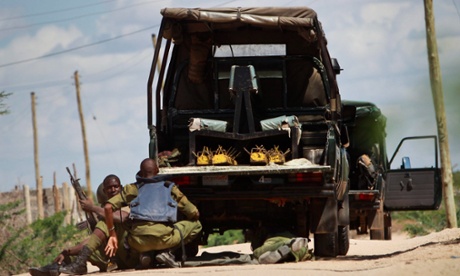
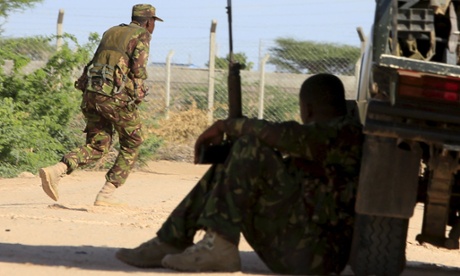
Kenyan troops at the scene of the attack.
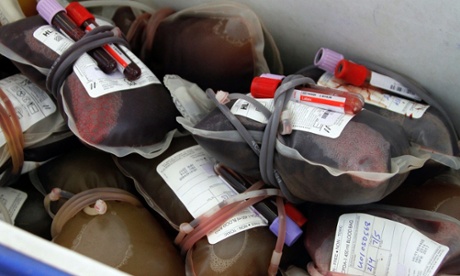
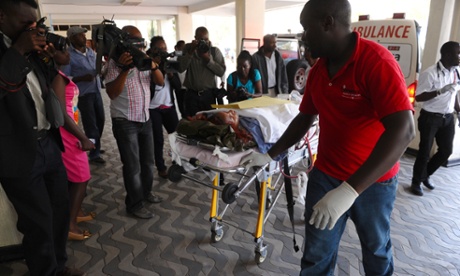
Preparations for the wounded.
This article in the Economist makes the point that the attack will further damage Kenya’s reputation as a tourist destination, while raising questions among Kenyans about intervention in neighbouring Somalia.
Thursday’s assault came just a day after President Uhuru Kenyatta dismissed in scathing terms a series of international travel warnings issued by governments in London, Washington and elsewhere in response to the terror threat. Britain updated its travel advice last week, and ruled much of Kenya’s coast out-of-bounds to British citizens who used to flock to the white sand beaches and warm seas.
“Kenya is as safe as any country in the world,” Kenyatta told a gathering of diaspora investors on Wednesday. “The travel advisories being issued by our friends are not genuine. I have not heard of any travel advisory issued to those visiting Paris, which recently experienced a terror attack.”
In fact, travel warnings were issued at the time of January’s terrorist attack on the satirical magazine Charlie Hebdo, but they were lifted after French security services took swift action to counter the threat— something, diplomats have pointed out, that is not true of Kenya.
This latest attack represents another heavy blow to Kenya’s tourism industry, already on the ropes. Increasingly, when foreigners think of Kenya they picture terrorist atrocities, rather than safari parks and beaches. Shabab has in the recent past attempted to raise its profile in the West. In February the group released a video which called on “Muslim brothers, particularly those in the West” to attack a series of “American or Jewish-owned shopping centres across the world”.
But the Garissa atrocity is intended to get attention locally, rather than globally. Shabab no doubt hopes that the increasingly border-blind conflict will cause Kenyans to reconsider their involvement in Somalia. Already some in Kenya’s political opposition as well as in the press and the wider public are questioning the wisdom of keeping troops abroad while the fight threatens those at home.
The interior ministry says two of the attackers have been “neutralised”. Presumably this means killed.
#GarissaAttack update: Two terrorists have been neutralised in the ongoing operation. Security agencies intensify rescue operation.
— InteriorCNG Ministry (@InteriorKE) April 2, 2015
Updated
From Kenya’s interior ministry.
Spokesman @mwendanjoka: We are putting on notice those publishing gory photos of victims from the #GarissaAttack legal action will be taken.
— InteriorCNG Ministry (@InteriorKE) April 2, 2015
President Kenyatta’s address to the nation following the attack.
Kenyan students describe the moment masked gunmen burst into their university compound and started firing, killing at least 15 people
A picture of Kuno.
Security agency raise bounty to Sh20m of Al shabaab militant behind Garissa University attack http://t.co/tOWAlCGiu8 pic.twitter.com/79VVNCOBMW
— The Standard Digital (@StandardKenya) April 2, 2015
The Daily Nation paper in Kenya has details on Kuno, the man the Kenyan government believes to be behind the attack.
A Kenyan and a former teacher in Garissa has been named as the mastermind of the terrorist attack at Garissa university college.
A Sh20 million bounty has been placed on the fugitive, Mohamed Kuno, who has been on the run since December last year.
Kuno was then identified as the al-Shabaab commander who oversaw the killings of 58 Kenyans in Mandera.
A security brief seen by the Nation says Kuno is a former teacher and Principal at Madarasa Najah in Garissa and has three aliases; Sheikh Mahamad, Dulyadin and Gamadheere.
He joined militants in Somalia at the time of the Islamic Courts Union, which later metamorphosed into al-Shabaab.
He uses his family members in carrying out terrorist activities in northern Kenya.
Kuno, the brief added, is al-Shabaab’s leader for the Juba region in Somalia, and currently in charge of external operations against Kenya.
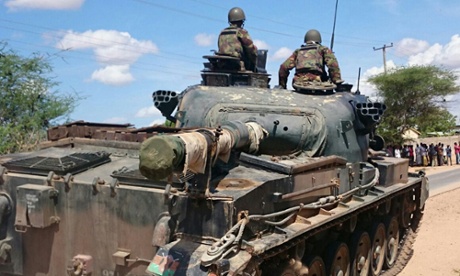
The Kenyan army has deployed tanks following the attack.
Updated
The Kenyan government has put a price on the head of the “mastermind” behind the Garissa attack.
The Kenyan government has named Mohamed Kuno as the mastermind of the #GarissaAttack and placed a $53,000 bounty on him.
— BBC Africa (@BBCAfrica) April 2, 2015
Garissa is in northeast Kenya, one of the country’s poorest regions. It is known for its pastoralists or nomadic herders. Here is an extract from an East Africa Community website.
In the northeastern province, where poverty rates are some of the highest in Kenya, the main economic activity is livestock production while minimal land is under cultivation since pastoralism requires large area of land to graze animals. Given the climatic conditions, the region is more favoured for livestock production than crop production. Only a few farmers grow cereals, legumes, horticulture and oil crops in the few areas having good soils with ample rainfall or on the minimal portion (8%) of irrigable land actually irrigated.
My colleague in Nairobi Murithi Mutiga has this quote from an eyewitness, student John Ongamo.
“When I heard the gunfire, I slipped out of bed and hid in the wardrobe. The attackers stormed into the hostel and said they wanted to know where the kafirs (unbelievers) were. The girls in the neighbouring hostel started screaming and running and in the confusion I managed to flee. It was terrible. I have never been that scared in my life. They were just spraying bullets around.”
Survivors have been describing horrific scenes to the Associated Press.
Collins Wetangula, the vice chairman of the student union, said he was preparing to take a shower when he heard gunshots coming from Tana dorm, which hosts both men and women, 150m away. The campus has six dorms and at least 887 students, he said.
He said that when he heard the gunshots he locked himself and three roommates in their room.
“All I could hear were footsteps and gunshots nobody was screaming because they thought this would lead the gunmen to know where they are,” he said. “The gunmen were saying sisi ni al-Shabaab (Swaihi for we are al-Shabaab),” Wetangula said.
When the gunmen arrived at his dormitory he could hear them opening doors and asking if the people who had hidden inside whether they were Muslims or Christians.
“If you were a Christian you were shot on the spot,” he said. “With each blast of the gun I thought I was going to die.”
The gunmen started to shoot rapidly and it was as if there was an exchange of fire, he said.
“The next thing, we saw people in military uniform through the window of the back of our rooms who identified themselves as the Kenyan military,” Wetangula said. The soldiers took him and around 20 others to safety.
Augustine Alanga, a 21-year-old student, described a panicked scene as gunshots rang out outside their dormitory in the pre-dawn hours when most people were asleep.
“I am just now recovering from the pain as I injured myself while trying to escape. I was running barefoot,” said Alanga, who was one of scores of students who managed to escape through barbed wire fencing.
President Uhuru Kenyatta has issued a statement on the standoff at Garissa university college, extending his condolences to the families of those who have died in the attack. He went on:
I also assure the nation that my government has undertaken appropriate deployment to the affected area, and is fully seized of the situation. I also urge Kenyans to stay calm as we resolve this matter, and to provide the authorities with any information they may have in connection with any threats to our security.
This is a moment for everyone throughout the country to be vigilant as we continue to confront and defeat our enemies. I further direct the inspector general of police to take urgent steps and ensure that the 10,000 recruits whose enrolment is pending, promptly report for training at the Kenya police college, Kiganjo. I take full responsibility for this directive. We have suffered unnecessarily due to shortage of security personnel. Kenya badly needs additional officers, and I will not keep the nation waiting.
Summary
The attackers stormed into the university shortly after 5am in the town of Garissa, about 90 miles from the volatile border with Somalia. Kenya’s national disaster operations centre said 280 of the university’s 815 students were accounted for but did not say how many it believed to be still inside.
The gunmen were in one of four residential buildings, the interior ministry said. Survivors told the Associated Press of harrowing scenes with people gunned down while others ran for their lives.
Updated