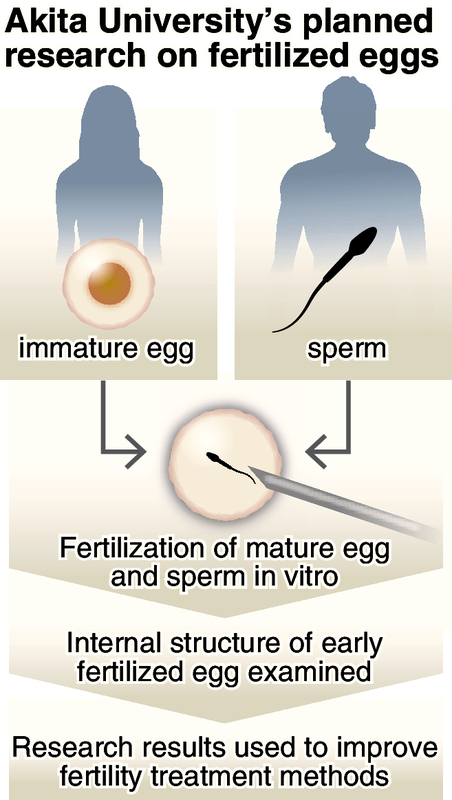
Akita University plans to begin research in which it will create fertilized human eggs and examine their condition in detail immediately after fertilization in the hope of improving the success rate of fertility treatments, it has been learned.
The aim of the research is to improve methods of selecting the fertilized eggs that are most likely to lead to pregnancy during treatment.
The university plans to receive egg donations as early as this month to produce about 20 fertilized eggs in a year. With the consent of patients, it expects to obtain sperm and immature eggs that are left over from fertility treatments at Akita University Hospital.
The eggs will be cultured in vitro and then fertilized with sperm. The personal information of the eggs and sperm donors will not be revealed, the university said.
Previous research on human fertilized eggs has been conducted using fertilized eggs that were a few days old, having been fertilized for the sake of fertility treatments but ultimately not used.
Akita University, however, has decided to produce freshly fertilized eggs and observe their internal structure immediately after fertilization because the success or failure of a pregnancy is often influenced by the state of eggs in the early stages, within the first few days after fertilization.
The university also plans to study differences in the condition of fertilized eggs depending on the age of donors, and use this information to help make decisions when selecting eggs to be used for in vitro fertilization. In line with government guidelines, the university will dispose of the fertilized eggs within 14 days after the fertilization and will not transfer any of the eggs into a uterus.
The creation of fertilized eggs for purposes other than fertility treatment is limited to basic research related to infertility under the government guidelines enforced in 2011, and such research requires government approval.
Akita University submitted its research plan to the government in August last year, and received approvals from the Health, Labor and Welfare Ministry and the Education, Culture, Sports, Science and Technology Ministry in January.
A clinic in Osaka also received government approval for research involving fertilized egg production in June 2019, but no actual research has been conducted due to delays in preparation and the impact of the coronavirus pandemic.
"Early research on fertilized eggs involves many things that cannot be understood through animal experiments, so we need to use human fertilized eggs. We hope to gain knowledge that will be useful for in vitro fertilization," Akita University Prof. Yukihiro Terada said.
Read more from The Japan News at https://japannews.yomiuri.co.jp/