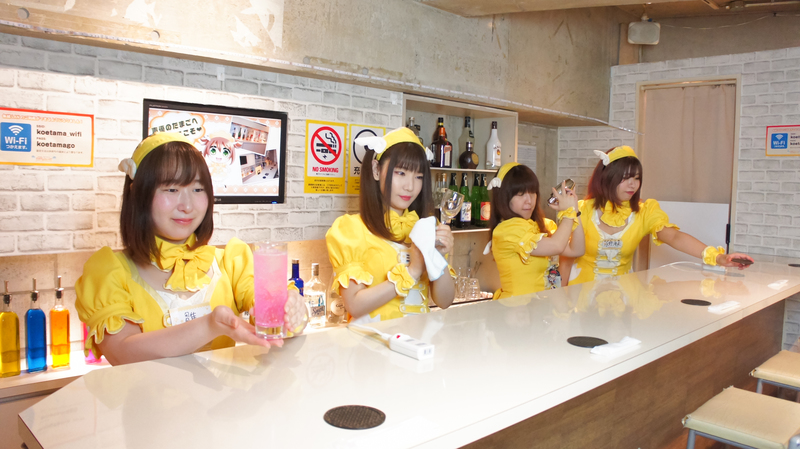
Many maid cafes in Tokyo's Akihabara district have closed temporarily in line with measures to prevent the spread of infections with the novel coronavirus.
One such cafe continues to offer face-to-face entertainment, with customers able to chat with an employee. However, there is no risk of catching the virus as the service is offered entirely online.
Those working in maid cafes often refer to the establishments as concept cafes, many of which feature themed interiors and staff clad in colorful uniforms.
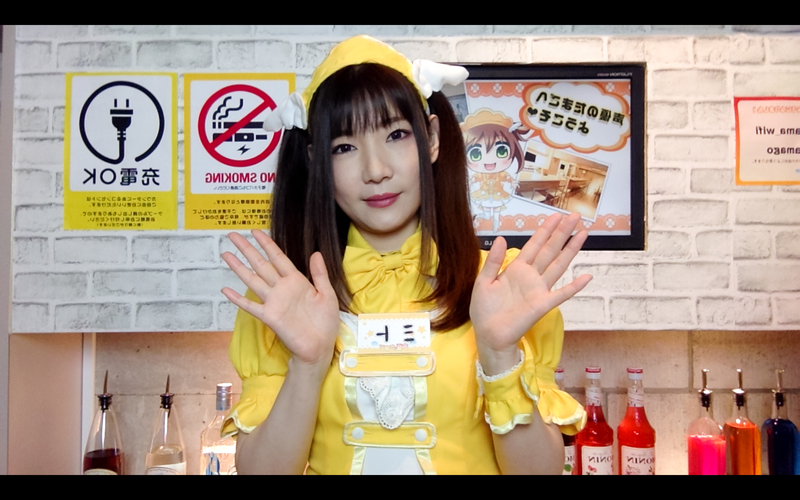
Seiyu no Tamago's theme revolves around voice actresses, who play the parts of characters in anime, games and movies dubbed in Japanese.
The cafe's name literally means "voice acting novices."
The cafe has eight employees, dubbed "cast members," some of whom are aiming to become professional voice actresses.
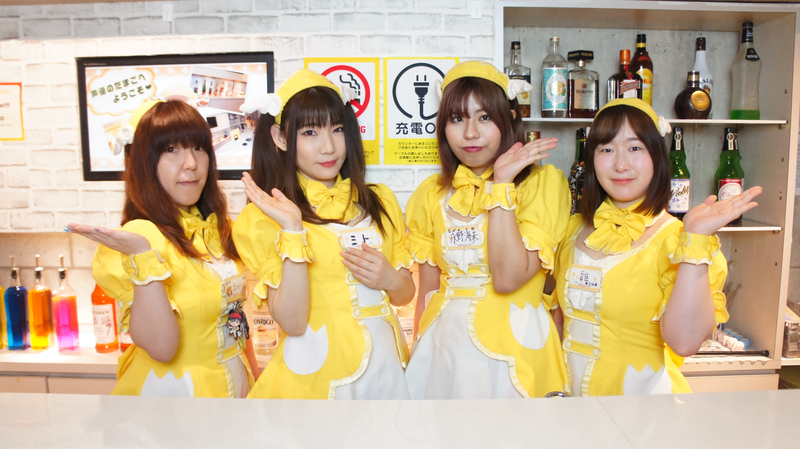
Like many of the concept cafes in Akihabara, Seiyu no Tamago has been affected by the ongoing coronavirus crisis.
The cafe began a service in April, after temporarily closing its doors due to the crisis, in which customers can chat online with Seiyu no Tamago cast members via teleconference systems such as Zoom and Skype.
OnTama, a portmanteau of "Online Seiyu no Tamago," takes its cues from the online drinking parties that have become popular during the pandemic. The main difference is that it is a paid subscription service.
To become a customer of the OnTama service, people buy digital tickets in the cafe's online shop with their credit cards or other digital payment options. They then register their email address, to which an internet URL to the designated teleconference room is sent. The one-on-one chat with the cafe's cast members begins at a designated appointment time.
Each cast member allocates their 30-minute time slots to customers who can choose their favorite cast member. A ticket for a time slot costs 3,000 yen.
As long as there is teleconference software installed, any personal computer, tablet or smartphone can be used to enjoy the OnTama service.
Though the cafe saw a sizable number of foreign tourists at its physical location, foreign customers living outside Japan are not currently able to sign up for the service, due to the accepted credit cards being limited.
However, Sera Ohno, one of the cast members responsible for cafe operations, says that it is theoretically possible for those living overseas to join the OnTama service.
"Although my fellow cast members don't speak English as well as I do, we can communicate even with non-Japanese customers through the use of body language over the teleconference system," she said.
Seiyu no Tamago's reaction to the escalating virus outbreak crisis has been swift.
After news reports revealed the risk of clubs that offer live music performances becoming the sites of infection clusters, the cafe quickly put an end to the cast members' live singing performances at the physical location. On March 26, it began operations as a curry restaurant, as a chain of curry restaurants was already using the space during lunchtime.
The Tokyo metropolitan government's urging of people to refrain from going to nightlife districts prompted the cafe's management and cast members to hold discussions, coming to the conclusion that the cafe would have to temporarily close.
The cafe's physical location effectively closed on April 4, before the government's declaration of a state of emergency on April 7. Ohno said the date when the cafe can reopen cannot be determined at this time.
She went on to mention that all of the changes implemented were based solely on their own judgment and that there had been no direct requests or instructions from any administrative authorities. On April 6, the OnTama service began.
At maid and other concept cafes in Akihabara, most of female employees are part-time employees working for hourly wages. So their workplaces' temporary closures mean a loss of income for the employees.
At Seiyu no Tamago, also, six of the eight cast members are part-timers. The OnTama and other online services have helped them avoid total income loss.
Ohno said, "As a part of the management's business strategy, we had been searching for new operation methods and new online services before the coronavirus ordeal began."
Though the OnTama service's goal wasn't originally to secure the part-time cast members' incomes, it eventually worked out for that purpose, she said.
Many other maid and concept cafes have faced difficult choices in the midst of the escalating coronavirus ordeal.
Among those temporarily closed, some are of types that did not need to do so, as they operate as ordinary coffee shops or teahouses. They voluntarily closed to offer their full cooperation to the prevention of infections in Akihabara.
At least one teahouse-style maid cafe has stopped accommodating customers inside, and instead began take-out sales of its sweets.
To secure the minimum incomes of their female employees, many maid cafes have either initiated or reintroduced their online shops, in which various items, such as photos of the girls in maid attire, are sold online.
There are a sizable number of maid cafes, especially those that have opened in recent years, that could not opt for voluntary closure because doing so would mean financially scrapping their businesses.
In one instance, a maid cafe, which did not close, hired the cast members of another concept cafe that was under temporary closure as short-term employees until their own workplace reopens.
Until the ongoing coronavirus ordeal ends, the young women will continue to struggle for not only the survival of their workplaces but also the famous culture of Akihabara.
Read more from The Japan News at https://japannews.yomiuri.co.jp/