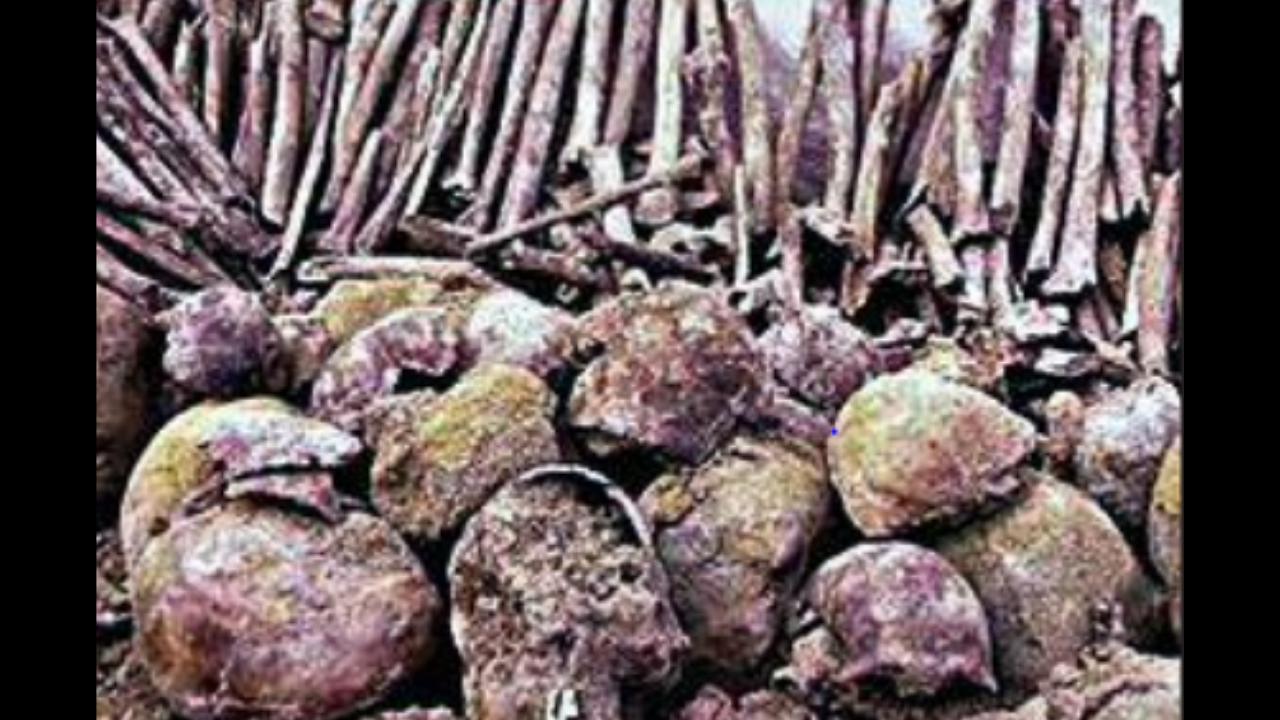
HYDERABAD: The mass of human skeletons, nearly 160 years old, found at Ajnala in Punjab in 2014 has always remained a mystery, with scientists and anthropologists coming out with their own theories.
But the lid over the mystery has now been lifted. Teams of geneticists and researchers from different institutions, including Hyderabad-based Centre for Cellular and Molecular Biology (CCMB) and Centre for DNA Fingerprinting and Diagnostics (CDFD), have said that the skeletons are of people from Bihar, UP and West Bengal and not from Punjab or Pakistan.
The latest study revealed that the mass of human skeletons belonged to soldiers of the Gangetic plain. These soldiers from 26th Native Bengal Infantry Battalion were posted at Mian-Meer, Pakistan, and had killed British officers during the mutiny in 1857. As many as 246 soldiers were captured by the British army near Ajnala and executed.
In 2014 many human skeletons were excavated from an old well in Ajnala town.
50 samples used for DNA analysis
Some historians said that they could be of people killed in riots during the Partition. The other prevailing belief, based on various historical sources, was that the skeletons were of Indian soldiers killed by the British army during the revolt of 1857.
But the identity and geographic origins of these skeletons continued to be debated due to lack of scientific evidence. Now, the finding of this study has revealed that the skeletons belonged to residents of the Gangetic plain. The study was published on Thursday in the scientific journal, 'Frontiers in Genetics'.
According to a CCMB statement here, researchers used 50 samples for DNA analysis and 85 specimens for isotope analysis. "DNA analysis helps understanding ancestry of people and isotope analysis sheds light on food habits. Both the research methods supported that the human skeletons found in the well were not of people living in Punjab or Pakistan. Rather, DNA sequences matched with the people from UP, Bihar, and West Bengal," said Dr K Thangaraj, chief scientist, CCMB, and director of CDFD, who was one of the researchers.
"The results from our research are consistent with historical evidence that the 26th Native Bengal Infantry Battalion consisted of people from the eastern part of Bengal, Odisha, Bihar and UP," said Dr Sehrawat, anthropologist from Panjab University.