In a city known for the dargah of Khwaja Moinuddin Chishti and the prestige of Mayo College, there is another old force that helped shape its identity. It does not draw crowds in the same way, but it has quietly powered Ajmer’s story for 150 years.
That force is the Ajmer Railway Workshop.
Set up in 1876 under the Rajputana Malwa Railway, the workshop began as a repair facility. Over time, it grew into one of the most important railway establishments in the country. It was also the third oldest railway workshop in undivided India.
Its contribution was not limited to machines. The workshop changed the social fabric of Ajmer in lasting ways. British and Jewish engineers, Parsi technicians, and workers from present day Uttar Pradesh, Gujarat, Kerala and Maharashtra all came here to work. Many stayed on, settled with their families, and helped build the city’s cosmopolitan character.
Even now, that legacy can still be seen in colonial bungalows, old railway institutes, churches, a Jewish cemetery near Ana Sagar and Parsi fire temples. Some railway colonies still carry faded markings from the Bombay, Baroda and Central India Railway days. In older neighbourhoods, rusted iron gates, tiled roofs and century old pipes sit beside newer buildings, offering small but telling reminders of the city’s layered past.
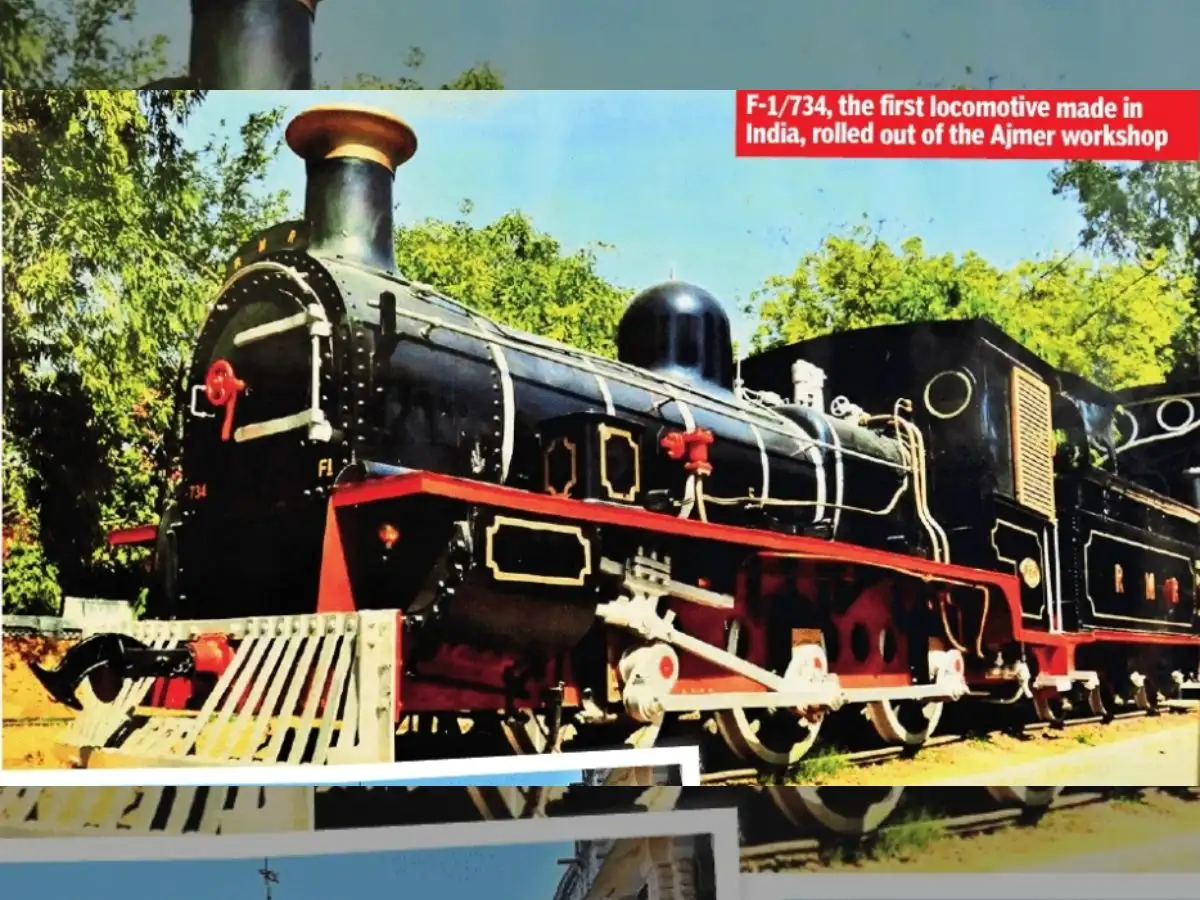
The workshop also played a role in Indian industrial history. In 1895, it produced India’s first indigenously made steam locomotive. During the First World War, it became a munitions hub and made artillery, shells and armoured trains for deployment in war zones such as Mesopotamia.
For Ajmer, though, the bigger change may have been social. The arrival of railway workers and their families from different communities turned the city into one of Rajasthan’s earliest cosmopolitan centres. That diversity still shows in its language, food, institutions and neighbourhoods.
The railway presence also helped shape Ajmer’s educational and institutional life. British and Anglo Indian communities formed clubs, churches and residential colonies. The Railway Institute became a social hub with ballrooms, sports and cultural events.
Bengalis came as teachers, clerks and railway officials. Gujarati traders expanded local business, while Agarwal families became closely tied to the city’s commercial life. The result was a city that grew not just around tracks and workshops, but around people, ideas and shared spaces.
Prashant Patel, a fourth generation Gujarati tobacco businessman, said his family’s link with Ajmer goes back to the railway era. He recalled how his great grandfather moved from Gujarat for business after the railways arrived. “Ajmer embraced us like its own,” he said, adding that Gujarati is still widely spoken in the city’s trading communities.
Sister Pearl, principal of Sophia College, said the railways also helped create an educational ecosystem. Institutions such as Mayo College, Sophia College, St. Anselm’s School and several convent schools grew in that environment. She said even the railways had opened a school for British children and others, and that attendance records are still preserved.
Parsis, too, played a major role in the workshop’s technical growth. They arrived as engineers, technicians and supervisors, bringing mechanical skills that were badly needed in the early decades of railway expansion. Hosi Dorabshah, 78, now based in Mount Abu, represents the fourth generation of his family in railway service.
His great grandfather came to Ajmer from Gujarat and worked in the railways. Dorabshah himself retired as a guard. He described himself as part of the “last generation” of Parsis in railway service, saying that only a small number of Parsis remain in Ajmer and Mount Abu today.
Many old Parsi and Anglo Indian homes are now locked up or have been sold as younger generations move away to Mumbai, Pune and abroad. Some railway quarters that once held large families are now occupied by elderly couples or caretakers.
Ajmer’s small Jewish community also traces part of its history to the railway era. Nearly 300 to 400 Jews once lived in the city, many connected to railways. Today, the Jewish cemetery near Ana Sagar remains one of the few visible reminders of that past.
The workshop itself has changed with the times. From a workforce of nearly 15,000 at its peak in the early 20th century, it now employs around 4,500 people after modernisation and restructuring. It still maintains modern coaches, locomotive stock, freight wagons and premium trains, including the Palace on Wheels and Vande Bharat.
As the sirens continue to sound inside the workshop, Ajmer carries on with another century and a half of memory behind it. The city may be known for its dargah and its famous school, but the railway workshop remains one of the quiet engines that helped make Ajmer what it is today.
(With TOI inputs)