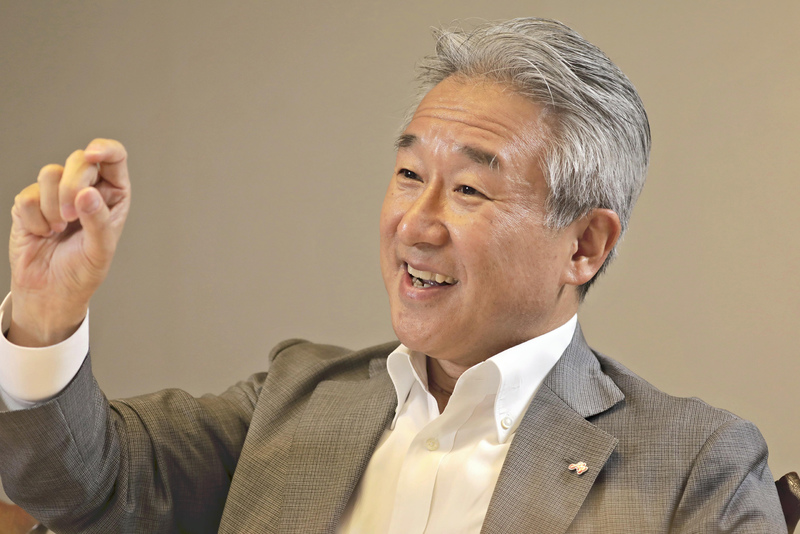
Ajinomoto Co. has enjoyed a high profile for taking progressive "work style reform" measures, such as bringing forward the end of the workday to 4:30 p.m. For this installment of Leaders, a column featuring corporate management and senior executives, The Yomiuri Shimbun spoke to Takaaki Nishii, the president and chief executive officer of Ajinomoto Co., about the aims of the reform and the concrete measures taken.
Ajinomoto Co., as a whole, has been working on promoting work style reform, especially through eliminating unnecessary tasks. We are trying to raise productivity and shorten working hours [at the same time].
[In April 2017, Ajinomoto Co. reset its daily work hours to seven hours and 15 minutes, shortening it by 20 minutes. Other major corporations' daily work hours are usually set at eight.]
We brought the start of business hours forward to 8:15 a.m. from 8:45 a.m. and ended the day at 4:30 p.m. instead of 5:20 p.m. The total work hours for fiscal 2018 will be 1,800 hours.
One concrete measure for reform was to begin reducing the number of meetings. We started our reform efforts in full in fiscal 2016. In fiscal 2015, the average total work hours across the company were 1,947. We examined this figure closely and found that in an average ten-hour work day, four hours were taken up by meetings. The result was almost the same across every office and section.
I strongly doubted this was necessary, thinking, "Do we really need so many meetings?" For that reason, I decided to abolish meetings held merely for the sake of reporting. All meetings are now held to determine something.
We can find many unnecessary tasks that take quite some time and are only for the purpose of giving reports -- time spent in a meeting just sitting and listening without speaking, and time spent documenting the meeting for people who did not attend. These jobs do not produce any value. Now, employees can simply read reports on the intranet. Reforming meetings also leads to reduced paper consumption.
A symbolic example of this reform involves a business report meeting that was being held every three months, convening around 80 people including branch and general managers across the country. Each person would present a five-minute report and no questions were asked by the other participants in the meeting. It took more than three hours just to listen to all the reports, which also required a great volume of materials to be prepared. When the materials had to be replaced just before the meeting, staffers in the corporate planning department had to work late into the night just to photocopy new materials.
I reduced the number of times this meeting is held to once a year and turned it into an important event at which the president delivers a message. As we continue to reexamine routine tasks, we find more and more that are unnecessary.
Satellite offices save time
We are also reducing travel time during work hours. For this purpose, we are establishing satellite offices in each region and creating infrastructure that allows people to work from anywhere, including from home.
Around train station terminals, home and office appliance manufacturers are renting out spaces for satellite offices and we are leasing such spaces for our employees. As of now, we have about 140 satellite offices. All of our employees have their own lightweight portable computer.
For example, after visiting a client, an employee goes to the nearest satellite office and finishes their work. They then go home without returning to headquarters. It takes 15 minutes on foot to get from Tokyo Station to our headquarters [located in the Kyobashi district of Tokyo]. Upon returning from a business trip to Osaka on the Shinkansen, an employee can save themselves the 30-minute round-trip by working at the satellite office close to Tokyo Station.
When heavy snow hit the Tokyo area in January, on one floor of the headquarters only 20 out of 100 employees were present. This is because they did not have to come in -- they could work and hold meetings at the satellite offices closest to their homes. This will surely be useful in case of a disaster.
At the moment, however, only about 10 percent of our employees use a satellite office on a daily basis. In my opinion, as the ratio increases, it will also increase business efficiency.
With the development of information technology (IT), there is increasing scope for improved business efficiency. Our salespeople can input an audio message about a business meeting with a client into a portable mobile terminal, and it will automatically be transcribed. Then, by just editing the text when they return to their workplace or at a satellite office, they can easily create a daily business report with explanatory data. As the data accumulates, it becomes easier to evaluate their work, and it can be informative when they hand over their job to a successor.
Our employees used to take notes during safety patrols in factories and share the information at meetings later on. Now, they take a microphone along and make voice recordings of what they find, while also sending visuals.
As we proceed with the reduction in working hours, employees may worry that their income will decrease. If they see reduced working hours as a financial matter, the reform will stall.
With such concerns in mind, during a negotiation with the labor union in spring last year, we decided to increase each employee's basic salary by 10,000, yen including raising various allowances, in order to return to the employees the profit made by reducing working hours. I participated in the negotiation with the labor union and gave them an assurance, saying, "The company guarantees the money for the increase." After this, the employees understood that the reform's goal is not to reduce labor expenses and they joined in the reform efforts.
We have already spent around 3 billion yen for the reform initiative, including investing in IT for more comfortable working environments at the satellite offices. In contrast, we saved a total of 1.7 billion yen last year by slashing overtime payments, travel and transportation expenses. We should expect more effects to emerge.
Healthy environment for all
Before becoming president, I worked in Brazil for about two years. This experience was instructive for me. Brazil has few national holidays, but it is obligated by law that people take 30 or more consecutive days off every year. Although there are some busy seasons when people have to work long hours, they take long breaks at other times. Nonetheless, sales results and profitability per employee are not necessarily low. Compared to Japan's work style, Brazil's seems much more reasonable.
The main goal of our work style reform is to lead efforts in innovation. That is why we must do away with unnecessary work to focus on the most essential and important jobs.
Moreover, I want to create an environment that will attract talented people with specialized skills. In this day and age, people are not interested in working for companies where employees have to work long hours.
Our reforms for increasing productivity have been implemented mostly by the personnel department in cooperation with people in the field and the labor union. But the management side has to take the initiative in this. Reform must be viewed as an important issue for management strategy and proposals from the workers themselves should be taken seriously.
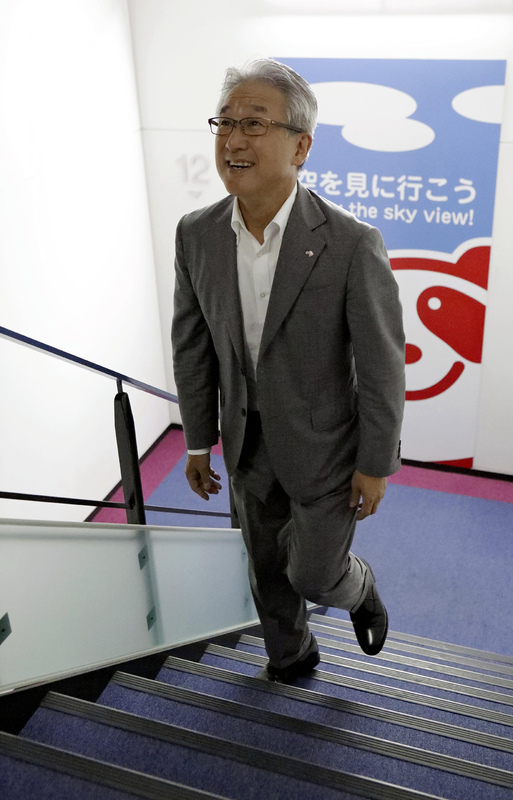
Ajinomoto Co. considers "health and productivity management" for all employees to be a duty. As for me, I take the stairs up to the 14th floor several times a week. I leave the main office at 4:30 p.m. so that my secretary will not have to work overtime. When I am meeting a client for dinner, I use the time in between to go swimming at the gym. I would like to be a front-runner in reform, in many respects.
-- Key Numbers
Top 10
Founded in 1909. Sells its products in more than 130 countries and regions and operates production factories in 24 countries and regions. Consolidated sales for the fiscal year ended March 2018 were 1.1502 trillion yen. Consolidated number of employees was 34,452 as of March 2018. Aiming to become a "Global Top 10 Class Food Company" by fiscal 2020.
-- Takaaki Nishii / President and Chief Executive Officer of Ajinomoto Co.
Born in 1959. From Nara Prefecture. Graduated from Doshisha University's Faculty of Letters in 1982 and joined Ajinomoto Co. After working as a member of the board at Ajinomoto Frozen Foods Co. and general manager of the personnel department, he became president of Ajinomoto Brazil in 2013, before taking up his current position in June 2015. At Ajinomoto Frozen Foods Co., he achieved an increase in profitability by improving quality and raising prices even during deflation.
Read more from The Japan News at https://japannews.yomiuri.co.jp/