
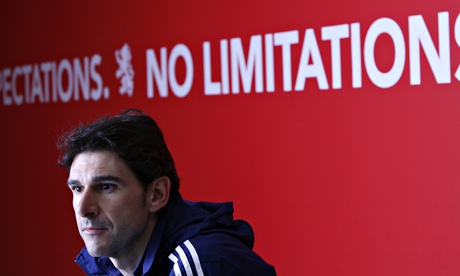
Aitor Karanka knew he would be happy at Middlesbrough by the end of his first evening as the club’s manager. The Spaniard had been out for dinner with Steve Gibson and was slightly surprised when Boro’s owner joined him on the walk back to his new home in a nearby apartment complex.
“Leo Percovich, my goalkeeping coach, was there too and when Steve came with us after we left the restaurant we thought he must live in the same block,” said Karanka, who completes his first year at the Riverside next month. “Steve was asking if everything was all right and whether we needed anything but when the lift arrived he suddenly said ‘goodnight’. We asked why he’d gone out of his way to accompany us and he explained he just wanted to check everything was OK. It was a little detail but to me it was a very big detail. Tiny details can be big things.”
Like Gibson, Karanka is unfailingly courteous and a firm believer that the devil really is in the detail. Big on punctuality, he is renowned for returning reports and briefing papers containing minor spelling mistakes to their authors for correction. It is all part of a desire to create a culture of excellence and with Boro travelling to Brighton on Saturday only one point off the top of the Championship, it seems to be working.
As Spain’s Under-16 coach, the former Real Madrid centre-half proved an innovative thinker but his attention to the small print stems partly from a subsequent stint back at the Bernabéu. Karanka returned to Madrid as José Mourinho’s assistant in 2010, embarking on a three-year, trophy-studded interlude resulting in an enduring friendship with Chelsea’s manager.
Yet even before that partnership, Karanka, now 41, boasted a contacts book most Championship counterparts could only envy. As he relaxes on a black leather sofa in his office overlooking the manicured pitches at Boro’s Rockcliffe Hall training headquarters near Darlington, he matter-of-factly explains how he became the “Special One’s” sidekick.
“I didn’t have a relationship with José before, so his call was a nice surprise. When I asked why he wanted me he said he’d spoken to Luís Figo, Clarence Seedorf and Predrag Mijatovic [all former Real team-mates] and they’d said good things – so I felt very proud.”
A gloriously intense chapter ensued. “With José you can learn something every single second. I felt like a doctor assigned to work with the world’s best surgeon in his speciality. José’s attention to detail was amazing, everything has to be done 100% properly. But the most important thing I learnt is that a manager has to be honest with his players. José was always very honest and I try to be the same.”
Karanka believes candour can negate the need for clubs to employ sports psychologists. “Honesty is the best psychologist,” he says. “My office door’s always open; I like to give players explanations when they’re not playing.”
Such frankness has enabled him to break with Championship convention and rotate in a manner almost unprecedented at this level. It is common for Karanka to make four or five changes per game but, so far, Boro’s players are buying into a policy designed to keep them fit, fresh and focused. “Rotation concentrates minds,” he says. “It makes players think – and, with so many games, people burn out if you don’t rotate.”
After radically remodelling his squad during the summer – (when seven recruits signed, five loanees arrived, 11 players were offloaded and four were loaned out) – Karanka now has two strong contenders for every position.
Just as importantly, there is a healthy blend between imported talents including Kike, a prolific Spanish striker, English staples such as the impressive Grant Leadbitter and academy graduates such as Ben Gibson, the owner’s nephew.
Then there is the Tottenham connection. While Patrick Bamford, Kenneth Omeruo and Jamal Blackman were borrowed from Chelsea, Spurs have placed Ryan Fredericks and Milos Veljkovic in Karanka’s care. “I took my coaching licences with Mauricio Pochettino and know him very well,” the Middlesbrough manager says. “We worked together on three courses, Mauricio’s someone I talk to a lot.”
These days Karanka speaks English with an impressive fluency and grasp of nuance but it was not always so. “I played in Denver [with Colorado Rapids] for a while so I’d learnt a bit,” he says. “But it wasn’t very good. We had a practice match in one of my first training sessions here. I told the goalkeeper to “wait, wait’ – except I said “white, white”. The lads said: “Gaffer, it’s reds v yellows.”
Back in 2005 Karanka would have trained on the very same pitch had Steve McClaren succeeded in signing him from Athletic Bilbao. “I always wanted to play in England,” he says. “But it was transfer-deadline day and they couldn’t finish the paperwork in time, there was a problem converting euros into pounds.”
He and his wife and children – a 12-year-old son and a daughter who is nine on Wednesday – are delighted to have finally relocated to Teesside. “North-east England and Newcastle especially remind me of the Basque country,” says Karanka, who was born and bred in Vitoria-Gasteiz, the Basque capital. “We like Newcastle, the restaurants are good and it’s an interesting city, but we want to get to know the whole region well. That’s important so we like visiting places like York and Whitby. We’re very happy, the people here are fantastic.”
Despite quietly revolutionising Boro’s playing philosophy and transfer-market strategy, he is anxious to retain links with the club’s past. Accordingly Gary Gill, a locally born member of Bruce Rioch’s team of the 80s, occupies an adjacent office in his capacity as head of European recruitment, while Craig Hignett is assistant manager.
“Craig’s very important,” says Karanka. “He scored the first goal at the Riverside [in a 2-0 win against Chelsea in 1995] so he’s part of club history. Craig’s like me at Madrid. I was the person who told José things he didn’t know – about Spain, other teams, people’s secrets.”
Further assistance comes from a dressing-room source. Jonathan Woodgate’s invariably stellar first-team appearances may be rationed by injury problems but the central defender’s influence on the promotion campaign must not be underestimated.
“Jonathan’s always thinking about helping the team, even when he’s not playing,” says Karanka. “He’s taking his coaching licence so he comes to me after training and asks questions. He’s interested in team philosophy – and the little, little details which can be big things.”













