In August 2021, the Tamil Nadu government had announced it would “speedily” take up the Airport-Kilambakkam Metro. Two years later, to the utter disappointment of commuters, thousands of people from the southern suburbs are forced to wade through choking traffic during peak hours every day without this mass rapid transit.
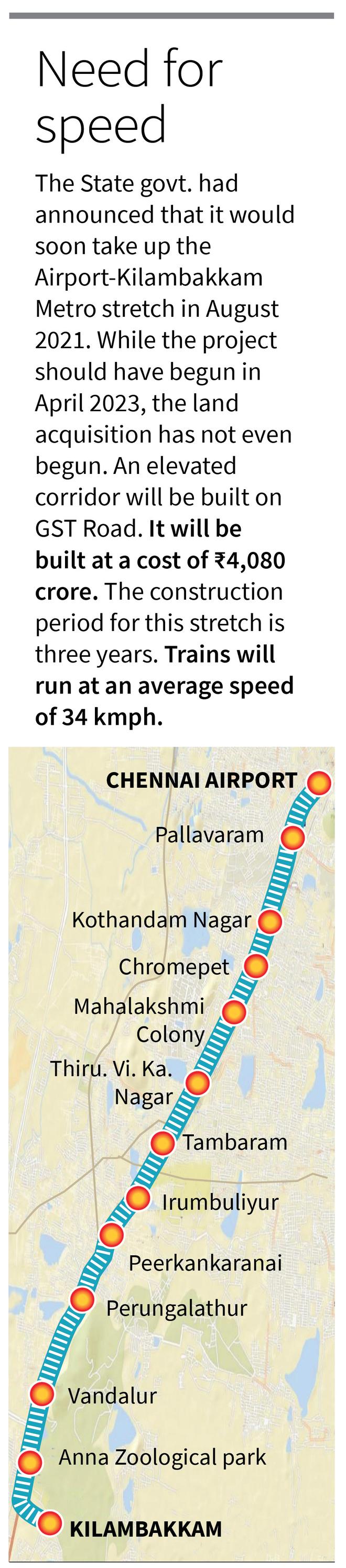
Chennai Metro Rail Limited (CMRL) had submitted the detailed project report (DPR) for this 15.3-km project that starts at the Chennai airport station and traverses through GST Road all the way to the upcoming Kilambakkam Bus Terminus. Planned at an estimated cost of ₹4,080 crore, this line will pass through several key locations, including Pallavaram, Chromepet, Tambaram, Perungalathur and Vandalur, and comprise 12 stations. As per the DPR, the project should have started by April 2023, so that it can be completed by 2026. But the start of the project itself has been delayed and even land acquisition has not begun.
Commuters say they dread the drive that has become more and more frustrating by the day. K. Subramaniam, a resident of Chromepet, who frequently travels from Chromepet to Nandanam, says it takes him almost an hour and a half to reach his destination at peak hours.
“It takes only 20 minutes to commute from the airport station to Saidapet, after which I walk down to my destination at Nandanam. But from my residence at Chromepet to the airport station, I spend an hour on the road by bike or auto. It is high time the government prioritised these projects and implemented them at the earliest,” he adds.
More congestion
D. Devaraj, a commuter who resides at Tambaram and travels to Vadapalani frequently, says that in recent years, the congestion has exacerbated owing to numerous factors, including the increase in two-wheelers and the mushrooming of many large-scale retail outlets that attract a lot of shoppers. If the government is going to open the Kilambakkam Bus Terminus, the majority of the buses will begin to ply from here and the traffic will grow manifold in these areas.
“How can those who travel to the bus terminus reach on time? The Airport-Kilambakkam project has already been delayed and needs to be taken up urgently. Commuters can easily save anywhere between half an hour to one hour if they can directly take the Chennai Metro Rail system,” he adds.
S. Bala, of Kundrathur who travels to Anna Salai every day for work, says he takes the minibus to the airport station and boards a train to Anna Salai.
“Minibuses are available only every 30 minutes. During the peak hours in the evening and morning, I wait for the minibus for half an hour and then the commute takes an hour. Had the Airport-Kilambakkam line been operational by now, I would have boarded from Tambaram or Pallavaram and saved at least 30 minutes in travel time,” he adds.
Shift to private transport
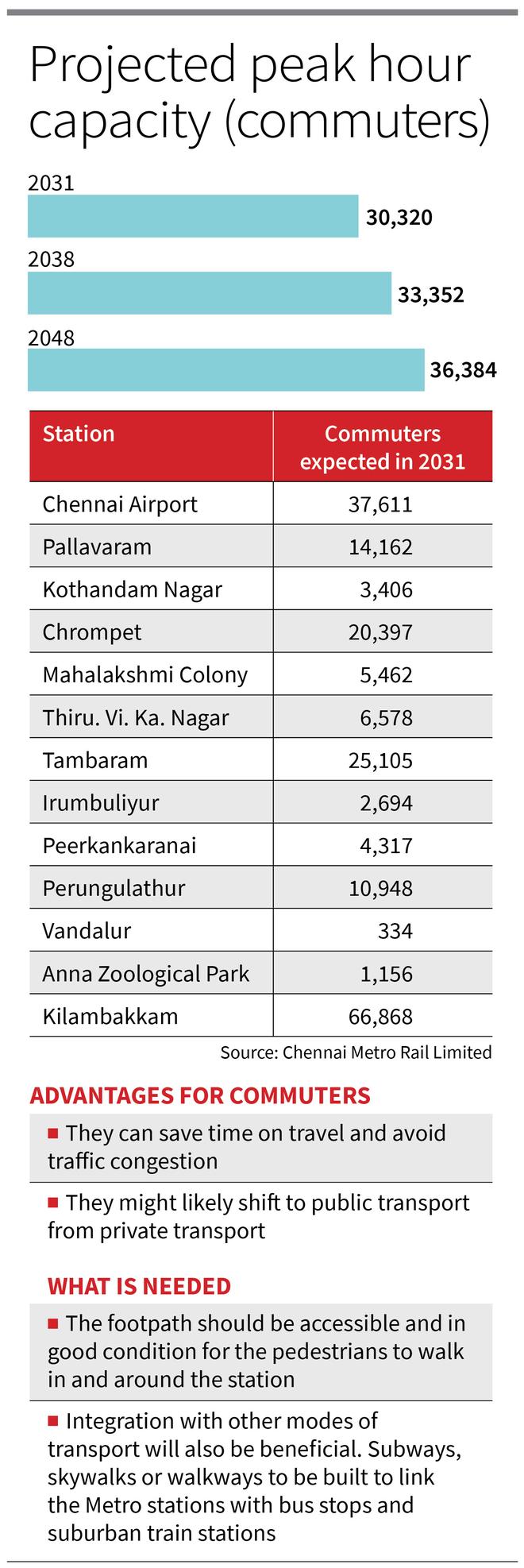
Urban planning experts say that in the absence of a well-connected, affordable mass rapid transit system, commuters will even more quickly shift towards private transport — two-wheelers or cars. Aswathy Dilip, managing director of ITDP India, says that between 1992-2018, Chennai witnessed a 23% increase in two- wheelers modeshare, while the public transport ridership fell by 17%.
“Hence it is imperative that the government stick to deadlines in these sustainable mobility projects to ensure good connectivity for our citizens. The option of a seamless and affordable mass rapid transit network would make life so much more comfortable and convenient for commuters and will decongest the roads. There needs to be a unified vision for the city for the next 5-10 years with clear alignment and phasing of projects across departments,” she adds.
Some also feel that during this time, the government will have to come up with another plan to help commuters as the Airport-Kilambakkam stretch will take a few years to be implemented. “Even if the construction of the proposed metro starts today, it will take another 5-8 years for it to become operational. But the citizens of the southern suburbs need better mobility today. The best solution that can be immediately implemented is metro-quality AC electric buses that operate on dedicated lanes to provide fast and reliable services that connect to the airport metro line,” says Shreya Gadepalli, urban mobility expert and founder of UrbanWorks Institute.