An Airbnb host who listed his Atlanta-area home as being situated in a “peaceful white neighborhood” is accused of rejecting a guest after finding out she was Black, according to a federal lawsuit obtained by The Independent.
When Sharona Stewart booked a stay at the 6-bed, 6-bath property, she exchanged “cordial” messages with owner George Yu Shihfang, a “superhost” on the online rental platform, her complaint states.
But once Shihfang began asking “racially based questions” of Stewart, and realized she was a person of color, the complaint says he suddenly stopped responding and canceled her reservation.
Stewart, who is in her mid-30s, promptly reported the situation to Airbnb, pointing out the “racially preferential language” used in Shihfang’s ad, the complaint goes on. However, it alleges, Airbnb “closed [her] complaint, refused to take action, and allowed the discriminatory advertisement to remain.”
“Defendant Airbnb knew or should have known that discriminatory practices were occurring on its platform,” the complaint argues.
Attorney Bataski Bailey, who is representing Stewart, told The Independent that his client was treated in a “grotesque” manner.
“Airbnb is probably a trillion-dollar business at this point,” Bailey said. “With AI and other tools, it should be able to put checks in place that catch things like this. That didn't happen here.”
Bailey said he “can’t imagine how many other people experienced the same thing,” and that filing the lawsuit was necessary to ensure racial discrimination is not permitted to exist without pushback.
“We have to call it out when we see it, and the only thing we can do at this moment is file a lawsuit and hold them accountable,” he said, adding that Stewart had “all but lost hope” that she might eventually have any recourse.
In an email, an Airbnb spokesperson said, “Discrimination has no place on Airbnb, and we removed the host from the platform.”
Shihfang, whose Airbnb profile describes him as a real estate developer who now lives in Mexico, was unable to be reached.
Black residents make up 46 percent of Atlanta’s population, according to U.S. Census Bureau data.
On June 2, 2024, Stewart was searching Airbnb for available long-term accommodations, and happened upon a promising listing in the affluent Atlanta suburb of Dunwoody, Georgia.
“Complete with a tennis court, pool and jacuzzi. Home to 1 out of 30 Giant Meta Sequoia in the south east [sic],” it read, according to her complaint. “Native to the Pacific West Coast the 250+ year old tree is what this unique Mansard Roof Home was built around in 1965.”
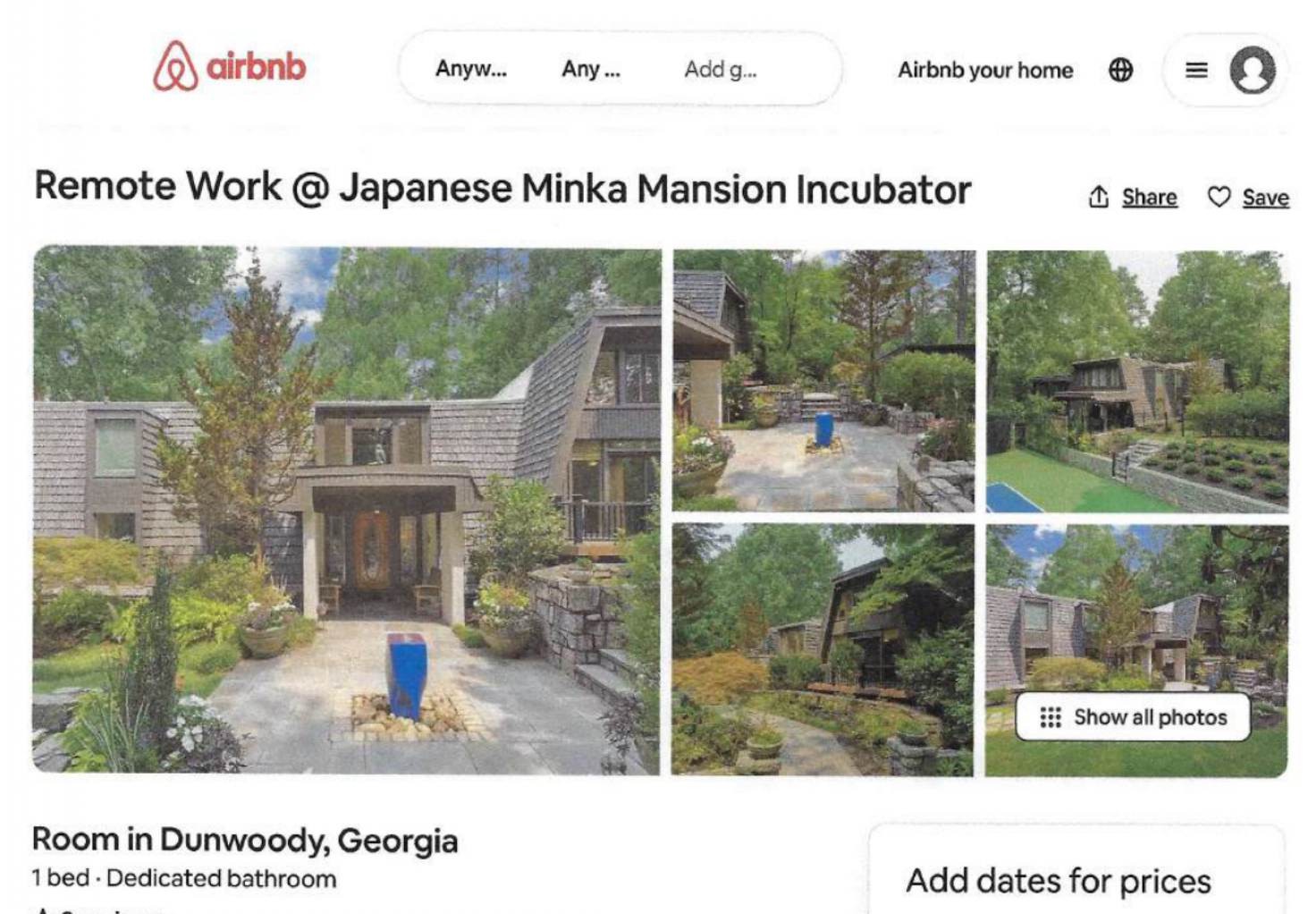
Stewart submitted a reservation request for the property, and “communications with [Shihfang] were cordial and indicated likely approval,” explains the complaint, which was filed May 29 in Atlanta federal court.
Yet, it goes on, “Upon learning Plaintiff’s race through specific racially based questions, Defendants changed their conduct toward Plaintiff.”
Shihfang and a pair of unnamed property managers, who are listed as “John Doe” defendants alongside Airbnb itself, “refused to respond further to [Stewart’s] reservation request or inquiries, which resulted in a rejection of [her] reservation request on the Airbnb app,” the complaint states.
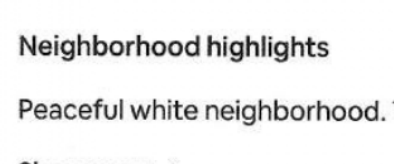
It was only then that Stewart studied the listing more closely, paying particular attention to the description under “Neighborhood Highlights,” according to the complaint.
“Peaceful white neighborhood,” it read. “The estate is on 2 1/2 acres in a private oasis. No neighbors around.”
Shocked, Stewart notified Airbnb about what she had allegedly experienced, the complaint says. Yet, it contends, the company took no steps to fix it, and did not remove Shihfang’s listing.

Shihfang and the two John Does “intentionally discriminated” against Stewart, and applied “disparate standards” in reviewing rental applications, and otherwise violated her civil rights, according to the complaint. For Airbnb’s part, the complaint accuses the platform of maintaining “policies, practices, customs or discretionary systems permitting race discrimination against African-American customers and/or other racial minorities.”
“Defendant Airbnb knew or should have known that discriminatory practices were occurring on its platform,” the complaint states, alleging that, at least in this instance, “similarly situated white applicants were treated more favorably.”
A 2015 Harvard Business School study found that guests with “African-American-sounding names” were nearly 10 percent more likely to have their reservation requests rejected by Airbnb hosts than identical guests with “white” names. The following year, Quirtina Crittenden, a Black traveler planning a trip to Miami, told ABC News that she faced unrelenting rejections until she reset her profile picture to a nondescript cityscape and changed her screenname to “Tina.”
“[O]nce that happened, I never had any issues booking on Airbnb,” Crittenden said.
In 2018, Airbnb changed its policies so that hosts would only see a guest’s profile photo after they accepted a booking. In 2019, the company settled a lawsuit with a trio of Black women who said they had been rejected by Airbnb hosts because of their race. And in 2022, with racially-based rejections continuing to occur with apparently unacceptable frequency, Airbnb suspended nearly 4,000 accounts globally for violating its nondiscrimination policy.
Airbnb says it specifically prohibits users from declining or canceling a booking based on a person’s race, imposing different terms, conditions or house rules, or “indicating a preference for or against a specific type of guest.”
It also prohibits hosts from using its platform to rent “former plantations where enslaved people lived or worked,” as well as “structures designed only to house enslaved people,” and “offerings that otherwise glorify slavery.”
Yet, according to Stewart’s complaint, Airbnb has “failed to adequately prevent, investigate, monitor or remedy discriminatory conduct,” despite “notice, complaints, prior incidents, public reporting, [and] internal data.”
“Airbnb materially participated in the transaction by controlling listings, communications, payment processing, platform access, ratings, booking approvals, dispute procedures, and enforcement mechanisms,” it says. “Defendants’ conduct was intentional, malicious, reckless, willful, wanton, and in conscious disregard of Plaintiff’s federally protected rights.”
Stewart is alleging violations of the U.S. Fair Housing Act, Georgia’s Fair Housing Act, two federal civil rights statutes, and negligence. Her complaint says she has suffered, among other things, emotional distress, embarrassment and humiliation, inconvenience, and loss of housing opportunity.
“She is doing as well as can be expected,” Bailey told The Independent. “Adulting is hard, and when you encounter something like this, it makes it even harder. You expect to be treated fairly, and when that doesn't happen, you almost don't know where to turn.”
The listing at the center of the dispute is finally down, Bailey said.
Stewart is now seeking general, special, compensatory, incidental, consequential and actual damages to be determined by a jury, as well as attorneys’ fees and court costs.