Summary
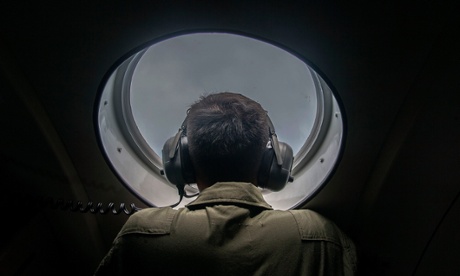
We’re going to close our live coverage of the search for the day, and plan to resume shortly before search operations do tomorrow morning local time in Indonesia.
-
Flight QZ8501 disappeared on Sunday flying from Surabaya, Indonesia, to Singapore, after last being seen on radar at 6.17am. The plane took off at 5.35am and was scheduled to arrive about two hours later with 162 passengers on board.
-
Indonesian officials believe QZ8501 is likely “on the bottom of the sea”, search and rescue chief Bambang Soelistyo said. The pilots were denied a request to increase altitude to avoid a storm shortly before losing contact, but gave no distress signal.
- The aerial search has been called off for a second night. No aircraft or ships have detected any sign of wreckage or traces of the plane, though crews will test oil slicks in the heavily trafficked area to see whether they contain aviation fuel.
- Families’ hopes dimmed despite officials’ vows to continue searching. Family and friends of the Indonesian pilot began grieving, and officials have prepared counseling services for families. The brother of a UK citizen on board the flight told the Guardian he is “prepared for the worst” and the sister of the French co-pilot said “When a plane falls out of the sky there are hardly any survivors.”
- Officials said the search area will expand Tuesday, as France, Australia, Malaysia, Singapore and China all joined the search effort with crew, ships and aircraft. Singapore has extra vessels ready to join in tomorrow’s search including a ship with submarine capability. Weather has so far impeded search efforts across the large but relatively shallow sea.
Updated
The search area will expand on Tuesday, Indonesian officials have said, saying that vessels will now patrol four more areas in addition to the seven searched Monday. The areas will now include certain areas of land, such as Belitung island.
At least 15 ships, seven aircraft and four helicopters are already looking for traces of the plane such as wreckage or oil, rescue spokesman Jusuf Latif said earlier today. Officials have asked the UK, US and France for sonar technology and and underwater search assistance.
France’s foreign ministry also said it has sent two investigators, and Australia dispatched a patrol plane to assist. Singapore and Malaysia have also sent ships and aircraft, and China’s defense ministry said it would send planes and ships, including a navy frigate. A ship and plane from Thailand are awaiting clearance to help, AP reports, and a number of Indonesian warships and local fisherman from Belitung have also joined the search.
The US navy fleet off the coast of Japan said it “stands ready to assist” but has not yet received a request from the search officials.
Weather has impeded the search so far, with rough waves decreasing visibility on the water and intermittent rain clouds obscuring the waves from above.
The search area is still vastly smaller, shallower and more stable than that for MH370, which is believed to have crashed in the remote and deep Indian Ocean after an erratic turn off its flight path.
Updated
Indonesian President Joko Widodo has ordered an immediate review of all aviation procedures, and vowed to find the flight no matter how long a search operation requires.
He said he was “shocked” to hear about the flight’s disappearance.
“I could feel the concern, the frustration and the sadness experienced by the passengers’ families, and I believe also felt by all the people of Indonesia.”
Air traffic controllers cited a crowded airspace as the reason they denied AirAsia 8501 its request to increase its altitude minutes before the plane disappeared, AP reports.
Six other commercial airliners were flying above the threatening Cumulonimbus clouds, controllers said, delaying the approval. More from AP:
Minutes later, the jet carrying 162 people was gone from the radar. No distress signal was issued. It is believed to have crashed into Indonesia’s Java Sea on Sunday morning, but exactly what happened and whether the plane’s flight path played any role won’t be determined until after the aircraft is found.
Broad aerial surveys on Monday spotted two oily patches and objects in separate locations, but it’s unknown whether any of it is related to the missing Airbus A320-200.
The last communication from the cockpit to air traffic control was a request by one of the pilots to increase altitude from 32,000ft (9,754m) to 38,000ft (11,582m) because of the rough weather. The tower was not able to immediately comply because of the other planes, said Bambang Tjahjono, director of the state-owned company in charge of air-traffic control.
AP spoke with a former pilot, Sarjono Joni, who’s familiar with Indonesian flight plans and weather. Sarjono said planes usually veer left or right when they encounter rough weather, and that pilots would only likely request to increase altitude if the plane was already experiencing heavy turbulence.
Heavy air traffic is common for the area, which bridges several densely populated cities.
Updated
The French co-pilot of AirAsia flight QZ8501 “dreamed” of flying as a boy, his sister has told a French radio station RTL. The translation of the tribute to Remi Plesel from his sister Renee by way of AFP:
“Since he was very young, it was his dream to be a pilot and the dream came true. He had been in Indonesia for three years … He was a very good pilot, an excellent one,” she said.
Renee said she was realistic about her chances of seeing her brother, originally from the island of Martinique in the Antilles, alive. “When a plane falls out of the sky, there are hardly any survivors.”
“We want them to find the plane, to explain to us what happened and to know whether we can go there, myself and my mother,” said Renee.
The co-pilot’s mother, Rolande Peronet-Plesel, told rolling news channel BFMTV that she received the call every parent dreads at 3am, from her son’s girlfriend.
“I’m waiting but we’re used [to planes going down] and not finding people. They never found the last plane that went down.”
Video of today’s search, which proved fruitless.
Indonesian authorities have so far discounted the likelihood that debris is related to QZ8501, and none of the search vessels have spotted plane wreckage yet.
Search chief Bambang Soelistyo has said boats will try to collect samples from an oil slick to see whether it could be aviation fuel, but the area is heavily trafficked so he and other officials urged caution.
Updated
Kirsten Han is in Singapore for the Guardian; she’s snapped a photo of a makeshift memorial at the airport for families of those on board QZ8501.
Messages left on the board for the families of passengers on #QZ8501 #Singapore pic.twitter.com/zVbTezFmfO
— Kirsten Han (@kixes) December 29, 2014
Summary
Information as to the location of the plane has remained scant but here is a summary of what we currently know about the short-haul AirAsia flight which was flying out of Indonesia’s second city Subrabaya destined for Singapore on Sunday with 162 passengers:
-
Flight QZ8501 disappeared on Sunday after taking off from Surabaya, Indonesia at 5:35am. Less than an hour later at 6:17am it had lost all contact with air control.
- Indonesian officials say it is likely the vessel is at the bottom of the sea, as hope continues to fade that the plane and passengers will be found safe. There has been no distress signal detected or any sign of wreckage found at this stage.
- The aerial search has been called off for a second night. Debris spotted by an Australian plane earlier in the day is now not thought to be related to the AirAsia jet according to Indonesian vice-president Jusuf Kalla.
- The brother of the only known UK citizen traveling aboard flight QZ8501 has told the Guardian he is “prepared for the worst”. Chi-Wai Choi says he is planning to travel to Singapore to support his family out there.
- Singapore has extra vessels ready to join in tomorrow’s search including a ship with submarine capability, MV Swift Rescue.
Updated
Brother of UK citizen "prepared for worst"
The Guardian has spoken to the brother of the only known UK national to have been on-board the AirAsia flight.
Named in reports as Chi-Man Choi, the energy industry executive was understood to have boarded the flight at the last minute with his two-year-old daughter, Zoe.
His brother Chi-Wai Choi, a 46 year old optometrist from Alsager, Cheshire said he was flying out to Singapore in the next few days to support his brother’s wife adding that he was “prepared for the worst.”
“There’s been no news officially but I guess you would kind of hope there’d be more information. But obviously we are concerned and we are prepared for the worst. We also try not to speculate.”
Choi said he was in touch with the UK’s foreign office who he said would be releasing a statement on the family’s behalf.
The latest update from transport ministry and aviation authority in Singapore confirms that earlier today, Indonesia accepted Singapore’s offer of two teams of specialists and two sets of underwater locator beacon detectors from the Singapore Ministry of Transport’s Air Accident Investigation Bureau (AAIB), to assist in locating the flight data recorders of the missing Indonesia AirAsia aircraft, QZ8501.
This afternoon the release says, Singapore also offered additional equipment and personnel from the Maritime and Port Authority of Singapore (MPA) to support the AAIB operations, including a sidescan sonar system and a robotic remotely-operated vehicle. It continues:
The Republic of Singapore Air Force (RSAF) deployed two C-130 aircraft to continue the search and locate (SAL) operation today, with the first taking off at around 6.30am in the morning and the second around noon. The RSAF plans to fly two sorties tomorrow.
The Republic of Singapore Navy’s (RSN) Formidable-class frigate (RSS Supreme) and Missile corvette (RSS Valour) have arrived at the search area and commenced the SAL operation. A Landing ship tank (RSS Persistence) also sailed off this evening to join in the efforts.
The Indonesian Search and Rescue Agency, BASARNAS, has also accepted the Singapore Armed Forces’ offer of a Submarine support and rescue vessel (MV Swift Rescue). It is ready to set sail.
Families at Singapore’s Changi airport have been supported by counsellors and care officers as well as staff from AirAsia and airport partners. So far, 27 family members have flown to Indonesia, the release adds.

Updated
Air search suspended
As darkness descends upon the Java Sea, the aerial search has now been suspended both CNN and the BBC are reporting.


Updated
UK satellite company Inmarsat who were involved in tracking missing flight MH370 earlier this year have told the Guardian that their location equipment was not installed on this AirAsia short-haul jet.
Debris discounted as related to missing jet
Following the press conference with the Indonesian vice president, Jusuf Kalla, the understanding is now that the debris spotted by an Australian search plane is unrelated to the missing AirAsia jet. This from AFP quotes him as saying:
“It has been checked and no sufficient evidence was found to confirm what was reported.”
Kalla said there were 15 ships and 30 aircraft searching the area. “It is not an easy operation in the sea, especially in bad weather like this,” he said.
Indonesian Air Force spokesman Hadi Tjahjanto told AFP the search was now focused on a patch of oil spotted off Belitung island in the Java Sea.
“We are making sure whether it was avtur (aviation fuel) from the AirAsia plane or from a vessel because that location is a shipping line,” he said.
Australia, Singapore and Malaysia have deployed planes and ships to assist in the Indonesian search for Flight QZ8501, which disappeared over the Java Sea on Sunday en route to Singapore.
Here is a updated map showing the area currently being searched by sea and by air.
Updated


Updated
This picture shows the Indonesian vice-president, Jusuf Kalla, addressing families gathered at Surabaya airport’s crises centre
Bertemu serta berdialog dengan keluarga penumpang Air Asia QZ 8501 di Crisis Center Bandara Juanda Surabaya pic.twitter.com/2d9HBm6F95
— Jusuf Kalla (@Pak_JK) December 29, 2014
Updated
The father of the pilot of the missing AirAsia plane has been speaking to the BBC. He said: “I want my son to come back alive and well but if that’s not meant to be, if God doesn’t want that, it’s in the hands of fate.
“My son, he’s not alone on the plane, if this is God’s will then so be it.”
Updated
Details are still hazy as to what exactly has been detected by an Australian Orion spotter plane in the Java sea but according to reports this is the debris’s location.
Here is a picture of some of the search equipment mentioned in the post below:

And here is an illustration of how the equipment will be used in the ongoing search operation:
Updated
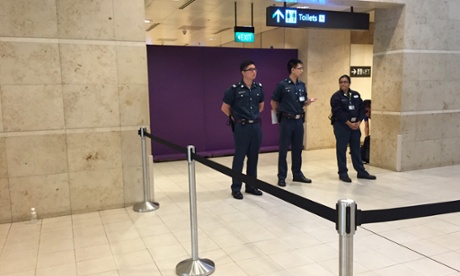
Kirsten Han who is in Changi airport, Singapore, for the Guardian says next-of-kin have been separated from the press and the public and airport staff are being tight-lipped about what is going on in the private holding area.
A media statement is expected at 6pm local time (10am GMT).
She says that earlier there had been a short presentation by the Ministry of Transport’s Air Accident Investigation Bureau displaying the underwater locator beacon detectors that are ready to be deployed.
They hope that these detectors will be able to pick up the acoustic signal from the underwater beacon on QZ8501’s flight recorder. The beacon is meant to transmit this acoustic signal for 30 days.
Updated
Reuters reports that German insurer Allianz is the lead re-insurer to the AirAsia jet, making it the third major airline accident it has been involved in this year:
The company, which has Malaysia Airlines as a client, was [also] the main reinsurer to flight MH370 that disappeared over the Indian Ocean in March, as well as to flight MH17 which was shot down in July while flying over Ukraine.
“We can confirm that Allianz Global Corporate & Specialty UK (AGCS) is the lead reinsurer for AirAsia, for aviation hull and liability insurance,” an Allianz spokeswoman said in a statement emailed to Reuters.
Aviation incidents accounted for four of the top 10 major insurance losses not linked to natural catastrophes in the first eight months of 2014, putting pressure on aviation claims that are already rising due to the use of expensive materials and demanding safety regulation, an Allianz report said.
Reuters calculations show the minimum payout to cover for this accident could be around $100 million.
“It is much too early to comment on reports of this incident at this stage, except to say that our thoughts and prayers are with all those affected by this missing flight,” Allianz said.
The Indonesian vice-president has arrived at Surabaya airport to visit the affected families.
Indonesia's Vice President arriving at Surabaya airport now to meet families #QZ8501 pic.twitter.com/NwfXUBwe4i
— Tom Phillips (@tomphillipsin) December 29, 2014
This pic courtesy of the Telegraph’s Tom Phillips
Updated
Object in sea spotted
Hello, this is Shiv Malik in the UK taking over the live blog from our Australia team.
Some breaking developments via AP news service: Indonesian official says Australian planes spot objects in sea in AirAsia search area.
What we know about AirAsia flight QZ8501
As the search for the missing AirAsia flight continues we still have very little information about what may happened to the plane. Here’s a short summary of what we know so far:
- Flight QZ8501 disappeared on Sunday after taking off from Surabaya, Indonesia at 5:35am. Less than an hour later at 6:17am it had lost all contact with air control. The flight is carrying 162 passengers on board. A major search mission is now underway in the Java Sea where the plane disappeared from radar screens.
- Indonesian officials say it is likely the vessel is at the bottom of the sea, as hope continues to fade that the plane and passengers will be found safe. There has been no distress signal detected or any sign of wreckage found at this stage.
Indonesia’s transport minister, Ignasius Jonan, said the government would review AirAsia Indonesia and determine whether safety improvements could be be made.
Here’s a few paragraphs from our latest story on the search for the missing plane from my colleague Jonathan Kaiman in Beijing:
An Indonesian official said that missing AirAsia flight QZ8501 is likely “at the bottom of the sea” on Monday morning, as hopes that an elaborate international search and rescue effort would find survivors began to fade.
The jet vanished from radar screens on Sunday morning with 162 people onboard, as it approached violent weather over the Java Sea about 40 minutes into a two-hour flight between the Indonesian city Surabaya and Singapore. The plane, an Airbus A320-200 operated by an Indonesian subsidiary of the Malaysian budget airline AirAsia, reportedly requested to deviate from its flight path to avoid a cloud. Moments later, it lost contact with Jakarta air traffic controllers. It did not send a distress signal.
“Based on the coordinates given to us and evaluation that the estimated crash position is in the sea, the hypothesis is the plane is at the bottom of the sea,” Bambang Soelistyo, Indonesia’s National Search and Rescue Agency chief told reporters on Monday, according to AFP. “That’s the preliminary suspicion and it can develop based on the evaluation of the result of our search.”
Welcome to our rolling coverage of the search for the missing AirAsia flight. I’ll be taking over our coverage from my colleague Michael Safi.
There has been considerable attention on the man behind AirAsia, Tony Fernandes. Here’s a profile from my colleague Gwyn Topham on Fernandes and his vision for the airline:
A childhood dream, a little mentoring from Richard Branson and a 20p purchase took Malaysian entrepreneur Tony Fernandes to the helm of the pan-Asian budget airline at the heart of aviation’s latest mystery.
Born in Kuala Lumpur in 1964, Fernandes went to boarding school in Epsom, Surrey, before going on to study at the London School of Economics. He followed Branson’s own trajectory of beginning in the music industry, working for Virgin after graduation. In 2001, aged 37, he made his move into airlines by snapping up AirAsia, then a troubled, state-owned airline that had run up large debts, for one ringgit, or around 20p. According to Forbes magazine, he now has an estimated personal wealth of around £400m. He was made a CBE in 2011.
The branding of Fernandes’s airline felt like Branson’s Virgin, down to the colour scheme and logo typeface, but the bigger inspiration was the boom in low-cost flying that was transforming Europe’s flightmaps. Soon the fleet was expanding rapidly, and within a decade AirAsia was flying 30 million passengers annually.
He described the missing flight as his “worst nightmare” on Twitter.
Local authorities in Belitung seem to be operating under the assumption the missing AirAsia flight has crashed, the Guardian’s Indonesia contributor Kate Lamb reports.
“We are anticipating the possibility of plane debris in Bangka Island waters,” said Abdul Muin, a spokesperson and senior commissioner with the Bangka-Belitung Police told Metro TV on Monday afternoon.
Muin said the search area has also been expanded to the entire waters around Bangka-Belitung, off the south coast of Sumatra.
I’ll be handing over the blog to my colleague Paul Farrell now, who will report any developments in the search as they happen.
One of the questions asked after the disappearance of Malaysia Airlines flight MH370, and again after this flight vanished from radar screens, is why there aren’t mandatory systems in place to track aircraft at all times - including after they’ve crashed.
Aviation journalist John Walton (@thatjohn), who previously broke the story of the Ethiopian Airlines ET703 hijacking on Twitter, says that such a system has been considered, but faces some big hurdles:
There are a number of difficulties around mandatory worldwide aircraft tracking. The principal difficulties seem to be political-economic, with the post-MH370 IATA Aircraft Tracking Task Force submitting some feeble proposals to ICAO. The political side of the aviation industry — UN body ICAO — and the airline side — trade association IATA — couldn’t even agree on the timing for the near term proposals.
The more we have airliners “disappearing” — like AF447, MH370 and now QZ8501 — the more that public opinion will be pressing for action.
Technically speaking, how simple would it be to create such a system?
First, you need to decide whether you want one system or to support multiple systems — what works for an A380 from Dubai to Sydney may not work for a Dash-8 from Sydney to Moree.
Then you have to figure out how those systems work with existing systems, and how to certify them for aircraft. That can take a number of years — especially if it’s a satellite system.
And don’t forget that all the airlines’ national regulators are independent: most, but not all, take their cues from the US FAA and Europe’s EASA, so that is a complicating factor.
My take is that after much to-ing and fro-ing we’ll likely see multiple providers, each running a slightly different system that will require a fair bit of integration. But the timescale will depend on the political (and therefore public) pressure on airlines.
A weeping woman at Subaraya airport shows photo of her relatives who were allegedly aboard missing #QZ8501. AFP pic.twitter.com/KvR2I4guQi
— The Philippine Star (@PhilippineStar) December 29, 2014
In Jakarta this morning to communicate with Search and Rescue. All assets now in region. Going back to Surabaya now to be with families.
— Tony Fernandes (@tonyfernandes) December 29, 2014
Keeping positive and staying strong. My heart bleeds for all the relatives of my crew and our passangers. Nothing is more important to us.
— Tony Fernandes (@tonyfernandes) December 29, 2014
Scores of red-eyed relatives are sat in a small room beside Surabaya airport. Among them are 2 very young kids
— Tom Phillips (@tomphillipsin) December 29, 2014
Looks like they are being briefed on what is happening. Many in floods of tears, clutching cloths to their faces #QZ8501
— Tom Phillips (@tomphillipsin) December 29, 2014
What we know so far
It’s nearly noon in Surabaya. Here’s where we are on the search for missing AirAsia flight QZ8501:
- Boats and aircraft from Indonesia, Malaysia, Australia and Singapore are combing a patch of the Java Sea near where AirAsia flight QZ8501 disappeared early on Sunday morning. No wreckage or survivors have yet been sighted.
- The chief of the rescue effort, Bambang Soelistyo, said the “preliminary suspicion” is that the plane is “at the bottom of the sea”. He said that Indonesia lacked the tools that would be needed to lift wreckage from the bottom of the sea, and would reach out to other countries for help.
- The Indonesian transport minister, Ignasius Jonan, has announced a review of AirAsia Indonesia in light of the incident. “Much will be reviewed in terms of its business operations and in terms of air transportation business, so that there are safety improvements,” he said.
- Indonesian officials remain hopeful that any wreckage of the plane will be found, as visibility has improved and the Java Sea, where the plane disappeared from radar screens, is relatively shallow. There are around six hours of daylight left on Monday.
- An extended family of ten and another of five people, including three children, are among those who narrowly missed boarding the QZ8501, which officials now believe crashed into the water about 42 minutes after taking off.
AirAsia: Malaysia has been tasked to comb an area 11,400 sq nautical miles around Belitung Island, Indonesia - Transport Minister
— BERNAMA (@bernamadotcom) December 29, 2014
The Sydney Morning Herald’s Michael Bachelard earlier tweeted that the total search area is 124,000 sq km.
Search area for QZ8501 is 124,000 sq kilometres
— Michael Bachelard (@mbachelard) December 29, 2014
Marine personnel have apparently christened the search and rescue operation to find this aircraft, Operation Rubber Duck, according to one Indonesian news outlet. We’ll try to confirm whether that name is official.
Operation 'Rubber Duck.' Surely they could have come up with something far less ridiculous sounding for the #QZ8501 SAR operation.
— Kate Lamb (@Katieolamb) December 29, 2014
Meanwhile, the Australian prime minister, Tony Abbott, has told 2GB radio that providing material support to the search and rescue effort for the AirAsia flight is an integral part of the friendship between Australia and Indonesia.
Abbott warned against comparing the apparent loss of the flight with earlier incidents. “This is not a mystery like the MH370 disappearance and it’s not an atrocity like the MH17 shooting down,” he said.
“It’s an aircraft that was flying a regular route on a regular schedule, it struck what appears to have been horrific weather and it’s downed.”
Update: a reader, itsme_jkt, has kindly clarified the Rubber Duck question below.
There is NO official operations name being given for the ongoing search and rescue (SAR) efforts for the missing AirAsia plane. The name “Rubber Duck Operations” is not designed for this SAR operation but it’s an existing name for a stealth technical military operation using inflatable boats. Of course, we’re not in a war situation to do a stealth military operation, but you get the idea, the marines will do some planned procedures (using inflatable boats) on the designated location to help find the missing airplane.
Updated
Tom Phillips, who is in Surabaya for the UK Telegraph, has seen maps indicating where Indonesian officials believe QZ8501 might have gone down.
Senior aviation official tells me 'we hope we can hear good news' abt survivors from #QZ8501 . Focus on area below pic.twitter.com/MwhIMdEYEa
— Tom Phillips (@tomphillipsin) December 29, 2014
He also tweets that another press conference has been called, with rumours swirling that the wreckage of the aircraft has been found.
Another map of spot #QZ8501 is thought to have gone down. Looks like +1 presser coming up. Rumours wreckage found pic.twitter.com/JsJPtPJN4Q
— Tom Phillips (@tomphillipsin) December 29, 2014
Updated
More details now from the press conference with Bambang Soelistyo, the chief of Indonesia’s National Search and Rescue Agency, which wrapped up a short time ago.
Via AFP:
The AirAsia plane which went missing with 162 people on board en route for Singapore is likely at the bottom of the sea, Indonesia’s National Search and Rescue Agency chief said Monday.
“Based on the coordinates given to us and evaluation that the estimated crash position is in the sea, the hypothesis is the plane is at the bottom of the sea,” Bambang Soelistyo told a press conference.
“That’s the preliminary suspicion and it can develop based on the evaluation of the result of our search.”
Soelistyo said Indonesia did not have “the tools”, such as submersible vehicles, required to retrieve the plane from the seabed, but that it is reaching out to other countries for help if necessary.
“Due to the lack of technology that we have, I have coordinated with our foreign minister so we will borrow from other countries which have offered. They are the UK, France and US,” he said.
Meanwhile, the Indonesian transport minister, Ignasius Jonan, said the government would review AirAsia Indonesia and look for safety improvements.
“We will review AirAsia Indonesia to make sure its performance can be better in the future,” he said.
“Much will be reviewed in terms of its business operations and in terms of air transportation business, so that there are safety improvements.”
Updated
Meanwhile, AirAsia CEO Tony Fernandes tells media in Jakarta the AirAsia group has carried 220 million passengers in 13 years and never had any fatalities. “Until today, we never lost a life,” he said.
He also said no airline can guarantee 100% safety to its passengers.
From Kate Lamb, our Indonesia contributor:
Aviation specialist Gerry Soejatman has been tweeting about the airspeed at which QZ8501 was traveling.
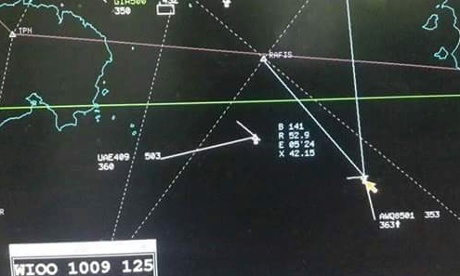
Radar shot of #QZ8501 with groundspeed of 353kts and 10kt tailwind translates to 187knots indicated airspeed. (Correction from 343kts)
— Gerry Soejatman (@GerryS) December 29, 2014
For people that don’t compute airspeed and tailwind automatically into real terms, I have spoken to Soejatman for further clarification.
Based on data he has seen, QZ8501 was not reaching the speeds required to sustain the aircraft at the altitude it was flying, an altitude of 36,000 feet.
“The plane appeared to be traveling well below what would have been its minimum speed at that altitude,” Soejatman told the Guardian, “This would indicate some sort of problem.”
Indications from the data show the airspeed was around 190 knots, well below the minimum cruise speed for that altitude, which is 220 knots.
This detailed report has just come through via the Associated Press:
The search for a missing AirAsia jet carrying 162 people that disappeared more than 24 hours ago on a flight from Indonesia to Singapore expanded Monday with planes and ships from several countries taking part.
First Admiral Sigit Setiayana, the Naval Aviation Center commander at the Surabaya air force base, said that 12 navy ships, five planes, three helicopters and a number of warships were talking part, along with ships and planes from Singapore and Malaysia. The Australian Air Force also sent a search plane.
Setiayana said visibility was good. “God willing, we can find it soon,” he told The Associated Press.
AirAsia Flight 8501 vanished Sunday in airspace thick with storm clouds on its way from Surabaya, Indonesia, to Singapore, and a rescue official said Monday that given the route of the plane he believed the most likely scenario was that it crashed.
“Based on the coordinates that we know, the evaluation would be that any estimated crash position is in the sea, and that the hypothesis is the plane is at the bottom of the sea,” National Search and Rescue chief Henry Bambang Soelistyo told a news conference.
At the Surabaya airport, passengers’ relatives pored over the plane’s manifest, crying and embracing. Nias Adityas, a housewife from Surabaya, was overcome with grief when she found the name of her husband, Nanang Priowidodo, on the list.
The 43-year-old tour agent had been taking a family of four on a trip to Singapore, Malaysia and Indonesia’s Lombok island, and had been happy to get the work.
“He just told me, ‘Praise God, this new year brings a lot of good fortune,’” Adityas recalled, holding her grandson tight while weeping uncontrollably.
Nearly all the passengers and crew are Indonesians, who are frequent visitors to Singapore, particularly on holidays.
The Airbus A320 took off Sunday morning from Indonesia’s second-largest city and was about halfway to Singapore when it vanished from radar. The jet had been airborne for about 42 minutes.
There was no distress signal from the twin-engine, single-aisle plane, said Djoko Murjatmodjo, Indonesia’s acting director general of transportation.
The last communication between the cockpit and air traffic control was at 6:13 a.m. (23:13 GMT Saturday), when one of the pilots asked to increase altitude from 32,000 feet (9,754 meters) to 38,000 feet (11,582 meters), Murjatmodjo said. The jet was last seen on radar at 6:16 a.m. and was gone a minute later, he told reporters.
Indonesia, Singapore and Malaysia launched a search-and-rescue operation near Belitung island in the Java Sea, the area where the airliner lost contact with the ground.
Sunardi, a forecaster at Indonesia’s Meteorology and Geophysics Agency, said dense storm clouds were detected up to 13,400 meters (44,000 feet) in the area at the time.
“There could have been turbulence, lightning and vertical as well as horizontal strong winds within such clouds,” said Sunardi, who like many Indonesians uses only one name.
Airline pilots routinely fly around thunderstorms, said John Cox, a former accident investigator. Using on-board radar, flight crews can typically see a storm forming from more than 100 miles away.
In such cases, pilots have plenty of time to find a way around the storm cluster or look for gaps to fly through, he said.
“It’s not like you have to make an instantaneous decision,” Cox said. Storms can be hundreds of miles long, but “because a jet moves at 8 miles a minute, if you to go 100 miles out of your way, it’s not a problem.
Authorities have not said whether they lost only the secondary radar target, which is created by the plane’s transponder, or whether the primary radar target, which is created by energy reflected from the plane’s body, was lost as well, Cox said.
Updated
A commenter has raised a point about the confusing timeline around this incident. Just to be clear, the Indonesian acting director general of transportation, Djoko Murjatmodjo, told reporters on Sunday that the flight was last seen on Jakarta’s radar at 6:16am (Surabaya local time) and was gone one minute later.
What’s confusing the issue is that AirAsia, in its early statements, said that all contact was lost with the control tower over an hour later at 7:24am (Surabaya local time). They haven’t clarified this time.
The plane took off around 5:35am, and disappeared around halfway through its scheduled 2h10m journey. Given that, I’m inclined to go with the government’s 6:17am figure. But we’re seeking confirmation from AirAsia now.
Updated
From my colleague Kate Lamb:
An Indonesian Search and Rescue official has said it is likely QZ8501 is now on the sea floor.
“The last coordinates were in the sea so it is likely it is on the sea floor,” Chief Marshal Bambang Soelistyo told a press conference at Soekarno Hatta Airport, Jakarta, on Monday.
According to Bambang search and rescue authorities are using a sonar system to detect the missing plane.
“They have a sonar system, [the system] can detect to a depth of about 1000-2000 meters,” said Bambang.
Updated
#BREAKING AirAsia Flight #QZ8501 likely 'at bottom of sea': Indonesia search chief
— Agence France-Presse (@AFP) December 29, 2014
Updated
Indonesia officials have struck an optimistic tone about the possibility of finding wreckage from QZ8501 - if indeed the plane crashed into the water. That’s partly because of the relatively shallow depth (46m) of the Java Sea, the part of the western Pacific Ocean where the aircraft vanished from radar screens.
In contrast, the faint Indian Ocean signals detected by the towed pinger locator aboard the Ocean Shield, in the search for MH370, were heard nearly 100 times deeper, at around 4,570m.
Updated
From my colleague Kate Lamb in Indonesia:
Neighbours of QZ8501 pilot Irianto, have held a mass prayer for the captain in his hometown of Sidoarjo, East Java.
The pilot’s wife, Ida, reportedly locked herself in her room after hearing the missing AirAsia plane lost contact with Indonesian air traffic control.
Local neighbourhood official Bagianto Djoyonegoro told reporters Ida was struggling to bear the weight of the news.
“We are sorry, she cannot be bothered because she is still in a state of shock,” said Bagianto.
Their children, Angela Anggi Ranastianis, 22 and Arya Galih Gegana age 7, were reportedly staying with family Yogyakarta and planned to return home on Sunday evening to be with their mother.
Angela posted a message on her social media account Path last night, as quoted by news portal liputan6.com.
The message translates in English as: “Papa, come home. I still need you. Bring back my father. Papa, come home, Pa. Papa has to be found. Papa must come home.”
Irianto is an experienced pilot with more than 6,000 flying hours. According to his neighbours the pilot is an avid motorist and actively engaged in his community, as one of the chairpersons of the local village council.
Daughter of #AirAsia #QZ8501 pilot Captain Irianto begs for him to come home (pic included in link). https://t.co/Q1fze669bI
— Oliver Miocic (@olivermiocic) December 28, 2014
My colleague Shalailah Medhora has rounded up Australian government reaction to this latest missing flight.
No Australians were on the AirAsia flight carrying 162 people that went missing over the Java sea on Sunday, the foreign minister, Julie Bishop, has confirmed.
“At this stage, I can confirm that there are no Australians on board,” Bishop said on Monday morning. “We are waiting for details of the [flight] manifest to determine whether there are any other linkages to Australia, [either] permanent residents or dual nationals,” she said.
Tony Abbott rang his Indonesian counterpart, Joko Widodo, on Sunday night to pledge Australia’s support in the search and rescue operation.
“The prime minister said he was very sorry to hear of the AirAsia flight QZ8501tragedy and that there would be many Indonesian families who would be left bereft by this loss,” a statement released by Abbott’s office on Sunday night said. Australia would do “whatever we humanly could to assist”, it said.
The United States Navy’s Seventh Fleet, which is stationed off Japan, says it stands ready to assist in the search for this missing flight, but has had no request to do so.
They’ve just sent this through, via my colleague Oliver Milman:
Following yesterday’s news of Air Asia flight QZ8501, we have received several queries regarding the U.S. Navy’s involvement in the search.
We are following the search and rescue operations for Air Asia flight QZ8501 that departed Surabaya, Indonesia for Singapore on December 28. The Indonesians and Malaysians are leading the search for the missing airplane. At this time, United States Navy assistance has not been requested. As we have in the past, the U.S. Navy assets in 7th Fleet stand ready to assist in any way that’s helpful. Our thoughts are with the passengers and families of Air Asia flight QZ8501.
At this stage the search involves Malaysia, Indonesia, Singapore and Australia.
Updated
The manifest for QZ8501 shows that 26 people booked their tickets but missed the flight, among them Inge Goreti Ferdiningsih, her husband, and three children.
The family cancelled their trip to the Singapore resort island of Sentosa at the last minute when Ferdiningsih’s father suddenly fell ill.
“The kids were still on holidays and [her son] Christopher was very upset when we said that we couldn’t go after all,” Ferdiningsih told Bloomberg.
“When we told him the plane was missing, he didn’t believe us until we showed him the tickets.”
Updated
The Indonesian Meteorology and Geophysics Agency (BMKG) has confirmed that QZ8501 was flying into an area of Cumulonimbus clouds before it disappeared in Indonesian Airspace more than 24 hours ago, the Guardian’s Indonesia contributor, Kate Lamb, reports.
“The BMKG recorded that weather conditions at the point where AirAsia lost contact, in the waters of Borneo had Cumulonimbus clouds with an altitude of 45,000 feet,” a BMKG spokesperson told Metro TV.
Cumulonimbus clouds are a type of dense and tall cloud often associated with thunderstorms and intense weather.
Actig director general of Air Transportation at the Transport Ministry, Djoko Murjatmodjo, told journalists on Sunday that the last time the plane had contact with the air traffic control it had requested to ascend to 38,000 feet to avoid thick cloud.
“The aircraft was in good condition,” said Djoko, “But the weather there was not good.”
Updated
Australian air force pilots have joined the search for this missing AirAsia plane. An RAAF P3 Orion maritime patrol aircraft left from Darwin early on Monday morning to join the search, Defence said in a statement.
Defence Force boss Air Chief Marshal Mark Binskin said the Orion had well-proven search and rescue capabilities.
It has a maritime search radar along with infra-red and electro-optical sensors to help the crew with their visual scans of the ocean.
The apparent loss of this flight caps a horror year for commercial aviation, coming after the disappearance of Malaysia Airlines flight MH370, the shooting down of MH17, and similar tragedies in Mali and Iran.
But this year has actually seen fewer airliner accidents than in the past, statistics show. Please note, this chart does not include the missing AirAsia flight, nor corporate or military aircraft. It defines airliners as planes that carry 14 or more people, and accidents as a crashes that leaves an aircraft beyond repair.
As you can see, despite the relatively low number of accidents, the loss of life this year has been quite high - though nowhere near spikes in 2005 and 2010.
The full data set, by the Aviation Safety Network, stretches back to 1942 and can be found here.
Updated
Indonesia’s ambassador to Australia, Najib Riphat Kesoema, has just told the ABC that Sunday’s search involved eight boats, two aircraft and three helicopters, and will be bolstered this morning by the assistance of Singapore and other countries.
Kesoema said the weather on Monday morning was still “not very good” but had improved from yesterday.
He said he had contacted the recovery effort to convey Australia’s offer to send an P-3 Orion surveillance plane to assist in the search.
The search resumed about 30 minutes ago, he added.
A copy of the manifest for AirAsia QZ8501 has been posted online by the Indonesian department of transport, and is available here.
Updated
Search and rescue efforts about to resume
From the Guardian’s Indonesia contributor, Kate Lamb:
The search and rescue efforts are about to kick off as dawn breaks in Indonesia but local authorities on the island of Belitung say there are a number of challenges ahead.
“There are ferocious sea currents and westerly winds,” police chief superintendent Nugraha Trihadi told Indonesian news website, detik.com on Monday morning.
The Indonesian military has deployed two Hercules aircraft, two helicopters and six ships to scour the search zone in the Java Sea, in between the islands of Borneo and Bangka-Belitung. Neighbouring Singapore and Malaysia have also offered to send naval and air backup to assist in the search.
Updated
The Australian foreign minister, Julie Bishop, has told the ABC that she and the prime minister, Tony Abbott, had been in touch with their Indonesian counterparts and offered their assistance “should that be required”.
Bishop said that “the theory at present” was that the bad weather had caused the plane to crash, but the plane needed to be located before any of the questions that surround this incident could be answered.
No Australians were aboard the aircraft, she said, but the department of foreign affairs is working to secure the plane manifest.
Updated
Aviation journalist John Walton notes that Monday’s AirAsia flight QZ8501 has just taken off, as we near 24 hours since the disappearance of yesterday’s plane.
Today’s AirAsia flight #QZ8501 is airborne. I can only imagine what those crew and passengers are feeling. pic.twitter.com/6wb60I0JS3
— John Walton (@thatjohn) December 28, 2014
Dawn has broken over the search area as we await official confirmation that search and rescue aircraft are in place.
AAP has spoken with an aviation expert, Geoffrey Thomas, who has speculated that QZ8501 may have been flying too slowly when it encountered bad weather conditions.
“Pilots believe that the crew, in trying to avoid the thunderstorm by climbing, somehow have found themselves flying too slow and thus induced an aerodynamic stall similar to the circumstances of the loss of Air France AF447 to crash in 2009,” Thomas told AAP.
The Air France AF447 crashed into the Atlantic Ocean in 2009 while en route from Rio De Janeiro to Paris.
“The QZ8501 was flying too slow, about 100 knots which is about 160 km/h too slow. At that altitude that’s exceedingly dangerous,” Thomas said.
“I have a radar plot which shows him at 36,000 feet and climbing at a speed of 353 knots, which is approximately 100 knots too slow ... if the radar return is correct, he appears to be going too slow for the altitude he is flying at.”
Thomas said this should not happen in an A320, a sophisticated aircraft, so it appears as though it’s related to extreme weather conditions.
“He got caught in a massive updraft or something like that. Something’s gone terribly wrong,” he said.
“Essentially the plane is flying too slow to the altitude and the thin air, and the wings won’t support it at that speed and you get a stall, an aerodynamic stall.”
The A320, while sophisticated, is not equipped with the latest radar, Thomas said.
The radar used by the A320 can sometimes have problems in thunderstorms and the pilot may have been deceived by the severity of these particular ones.
The latest technology radars, which were pioneered by Qantas in 2002, can give a more complete and accurate reading of a thunderstorm, but they haven’t been certified for the A320 until next year.
“If you don’t have what’s called a multi-skilled radar you have to tilt the radar yourself manually, you have to look down to the base of the thunderstorm to see what the intensity of the moisture and the rain is, then you make a judgment of how bad it is. It’s manual, so it’s possible to make a mistake, it has happened,” Thomas said.
Approximate last location of #QZ8501, plotted on weather image from @EarthUncutTV. pic.twitter.com/iHknp2AK8V
— John Walton (@thatjohn) December 28, 2014
Michael Bachelard, of the Sydney Morning Herald, has this story of a 10-member extended family who missed boarding QZ8501 by only minutes.
But it was 9am local time before an airport official approached Christianawati and her big family and said the words she will never forget.
“This must have been the best Christmas gift your family ever received,” she recalls him saying. “The flight you were supposed to be on has crashed.”
While that has still not been confirmed, the effect of this revelation on Christianawati and her family was immediate.
“We felt completely limp, the whole family,” Christianawati told Fairfax Media, “It was like we’d lost our spirit.”
We’re awaiting the resumption of the search for the missing flight, which Indonesian officials are suggesting will be found “quickly” if weather permits. In the meantime, here’s a timeline of how AirAsia QZ8501 vanished:
AirAsia’s flight QZ8501 took off from Juanda international airport in Surabaya, Indonesia’s second largest city, at 5.35am, shortly after sunrise on Sunday. The plane seated 180 but only 162 passengers were on board, allowing a few to stretch their legs into empty adjacent seats. The flight was scheduled to arrive in Singapore about three hours later. The sky was cloudy, the air warm.
Indonesian authorities said that, at 6.13am, the pilot - an Indonesian man named Iriyanto - contacted air traffic control in Jakarta with a request: the plane was cruising at 32,000ft over the Java sea and was approaching some nasty weather. Could he rise to 38,000ft to avoid a storm cloud?
Then, mysteriously, the captain went silent. The flight was last seen on radar at 6.16am and was gone a minute later, the Indonesian acting director general of transportation Djoko Murjatmodjo told reporters. Iriyanto had not sent a distress signal, he said.
My colleague Gwyn Topham has put together this profile of Tony Fernandes, the Malaysian tycoon who took over AirAsia in 2002:
A childhood dream, a little mentoring from Richard Branson and a 20p purchase took Malaysian entrepreneur Tony Fernandes to the helm of the pan-Asian budget airline at the heart of aviation’s latest mystery.
Born in Kuala Lumpur in 1964, Fernandes went to boarding school in Epsom, Surrey, before going on to study at the London School of Economics. He followed Branson’s own trajectory of beginning in the music industry, working for Virgin after graduation. In 2001, aged 37, he made his move into airlines by snapping up AirAsia, then a troubled, state-owned airline that had run up large debts, for one ringgit, or around 20p.
Here’s our latest report on the missing flight, from my colleagues Jonathan Kaiman and Alexandra Topping:
Hopes were fading on Sunday night for the safe return of 162 passengers aboard the missing AirAsia flight QZ8501 after the first day of the search was called off in Indonesia due to failing light and the government in Jakarta said it did not “dare to presume what [had] happened” to the aircraft.
In what appeared to be the third mysterious air tragedy to beset south-east Asian air travel this year, the Airbus 320-200 passenger jet took off from the Indonesian city of Surabaya for Singapore at 5.35amon Sunday, but lost all contact with air control at 6.17am.

Fernandes: flight’s disappearance “unbelievable”
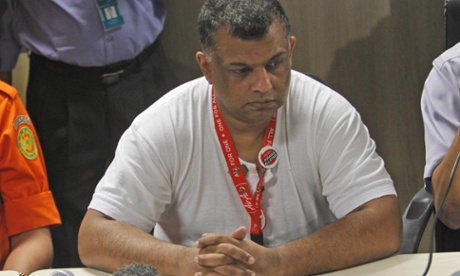
The chief executive of AirAsia, Tony Fernandes, told a press conference a few hours ago that the plane’s disappearance was “unbelievable”.
“This is a massive shock to us and we are devastated by what has happened,” he said. “We don’t want to speculate but right now of course the plane has been missing for 12 hours and there’s a deep sense of depression here.”
AirAsia has said that the aircraft’s pilot asked for permission to ascend rapidly to avoid poor weather shortly before the plane disappeared. “That’s as far as we know, and we don’t want to speculate ... we really don’t know. Let’s find the aircraft, and then we will do a proper investigation,” Fernandes said.
Updated
Welcome to our live coverage of the search for Air Asia flight QZ8501, which disappeared on Sunday shortly after setting off from Surabaya, Indonesia, carrying 162 passengers.
The aircraft departed at 5.35am local time, but by 6.17am had lost all contact with air traffic control. It was about halfway to its destination, Singapore, and was encountering heavy storms.
According to AirAsia, there were 155 Indonesians, three South Koreans, one French national, one Malaysian, one Singaporean and one British passenger on board the plane.
The search was called off late on Sunday due to bad weather and poor light. It will resume around 6am local time on Monday, which is in about two hours.
You can follow developments with us here throughout the day. Our Indonesia contributor, Kate Lamb (@katieolamb), is on hand. Kirsten Han (@kixes) is at Singapore airport, where the families of some of the missing passengers are gathered. Reach me at @safimichael
Updated