Summary
Poor weather off the Indonesian coast means that recovery efforts have been suspended, so we’re going to close down our live blog for now. Here’s are today’s major developments:
- Indonesian officials are citing sonar images which they say could show the fuselage of the AirAsia flight lying upside down at the bottom of the Java Sea. It remains unclear whether the aircraft is in one piece or broken up.
-
Stormy weather and waves up to 3m high have forced rescuers to temporarily suspend the air search for the bodies of those on board AirAsia’s flight QZ8501. “We are in a wait and see. Weather is bad currently. High tides and heavy rains. Every element is now in their position ready to make a move when weather improves,” the national search and rescue agency chief, Bambang Soelistyo, said.
- Three more bodies were recovered by divers on Wednesday morning, for a total of six - three male, three female - since debris from the plane was spotted on Tuesday. One of the bodies is believed to be that of 20-year-old trainee flight attendant Khairunisa Haidar Fauzi. Reports late on Tuesday that 40 bodies had been pulled out of the water were dismissed by officials.
CNN is now confirming that earlier report that Indonesian officials believe they have found the fuselage of AirAsia flight QZ8501.
Indonesian searchers say sonar equipment has detected wreckage from AirAsia Flight QZ8501 at the bottom of the sea, a day after the first signs of debris were spotted.
It’s still unclear whether the aircraft is in one piece of broken up, said Hernato, a search and rescue official who goes by one name.
The grim discovery Tuesday of parts of the missing plane and several bodies on the surface of the sea dealt a heartbreaking blow to families whose loved ones were lost.
A name tag on one of the bodies recovered on Wednesday appears to suggest it is that of 20-year-old trainee flight attendant Khairunisa Haidar Fauzi. Her father spoke to Fairfax Media’s Michael Bachelard.
Three male and three female victims found from #AirAsia8501 including, it seems, 20yo trainee flight assistant Khairunisa Haidar Fauzi
— Michael Bachelard (@mbachelard) December 31, 2014
Ms Khairunisa’s father, Haidar Fauzi, says: “This is what we expected, and the sooner the body is returned, the sooner we can have her back”
— Michael Bachelard (@mbachelard) December 31, 2014
Father of dead flight attendant: “We plan on burying her back in our home town, Palembang. We’ve been promised they will facilitate it".
— Michael Bachelard (@mbachelard) December 31, 2014
Updated
WSJ: Sonar images obtained by Indonesia "may be" missing jet
Indonesia’s search and rescue agency has obtained a sonar image that it claims may be the wreckage of the AirAsia plane on the floor of the Java Sea, the Wall Street Journal has reported.
The agency said the image appears to show an airplane upside down on the ocean floor in 24 meters to 30 meters of water. The image was obtained Tuesday by an Indonesian Navy ship that is part of the search-and-recovery effort, the agency said in a release early Wednesday morning.
Confirmation that the plane has been found keeps rolling in; we’re tracking down more details now.
BREAKING: #Indonesia confirms it has found location of plane, sonar shows flight #QZ8501 at bottom of Java Sea #PrayForAirAsia
— Yahoo Singapore (@YahooSG) December 31, 2014
Reports that sonar image appears to show aircraft upside down on ocean floor
The Wall Street Journal’s Jason Ng is tweeting from a press conference with Indonesia’s search and rescue agency.
#QZ8501 UPDATE: Indonesia SAR agency says sonar image appears to show aircraft upside down on ocean floor
— Jason Ng (@ByJasonNg) December 31, 2014
#QZ8501 UPDATE: Indonesia SAR agency says object spotted is in 24-30 meters of water
— Jason Ng (@ByJasonNg) December 31, 2014
UPDATE: High waves hampering #QZ8501 recovery efforts, says Indonesia search and rescue agency
— Jason Ng (@ByJasonNg) December 31, 2014
Updated
Three more bodies recovered as search suspended due to bad weather
Stormy weather has forced Indonesian rescuers to suspend their search for the bodies of those on board AirAsia’s Flight QZ8501, AFP reports.
More than 48 hours after the Airbus A320-200 disappeared en route from Indonesia’s second largest city Surabaya to Singapore, aerial searchers found wreckage and bodies floating in the Java Sea on Tuesday.
“We are experiencing bad weather now. Rains and winds prevented us from resuming the search operation this morning,” air force rescue coordinator SB Supriyadi said on Wednesday.
National Search and Rescue Agency chief Bambang Soelistyo told a media conference that six bodies had now been recovered, including a woman in crew uniform.
“As soon as the weather is clear, the bodies will be brought to Pangkalan Bun,” the town with the nearest airstrip to the crash site, said Soelistyo.
“We are in a wait and see. Weather is bad currently. High tides and heavy rains. Every element is now in their position ready to make a move when weather improves,” he said.
“Singapore and Malaysia vessels are also in the area now. They have joined us since the early search period, before we located the wreckage.”
Supriyadi said that hundreds of people from the military, police and national rescue agency were on standby waiting for clear weather in Pangkalan Bun.
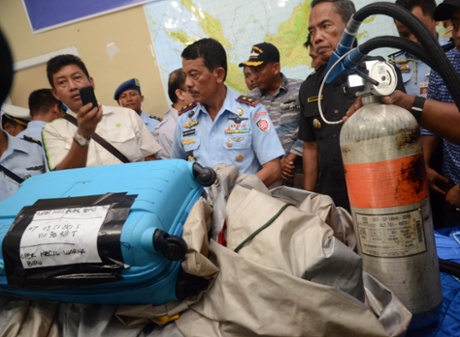
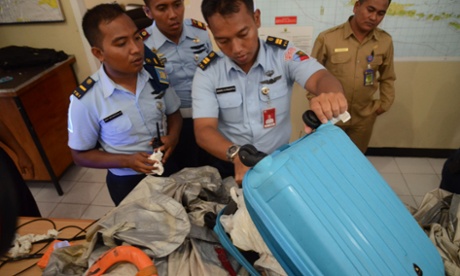
The plane carrying 162 people crashed into the Java Sea southwest of the island of Borneo, with debris including an exit door and a blue suitcase so far retrieved from the area.
So far that’s three men and three women recovered from the Java Sea, from a total of 162. None have been identified.
What we don’t know
As divers and ships trawl the Java Sea for more bodies and debris, it’s worth unpacking a couple of things we still don’t know about this tragic incident. Here’s my list, but please add your own suggestions in the comments below.
1. Why did the plane go down?
It’s understandably too early for definitive answers on this question – which some experts have suggest might not be fully reconciled for a year or more. But in his press conference on Tuesday evening, AirAsia CEO Tony Fernandes pointed to the weather as a possible factor: “There were some very unique weather conditions and let’s wait for the investigation to be concluded.”
However, over at the aviation website Runway Girl, researcher Simon Proud is quoted describing the weather at the time as “challenging, but nothing out of the ordinary”
“That area is well known for having severe weather and a crew with as much experience as this one would probably have faced worse weather in the past,” he said.
2. Why haven’t signals from the emergency locator beacon been detected?
The beacon, which is located in the aircraft’s black box, should have started sending out pings as soon as it detected water. The beacon has a finite range, and its signals could be getting blocked behind geological formations in the water.
But the Java Sea is also fairly shallow, and the chief of Indonesia’s search and rescue surface has spoken of a “shadow” in the water about 30 metres deep that authorities suspect could be the aircraft’s wreckage.
Over at the website Australian Aviation, journalist John Walton adds three more:
First, given the proximity of the current débris field to the last reported location of flight QZ8501, why did it take three days to locate it?
Second, would additional onboard tracking systems have enabled authorities to locate the aircraft faster?
Third, would additional post-impact locator systems have sped up the search too?
Updated
Meanwhile, Malaysia Airlines, another carrier afflicted by tragedy this year, has turned its social media presence grey in solidarity with AirAsia, which did the same thing on Sunday after the plane’s disappearance was announced.
#QZ8501: #MalaysiaAirlines logo goes grey "in solidarity" with #AirAsia #togetherwestand http://t.co/8ZxIvqVE1b pic.twitter.com/3rtSAGhXv0
— darren™ (@darrenLTA) December 31, 2014
The chief of the Malaysian navy, Abdul Aziz Jaafar, is tweeting live updates on the search.
#QZ 8501: Keadaan cuaca di lokasi pencarian-hujan, kod laut 3, kelajuan angin 15-20 kts. PHG dan LKR baru diperuntukkan Sektor I.
— Abdul Aziz Jaafar (@ChiefofNavy) December 31, 2014
Aviation journalist John Walton has translated the latest update:
TPT: #QZ8501: Weather conditions in the search location-rain, sea codes 3, 15-20 kts wind speed. PHG and new LKR intended Sector I.
— John Walton (@thatjohn) December 31, 2014
That likely means waves of up to 1.25m (4.1 feet) in the area, Walton adds.
Updated
It might be a year, or longer, before investigators have a definitive idea of what brought down AirAsia flight QZ8501, according to Steve Preteska, the director of Aircraft Accident Investigation Programs at the Southern California Safety Institute.
“These scenarios typically take a year or more,” Preteska told ABC Newsradio. “It’s a long process for lots of different reasons, not the least of which is that investigators want to access as much data available, and do as thorough a job as possible.”
You can listen to the full interview below.
Updated
Singapore’s Straits Times has an interesting round-up from aviation experts, who are suggesting the plane likely broke up after crashing into the Java Sea, rather than exploding in mid-air.
Retired United States airline pilot John Cox, who runs his own consultancy, said: “I am now seeing doors and reports of a large section located on the sea floor which are indicators, but not conclusive evidence, that the plane was in one piece when it hit the ocean.
“If the wingtips, nose and tail are found in the same area, then it will be conclusive that the plane was intact upon impact with the water.”
Mr Jacques Astre, president of industry consultancy International Aviation Safety Solution, said: “The fact that the debris field is relatively small would suggest the aircraft broke up upon impact with the sea and not in flight.”
If some bodies are found intact, it would suggest the same, said Mr H.R. Mohandas, a former pilot and now programme head for the diploma in aviation management at Republic Polytechnic.
Mr Astre added: “The close proximity of the debris field to its last known location also suggests the aircraft descended fairly quickly.”
The story notes that the debris field is about 10km from the aircraft’s last known location.
Updated
The White House has issued this statement about the AirAsia flight.
White House statement on AirAsia Flight #QZ8501: pic.twitter.com/5dNn49Tbfe
— Dan Linden (@DanLinden) December 30, 2014
The chief of Malaysia’s navy, Abdul Aziz Jaafar, tweets an image of the four search sectors that will be scoured today.
#QZ 8501: Kawasan Pencarian KD Pahang dan KD Lekir akan diumum kemudian. 4 Sektor ditubuhkan @ seluas 28x56 nm. pic.twitter.com/VMQCMCaS08
— Abdul Aziz Jaafar (@ChiefofNavy) December 30, 2014
He says the areas encompass about 5,378 sq km.
My colleague Oliver Milman passes along this message from the United States Navy’s 7th Fleet, which has contributed the warship USS Sampson to the recovery effort.
USS Sampson arrived on station in the Java Sea in the early afternoon on Dec. 30 and began assisting in the search at the request of the Indonesian government. The ship’s MH-60R search and rescue helicopters launched to assist in the search efforts and the crews discovered debris late on the 30th. The ship and her helicopters are still on station and continuing to search. Today, Sampson is awaiting tasking from the Indonesian authorities to determine the continued recovery plan.
USS Fort Worth, the littoral combat ship deployed to 7th Fleet, is in port in Singapore. She is prepared to aide in search efforts if her assistance is requested. U.S. 7th Fleet and U.S. Pacific Fleet continue to evaluate ships, aircraft and support units in the area that may be helpful in the search efforts, and we are taking steps to make sure they are ready if the Indonesian government requests them.
Reports by the Indonesian navy late on Monday that 40 bodies had been recovered from the Java sea were not corroborated by Basarnas, the country’s search and rescue agency, which said only three had been fished from the shallow waters.
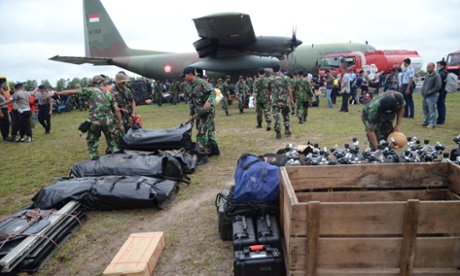
A number of other items were recovered though, and brought back to the search and rescue operations centre in Pangkalan Bun.
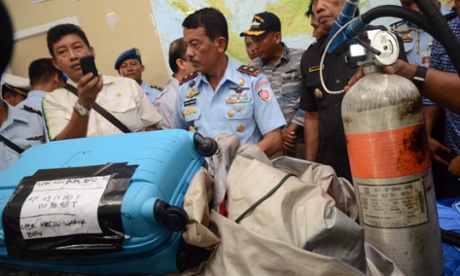
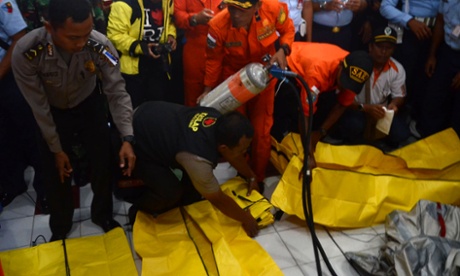
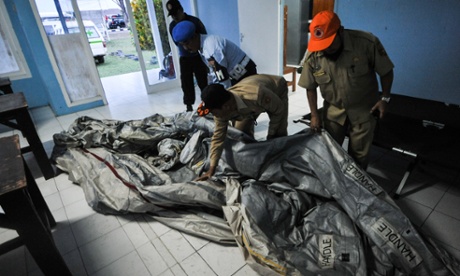
Updated
My colleague Paddy Allen has put together this handy graphic showing the plane’s flight path, last reported position, and where the debris has been spotted.
UK newspaper the Daily Telegraph has this fascinating story about a 38-year-old Indonesian fisherman, Mohammed Taha, who was the first to spot wreckage from the AirAsia flight while on a fishing trip on Sunday. The trouble was he didn’t know a plane had gone missing – and didn’t find out until Monday night.
When he arrived in his village, he heard the news about the missing Air Asia flight QZ8501. He later said he was familiar with the airline’s red logo and recalled that some of the floating objects had been red.
“I found a lot of debris – small and large - in the Tujuh islands,” Mr Taha told Tempo online.
“The largest was four metres [13 feet] long and two metres wide [seven feet]. They were red coloured with white silver. It looked like the Air Asia colours.”
Mr Taha immediately called Bagus Rai, his local police officer, and provided an account, including the location.
Officer Rai contacted the search authority, which organised an aerial search for the following morning. At 8.00am, the objects were spotted.
More air searches revealed that the objects included the exit door and were from the plane.
“The fisherman said he saw the debris looked like the body of a plane,” officer Rai told Kompas online. “He did not bring the debris back. We then planned to do the search.”
Updated
Here’s our latest report on the developments of the past few hours, including shocking details of the way that relatives of QZ8501 passengers discovered the fate of their loved ones.
Two and a half days after the plane carrying their loved ones vanished from radar screens over the Java Sea, the anguished relatives crowded into a room already assumed the worst. But the confirmation came in a particularly brutal way: live television coverage showed a half-naked, bloated body floating in the sea.
Many people began crying hysterically. Several fainted and had to be carried out of the room at Surabaya’s airport, the starting point for the ill-fated AirAsiaIndonesia flight QZ8501 that departed early on Sunday morning. “You have to be strong,” said the mayor of Surabaya, Tri Rismaharini, as she comforted relatives. “They are not ours, they belong to God.”
But one woman, dressed in an AirAsia uniform, raged at the TV. “Is it possible for you not to show a picture of the dead?” she shouted. “Please do not show a picture of a dead body.”
A man awaiting news of his younger brother said the relatives had been calm before the broadcast of the grisly images, shot from a search helicopter, showing a body floating face down, clad only in underwear and socks. “But the atmosphere was very different after the footage of a dead body was shown,” said Munif, 50, who in common with many Indonesians uses one name. “Families became hysterical.”

Only three bodies recovered so far, Indonesian authorities say
Welcome to our rolling coverage of the operation to recover the wreckage and remains of the 162 people who perished aboard AirAsia flight QZ8501. Parts of the aircraft were found on Tuesday after an exhaustive two-and-a-half day search of the Java sea.
The discovery of the plane has brought a measure of closure to some of the bereaved, but questions about what brought the aircraft down remain unanswered. Authorities are hoping the recovery of the black box flight recorder might offer some clues about what happened in the minutes after 6:17am on Sunday, when the aircraft apparently sought to change course to avoid a storm, and then vanished from radar screens.
Contrary to reports yesterday that 40 bodies had been fished from the sea, the head of Indonesia’s Search and Rescue Agency has confirmed the recovery of only three bodies. The search will resume at daybreak in about one hour, and we’ll bring you all the latest developments.
Updated