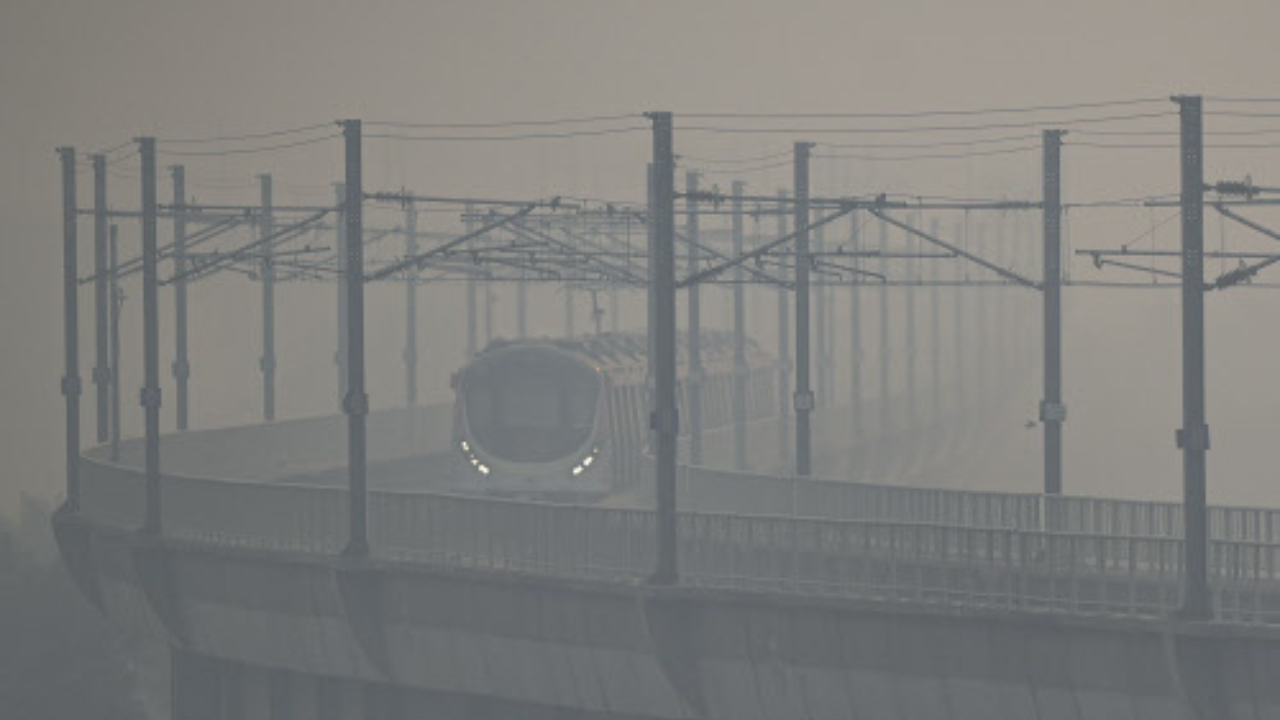
NEW DELHI: Despite the relief brought by rain, Delhi witnessed a surge in pollution levels and the return of a smoky haze on Monday morning. This followed residents disregarding the ban on firecrackers during Diwali night.
According to air quality monitoring specialist IQAir, Delhi ranked as the most polluted city globally on Monday, with Lahore and Karachi in Pakistan following closely. Mumbai and Kolkata secured the fifth and sixth spots among the world's most polluted cities.
On Diwali day, Delhi had recorded its best air quality in eight years, with a 24-hour average Air Quality Index (AQI) of 218 at 4 pm. However, late-night firecracker activity led to a spike in pollution amid low temperatures.
The AQI, which categorizes air quality, rose from 275 (considered poor) at 7 am on Monday to 358 by 4 pm. In the 24-hour period ending at 4 pm, AQI levels increased significantly in neighboring areas such as Ghaziabad, Gurugram, Noida, Greater Noida, and Faridabad.
Within Delhi, certain areas, including RK Puram, Jahangirpuri, Bawana, and Mundka, experienced 'severe' pollution levels. Concentrations of PM2.5, a fine particulate matter harmful to the respiratory system, exceeded safe limits by six to seven times in these areas.
Firecracker bursting resulted in PM2.5 concentrations surpassing 1,000 micrograms per cubic meter in places like Okhla and Jahangirpuri early in the morning. Data from the Central Pollution Control Board (CPCB) revealed a rapid increase in air pollution levels across India post-Diwali.
The DPCC reported that PM2.5 levels at the Jawaharlal Nehru Stadium peaked at 1,423 micrograms per cubic meter at 2 am but gradually decreased due to a rise in temperature. Similar trends were observed at other monitoring stations.
Comparing to last year, DPCC analysis indicated a 45% increase in PM2.5 and a 33% increase in PM10 on Diwali. Most air quality monitoring stations in Delhi recorded higher pollution levels this Diwali compared to the previous year.
Despite the comprehensive ban on firecrackers within the city, the pollution situation in Delhi worsened, attributing stubble burning in neighboring states and transport as significant contributors. The Decision Support System estimated that stubble burning accounted for 35% of PM2.5 pollution on Sunday, expected to decrease to 22% on Monday and 14% on Tuesday. Transport contributed 12 to 14% to Delhi's air pollution over the past few days.
This contrasts with the clear skies and improved air quality experienced in Delhi just before Diwali, attributed to intermittent rainfall and favorable wind conditions. The ban on firecrackers and other measures did not prevent a post-Diwali increase in pollution levels, emphasizing the persistent challenges faced by the city.
(With agency inputs)