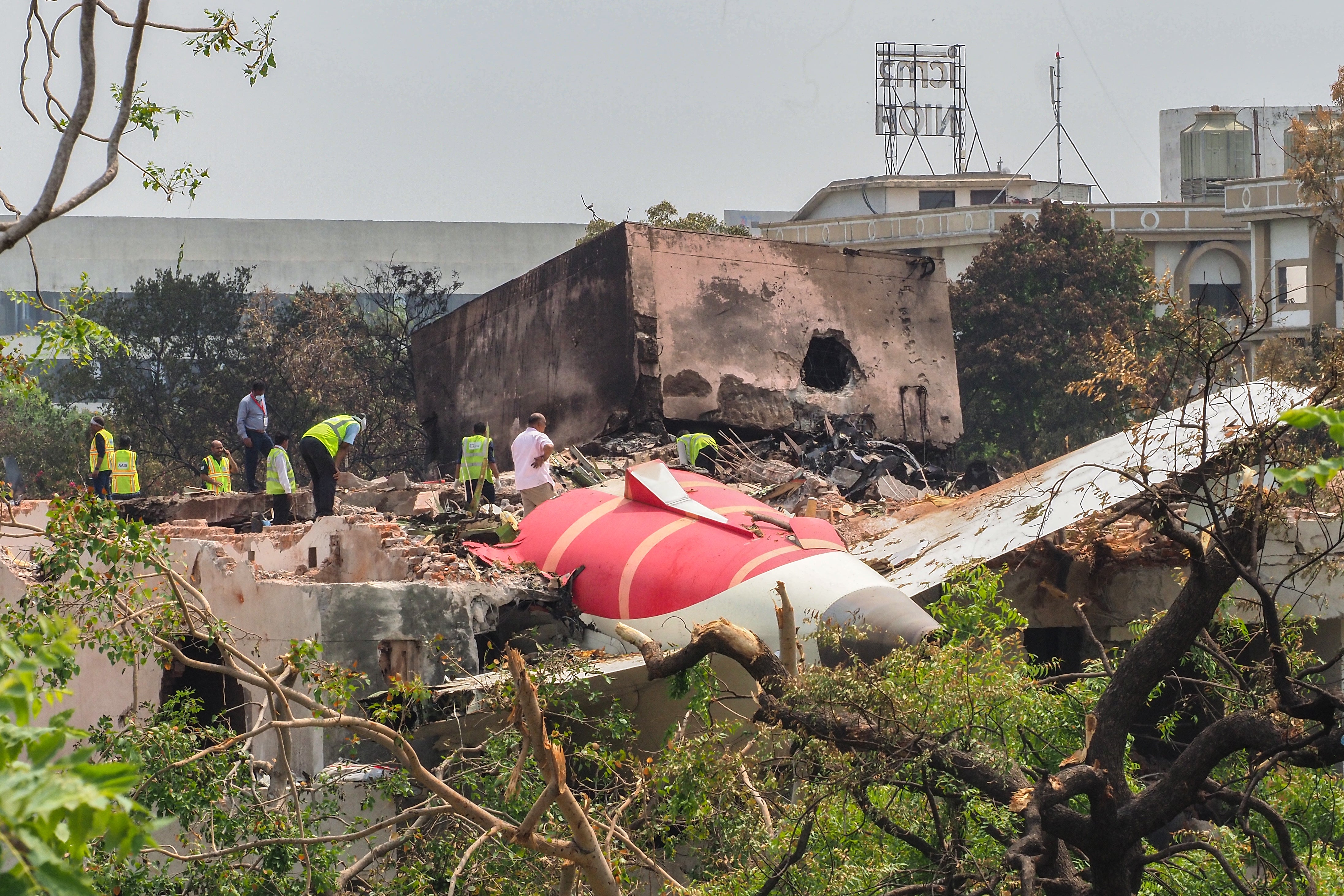
The Supreme Court of India on Thursday clarified that the ongoing investigation into the Air India plane crash, which killed 260 people in June, was intended to determine the cause of the disaster and not to assign fault to any individual.
The observation came after the solicitor general submitted that the preliminary investigation report released a month after the disaster did not attribute blame.
“There’s no blame attributed to anyone,” Tushar Mehta argued. “As a matter of fact, after the interim report, which had to be given mandatorily within a month of the accident as per international standards, since there was some misconception, the ministry of civil aviation had issued a press note.”
The submission was made as Justices Surya Kant and Joymalya Bagchi were hearing petitions seeking an inquiry monitored by the court into the crash in the western city of Ahmedabad which claimed the lives of all 12 crew members, all but one of the 230 passengers, and 19 people on the ground.
Appearing for the government, Mr Mehta said the investigation by the Aircraft Accident Investigation Bureau (AAIB) was being conducted strictly in line with international civil aviation conventions.
“There is an international convention, a regime in place, and mandatory steps to be followed in cases of air crash investigations,” he was reported as saying by the daily Hindustan Times.

The court reiterated that such investigations were “to clarify the cause and then give recommendations so that such a situation does not arise again”.
The petitions before the court were filed by Pushkaraj Sabharwal, 91, father of Sumeet Sabharwal, the captain of the doomed flight, and the Federation of Indian Pilots.
They alleged that the Indian government’s inquiry failed to meet the standards laid out in the International Civil Aviation Organisation (Icao) conventions.
Mr Sabharwal, represented by senior advocate Gopal Sankaranarayanan, said that his plea was prompted by “nasty” media coverage suggesting that his son was responsible for the crash.

Speculation that the crash was caused by pilot error began soon after the preliminary report was released to the press in July.
It contained excerpts from the cockpit voice recorder indicating that both engine fuel control switches had moved from “RUN” to “CUTOFF” seconds after take-off, leading to an immediate loss of thrust.
One pilot was heard asking about the fuel cutoff and the other replying that he hadn’t flipped off the switches. Although a backup power system deployed automatically and one of the two engines began to recover, the aircraft was unable to regain altitude and crashed moments later.
Mr Sankaranarayanan argued that the AAIB investigation had not fully complied with Icao procedures.
Advocate Prashant Bhushan, representing the non-profit Safety Matters Foundation, said that under India’s aviation rules, a full court of inquiry – rather than a bureau-led probe – was required in cases involving serious air disasters.
“The rules mandate a court of inquiry. There is no other option,” Mr Bhushan told the bench, adding that the Boeing 787 model had experienced “several systems failures” worldwide, The Hindu reported.
“Everybody flying in these aircraft is at risk,” he warned. “The pilots’ association has said these aircraft have to be grounded immediately.”
Mr Mehta dismissed such claims as “kite-flying meant to create panic” and urged the court to allow the ongoing “focused” investigation to continue without interference.
He also stressed that India’s compliance with international protocols was especially important given that several foreign nationals were among the victims.
At a previous hearing, the judges had told Mr Sabharwal that no government report suggested the pilots were at fault.
“This is an extremely unfortunate accident. But you should not carry the burden that your son is being blamed,” Justice Kant remarked during that hearing on 7 November.
The petitions also raised concerns about potential conflicts of interest, noting that officials from the Directorate General of Civil Aviation, the aviation regulator, were part of the AAIB panel. They argued that this undermined the independence of the probe.
The court adjourned the matter after issuing a notice to the government, allowing it time to file a detailed response.
Flight AI171, a Boeing 787 Dreamliner, was en route to London when it crashed shortly after take-off.
The AAIB is leading the inquiry with assistance from the US National Transportation Safety Board, Britain’s Air Accidents Investigation Branch, and representatives from Boeing.