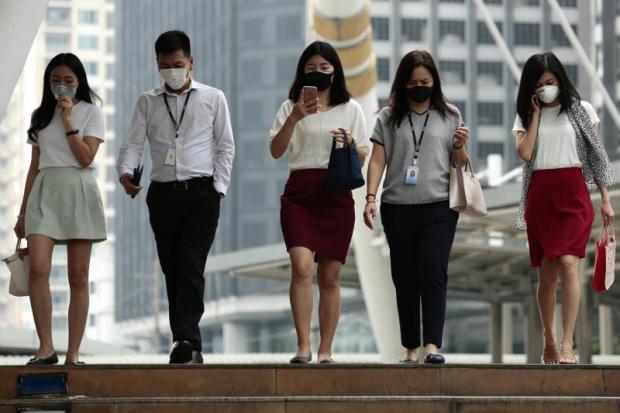
The haze blanketing Bangkok has people wearing face masks to filter fine particulate matter PM2.5, which is now severely hitting Thailand's northern provinces. Layering the face with anti-pollution formulas is another measure to protect the skin.
The environmental crisis has boosted sales of these products, not to mention air purifiers, as well as introduced on-the-go fresh air, which absurdly seems like a gimmick but is relevant in this day and age.
The situation is worsening. Last week, Chiang Mai was reported as the world's worst-polluted city, with its Air Quality Index (AQI) at 230, according to the AirVisual app on March 12 at 4pm.
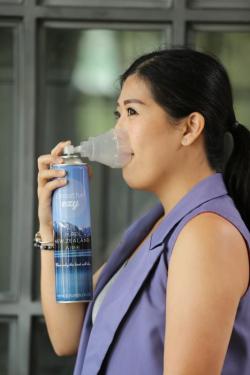
Breathing in a puff of Breathe Ezy Pure New Zealand Air.
It was much higher compared to the second-worst city, Dhaka in Bangladesh, whose AQI stood at 170, while Bangkok, along with Chengdu and Chongqing in China, were also in the top 10.
Without access to quality air, Chinese consumers have already turned to imported and pricey bottled air.
Will an invisible commodity appeal as much to Thais choked by smog?
Launched on Monday in Thailand, Breathe Ezy Pure New Zealand Air contains air collected, triple-filtered and bottled in locations throughout South Island.
The Christchurch-based company has its "air farmers" travelling to various lakes, Mount Cook, the coast and other places to harvest Pure New Zealand Air.
Priced at 960 baht, each pressurised canister has a GPS code that indicates the source, while containing eight litres of pure air for approximately 150 breaths.
The purity of New Zealand air is due to the isolated location, by which the cool westerly trade winds blow uncontaminated air into the country, without passing major land masses or populated areas.
Other air harvesters include Canadian start-up Vitality Air, which captures air in the remote Rocky Mountains; and Green & Clean, offering Australian air sourced from unpolluted locations in the South Pacific.
British company Aethaer sells premium anti-pollution masks and jars of air, collected from pristine sites, such as in Somerset, Yorkshire and Wales.
Critics doubt the health benefits of breathing in a puff of the portable air from a bottle that feels pretty much empty.
But as pollution is clearly here to stay, canned air may not be bogus or a fad, in the same way another basic need -- water -- has become a bottled commodity.