NAGOYA -- Arimatsu means "there are pine trees," but according to the children's book "Arimatsu no Shokuro," written by Naomi Nakagawa, this former town that is now a district in Nagoya City didn't get its name because it had some pine trees. It was because Arimatsu had nothing but pine trees, says the book, which describes the history of the Arimatsu Shibori tie-dyeing produced mainly in the district.
The story of "Shokuro" goes like this: In the beginning of the Edo period (1603-1867), the Owari domain tried to build a new village in a deserted place along the Tokaido road, to assure the safety of the road. Takeda Shokuro and others gathered together from a nearby village, the second and third sons of farmers who didn't have the right of inheritance in those days. However, the place was a hilly area and crops didn't grow.
When Shokuro worked on the construction of Nagoya Castle, he saw a washcloth belonging to a construction worker from Oita dyed using the Bungo Shibori tie-dyeing technique. This gave Shokuro the idea of making tie-dyeing his village's industry. After various efforts, he finally produced Arimatsu Shibori tie-dyeing, which became a big hit. Thanks to this industry, Arimatsu developed and luxurious merchant homes were built in the town.
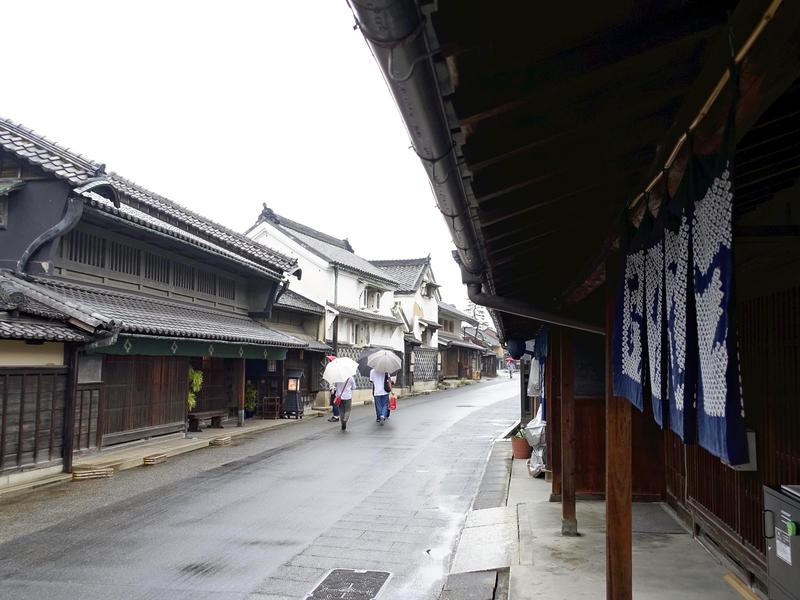
In the book's illustrations, Mika Koshida drew merchant residences crowded with people in the Edo period. These residences remain unchanged in Arimatsu today, making me feel like I was walking in a continuation of the story.
But a story is just a story.
"Because it was new, it was called 'Aramachi [new town],' and some say the current name Arimatsu comes from that," said Akemi Kato, 58, vice chairperson of an Arimatsu guide group. In fact, most of the town's original buildings burned down in a massive fire in 1784 and were reconstructed. So there are buildings constructed in the Edo period, the Meiji era (1868-1912) and the early Showa era (1926-1989).
Yet they all work in great harmony with each other. On both sides of the gently winding Tokaido road are fire-preventative structural elements called udatsu, koshi latticework, mushikomado windows with ultra-fine lattices, onigawara roof tiles and dozo storehouses. A statue of Zhong Kui, a deity that expels evil, is placed on top of roof tiles.
In 2016, Arimatsu was designated by the central government as an Important Preservation District for Groups of Traditional Buildings, and certified by the Cultural Affairs Agency as a Japan Heritage site in May this year. "The town has a calm atmosphere, and anyone can feel relaxed here," Kato said.
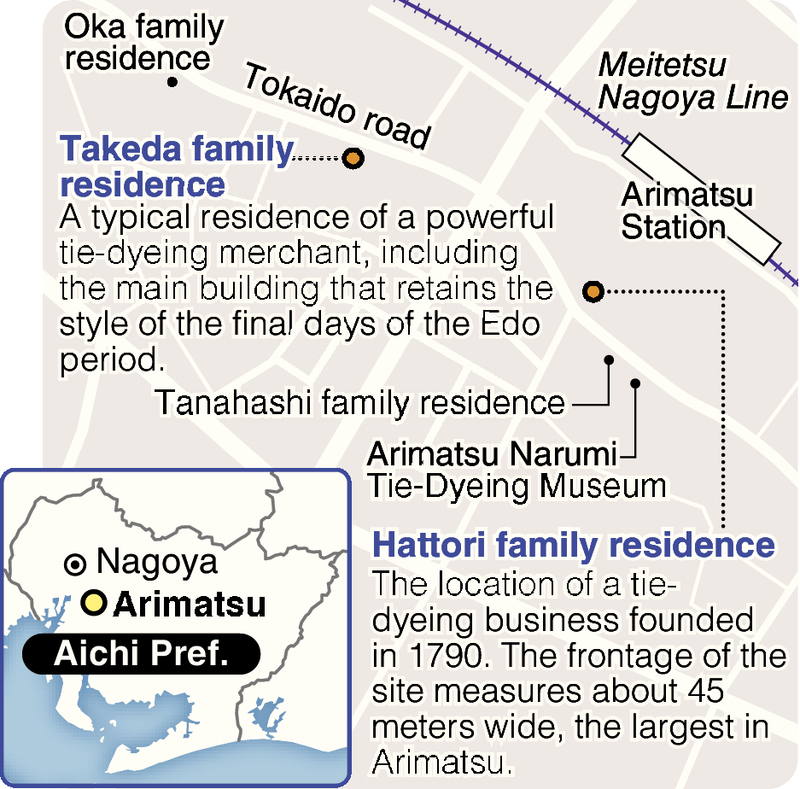
Historical buildings line an about 800-meter stretch of road, it takes less than 15 minutes to walk around the district. However, the town's history is much longer, stretching back 400 years.
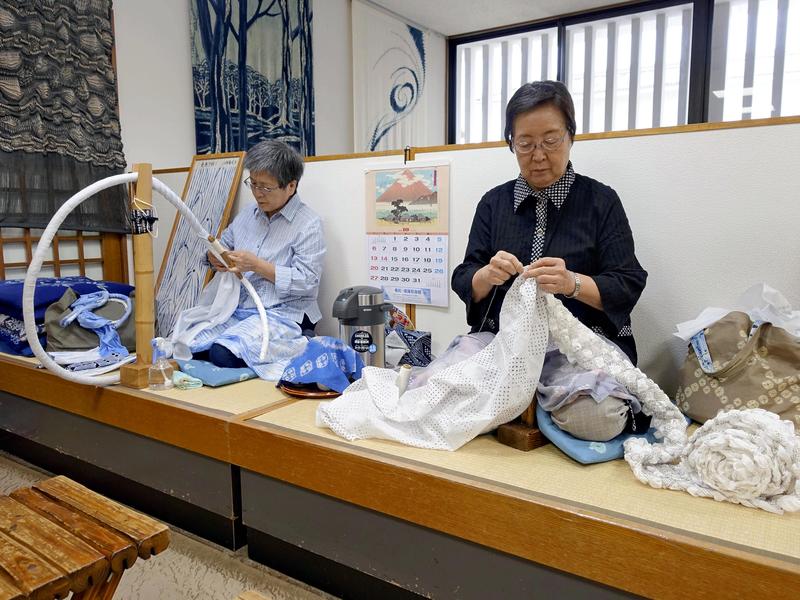
The Arimatsu Narumi Tie-Dyeing Museum gives demonstrations of the Arimatsu tying technique. When I visited there, Sachiko Fukaya and Kiyoko Kobayashi were sticking a needle into cloth. The finished look is determined by how the threads are tied. More than 100 kinds of techniques exist, but there is a rule that each craftsperson uses only one technique.
Fukaya, 78, said: "It's more effective. If a single person uses many techniques, those techniques will be lost if the person dies. The tie-dyeing has lasted for more than 400 years because each person has only one technique."
There used to be about 120 kinds of techniques, but only about 70 remain due to the decline in the number of craftspeople.
I tried the tying technique on a handkerchief. I stitched along a pattern and tied the thread tightly. It took about an hour to finish a simple pattern. The handkerchief was dyed and will be sent to me shortly.
Trying one's hand at the tying technique costs 1,100 yen for a handkerchief, 4,000 yen for a man's T-shirt and 3,400 yen for a woman's T-shirt, all including a fee for watching a demonstration of tying. It takes about three weeks to finish the dyeing, and the tie-dyed item is sent to an address of your choice, which requires an additional shipping fee.
Yuzuke rice with hot water
The Japanese restaurant Yamato is located in a renovated building of Kamihantei, a tie-dyeing wholesaler that was in business for 13 generations. Customers can enjoy a kaiseki meal set (from 5,000 yen) and other traditional Japanese dishes while looking at a landscaped garden.
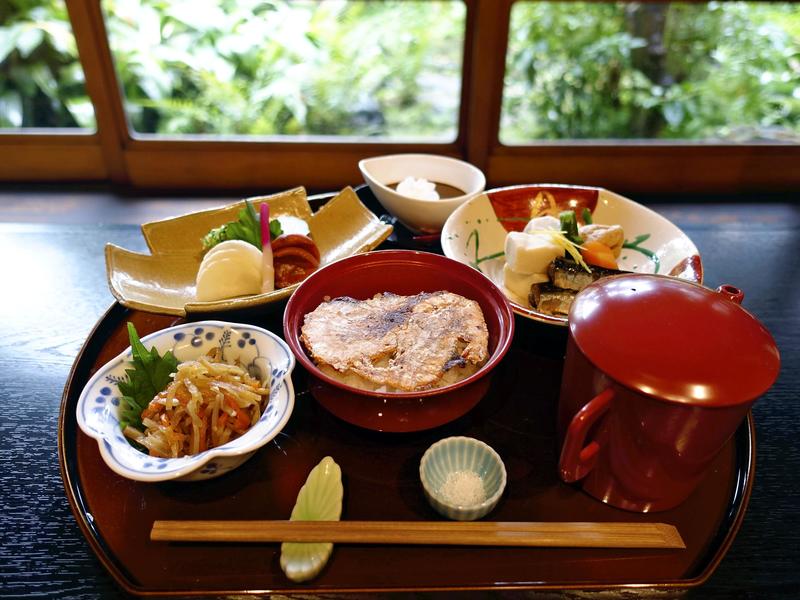
The yuzuke (a bowl of rice with hot water) lunch set involves pouring bancha coarse tea onto rice topped with homemade shrimp senbei rice crackers.
To enjoy the dish even more, break the senbei into smaller pieces and then pour the bancha tea over them and the rice so you can enjoy the flavor of the shrimp and the savory smell of the senbei. For 1,500, yen the set includes yuzuke, a stewed menu item, small dishes of various foods, and Japanese pickles and dessert. The specific ingredients in the dishes vary depending on the season.
Access
It takes 100 minutes by JR Shinkansen train from Tokyo Station to Nagoya Station. Change to the Meitetsu Nagoya Line, on which it takes about 20 minutes by a junkyu (semi express) train to Arimatsu Station.
For more information, call the Arimatsu tourist information office at (052) 626-6030.
Read more from The Japan News at https://japannews.yomiuri.co.jp/