INUYAMA, Aichi -- It all started with the movie "The Graduate." I heard a song by Simon and Garfunkel for the first time while watching the movie, which stars a young Dustin Hoffman.
Through their song "So Long, Frank Lloyd Wright" I was introduced to the leading American architect of the 20th century. Eight of Wright's buildings in the United States were included on UNESCO's list of World Heritage sites in July.
Inspired by Japanese culture such as ukiyo-e, Wright visited Japan seven times and designed several buildings that were constructed in the country, many of which are still standing today. Part of the former main building of the Imperial Hotel, which Wright designed, has been reconstructed and is displayed at Museum Meiji-Mura in Inuyama, Aichi Prefecture.
The former main building was completed in 1923 in the current Uchisaiwaicho in Chiyoda Ward, Tokyo, facing Hibiya Park. The unveiling ceremony on Sept. 1 of that year was canceled because of the Great Kanto Earthquake, which devastated the capital on that day. Miraculously, the building was not seriously damaged.
In the beginning of the 1960s, the decision was made to reconstruct the main building because of aging and to accommodate the increasing number of foreign visitors.
The decision caused the first full-fledged building preservation movement in Japan, but the iconic hotel was demolished by 1968. The central entrance of the former main building is open to the public at Museum Meiji-Mura, an open air architectural museum.
Reflected on the surface of the pond in front of the building, the structure resembles some kind of ancient site.
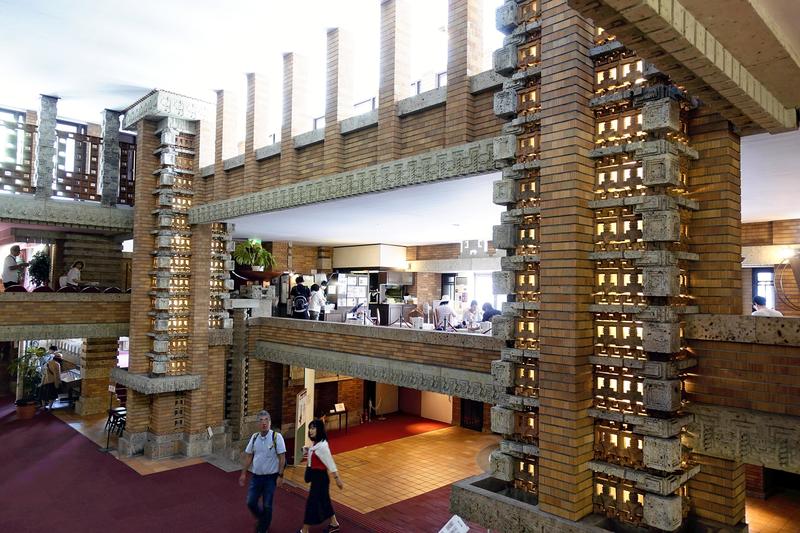
The structure is made up of a combination of rough patterned brickwork, Oya stone produced in Tochigi Prefecture, and unglazed terra cotta. The building's interior features the same raw materials as the facade.
The large pillars supporting the atrium are one of the first things that catch the attention of visitors when they enter the lobby.
Illuminated with the soft light that creeps through the gaps of the terra cotta, the unique space is a harmony of stone, brick and clay.
Yutaka Mizukami, 49, an associate professor at the University of Hyogo and an expert on Wright architecture, shared his thoughts on the architect's possible intention: "A part is for a whole and a whole is for a part. Wright, who regarded nature as his mentor, valued a sense of unity in which the whole and the part resonate together."
Novel cuisine
"Shokudoraku (gourmand)," a novel written by Gensai Murai, was one of the best-selling books in the Meiji era (1868-1912).
It is a romance in which a literary student with a big appetite who is engaged to be married falls in love with another woman who can cook well. The story also features recipes for Western dishes and other kinds of cuisine.
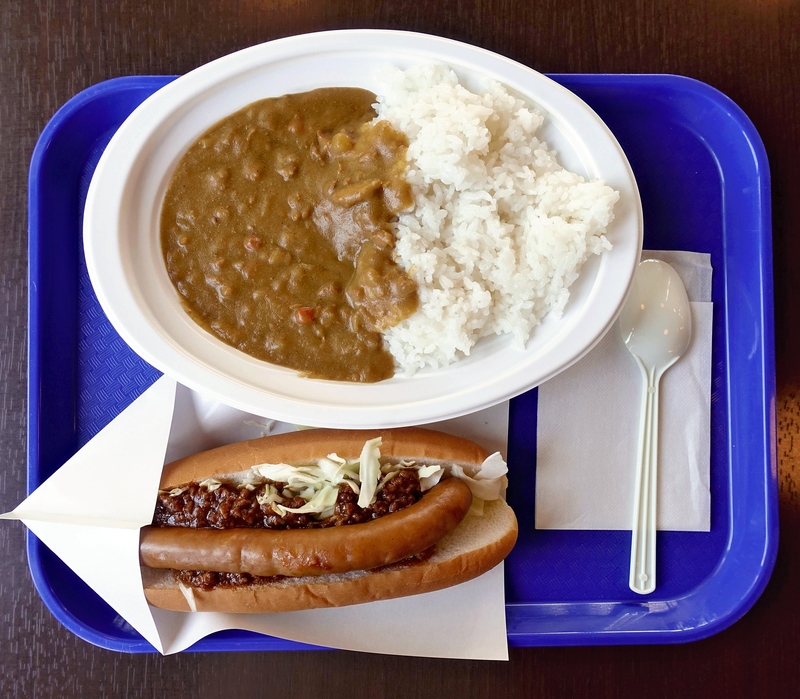
Shokudoraku no Cafe in the Museum Meiji-Mura serves meals related to the novel, such as a curry dish priced at 750, yen and a hot dog with hashed beef priced at 500 yen.
"The dishes are based on recipes from 'Shokudoraku' but are given modern twists," the museum's restaurant manager said.
Curry breads and croquettes inspired by the novel are also available.
Developing new products "is how we can attract visitors," said Yukari Kani, 26, who is in charge of food and drink sales at the museum.
She recommended the St. Francis Xavier's Cathedral candy (490 yen per package), which includes sweets bearing the image of the famous missionary and a stained glass window of the cathedral.
"Everybody is familiar with his face, as they've seen it in history textbooks at least once," Kani said.
The cathedral, which has a typical Gothic structure with a large rose window, was built in 1890 and later relocated from Kyoto to the museum.
Old castle town
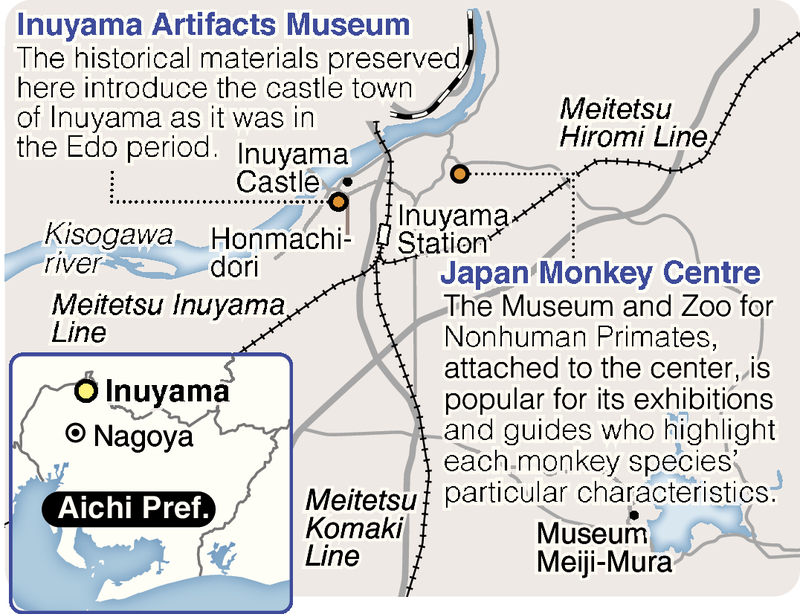
Another famous example of Japanese architecture can be found in Inuyama City.
Inuyama Castle, which stands on a small hill along the Kisogawa river, was completed in 1601. The tenshu main tower keep is a national treasure along with the castles of Matsumoto, Hikone, Himeji and Matsue. Admission is restricted until the end of December because of restoration work.
A row of shops selling sweets and souvenirs line the scenic Honmachi-dori Street that leads up to Inuyama Castle.
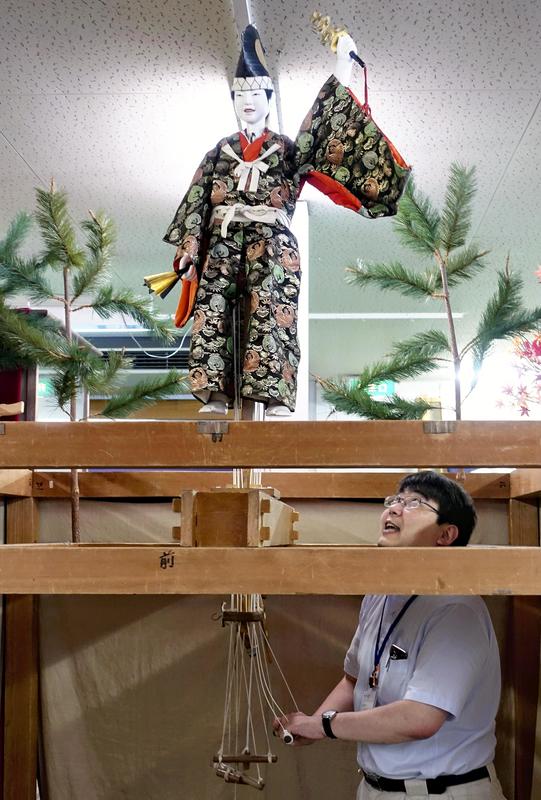
On weekends and holidays, there are demonstrations of karakuri mechanical dolls at the Karakuri Exhibition Room, an annex across the street from the Inuyama Artifacts Museum.
"The mechanism inside karakuri dolls includes gears and cams that are similar to that of modern robots," said Yasumasa Hayashi, 31, a part-time employee at the hall.
Access
The JR Tokaido Shinkansen from Tokyo to Nagoya takes about one hour and 40 minutes. It takes about 30 minutes from Nagoya Station to Inuyama Station on the Nagoya Railroad Meitetsu Inuyama Line. Museum Meiji-Mura is about 20 minutes by bus from the station.
For more information, call the Museum Meiji-Mura at (0568) 67-0314, or the Inuyama Tourist Information Center at (0568) 61-6000.
Read more from The Japan News at https://japannews.yomiuri.co.jp/