
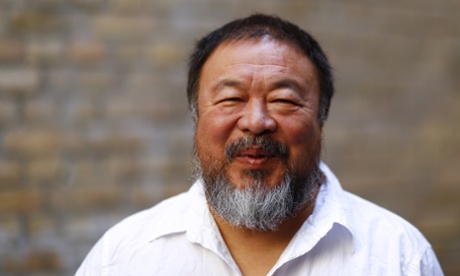
That's all for today!
Thanks to Ai Weiwei for his time and his brilliant answers, and to everyone who submitted questions. Until next time!
"Censorship works: [Chinese students] have never heard of me, or heard of the Tiananmen massacre in 1989"
ID9191105 asks:
I teach in a High School in Nanjing China. Not one of my 16-17 year old students know who you are. How do you feel about that?
ID3413518 asks:
Do you think you would be feted and lauded by the West if you weren’t perceived as a “victim” of Beijing policies?
 Guardian contributor
 I think that's incomplete. Many people have been treated that way in past decades, and many people are much more badly treated than me. They or their family would lose their lives, or suffer. That is to say, only being treated bad would not necessarily bring you recognition. As an artist I am very keen on communication and expressing myself; I have made a steady effort to protect freedom of speech, which helps China and its people to come into the modern age. That is what is being recognised, not just Ai Weiwei as a person.
"My greatest joy is talking to people I don't know on the internet"
MKArtLover asks:
What brings you joy?
Guardian contributor My greatest joy is talking to people I don't know on the internet! I love it because it's purely focussed on discussion, and is very abstract. I was talking on Twitter 24 hours a day in 2009, after they shut off my blog and before I got arrested, and for a moment I had the illusion that I would generate a revolution by myself. It was a riot.
Updated
aiweiwei2015 asks:
I want to learn more about the topic “crises” in many different ways.
That’s why I ask you to tell me something about it:
What does the term “crisis” mean to you?
Can you tell me something about a crisis in which you were involved?
How did the crisis end?
What did you learn from it?
Guardian contributor My crisis would be only one, even though I've gone through very many difficult moments. For art history and for humans, the real crisis is how you identify your existence, or recognise the possibility life has given. Sometimes you find out that the boundaries are impassable. That struggle and effort is the one. It can't be separated from experience, knowledge or wisdom, because they're all interrelated. Old experiences could be very bad, but offer possibilities for new ones. I once said that art is not the end, but always the beginning. All those difficult moments give me a unique opportunity to rethink my position and come up with a solution, which mentally I needed to overcome. For example, after my detention the govemment gave me a big tax fine, 15m yuan, over £1m. To anybody, this would be devastating. But it was a good opportunity, so I put that in the public domain and it generated a great discussion. Within 10 days, we accepted donations of 9m yuan from the public, which gave us the chance to pay a deposit which then gave the chance to take the Chinese government to court. That happened so spontaneously and was so successful. People always say that was their first chance to cast a vote. The money they donated is their first democratic act.
"I couldn't even imagine not having gone to New York. I felt totally free there, and I was poor but desperate"
PlainClothes asks:
How different would life be for you now if you had not been to New York when you were younger?
Guardian contributor It would be a disaster. I met Allen Ginsberg in a poetry reading there in St Mark's church, when he'd just come back from China where he had met my father. They're both poets, and my dad hugged him, which made Allen very happy. We became friends. I couldn't even imagine not having gone to New York. I felt totally free there, and I was poor but desperate. I had many jobs in the United States, from construction to house-cleaning, even babysitting.
jlcontreras asks:
Other than China, what other country would you like to permanently live in and why?
Guardian contributor It's hard for me to say, because my experience with other locations are so superficial and limited. Germany is a place which gave me a great help when I was in extreme conditions: in 2011 and even before that, Germans are persistently asking or demanding my rights. I halfway live there now, because I teach in Berlin. I haven't totally got into its art scene yet, in the few weeks since I got my passport back, but there's a lot of young artists and it's lively - and the rent is cheap!
David “Edenapple” Chu asks:
What is one thing you would like to change about the Chinese government?
Guardian contributor The change would only happen when the leaders become conscious about how China as a society would function when the individual's rights are recognised. That's just not the political environment, but rather a necessity for survival economically and culturally. First they have to be a society ruled of law rather than ruled by law, so nobody is above the law. And second, to really have an election. And to really have freedom of media, so people can state their mind and can examine the government's performance.
ID5492842 asks:
Is mainland China more democratic now than 30 years ago?
Guardian contributor Compared to 30 years ago, it has a broader law establishment. But the authorities very often violate the law that they established. That's very common on every level. Even China has been much modernised, but its communist structures are still the same as half a century ago. That has nothing to do with democracy. Even within the party, there are no democratic procedures. That affects everybody in society. Everyone is scared to give their opinions. People are supposed to make contributions to society - to be creative - but they're not able to. Their voices cannot be heard, and if they are creative, they can be hurt or damaged because of their opinions.
"In China there are 100,000 so-called 'internet police'. They're purposefully misleading, which distracts from the real topics people wish to discuss. In China, that's a profession"
Geraint Duckfield asks:
What’s the one thing that you hope your art has achieved through your career and if there is, was this something you set out to achieve when you first moved into art?
Guardian contributor I think my biggest achievement is communication between me and the audience which is not done totally through the traditional media, but with social media, writing, interviews and political analysis. I had to overcome the difficulties in China: there, all the social media from the west is blocked, and you have to use a very special VPN to get over the firewall. But still, very few people can do that. The first and most active group of people who got involved with criticising China online were people in technology, as information from the west was so crucial to them. My blog was shut down in China in 2009, and your name's been forbidden in Chinese search engines since then. If you search for me, it says: 'sensitive or unlawful words have been used'. I've heard they've loosened up recently. Maybe they think they cannot really block it, because people can paste information from outside China on to our social media. In China there are 100,000 so-called 'internet police': we call them the 50 cents army because everything they put on the internet could well earn them 50 cents. They get paid per month by how many propaganda topics they put on the internet. They're purposefully misleading, which distracts from the real topics that people wish to discuss. In China, that's a profession.
Updated
"Duchamp is the artist I have been influenced by. He liberated art from the studio"
Golub2 asks:
Which Western artists, if any, inspired your creativity early in your career and which other artists from around the world today are some of your current favourites?
Guardian contributor Hello! I always have to say Duchamp is the artist I have been influenced by, as of course have many many other artists. He liberated art from the studio, and took from poetry, dadaism, surrealism, and language, and poetry was very important to him. His lifestyle related to art, which was more natural. When I started making 'so-called' art I paid attention to life and literature, all different things.
Updated
Ai Weiwei is with us now – and he's topless
And he is exposing himself to your questions.
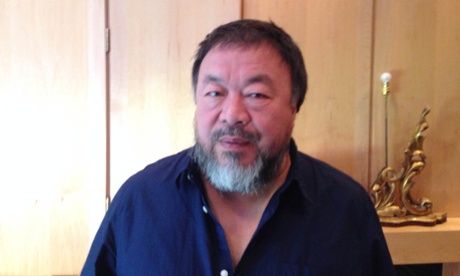
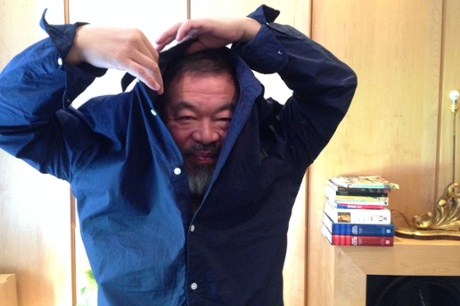
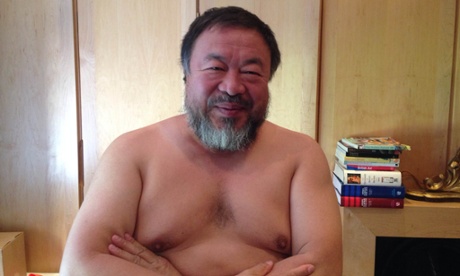
Let’s kick things off!
Updated
Post your questions for Ai Weiwei
From his vast sea of sunflower seeds in Tate Modern, to his vision for the Bird’s Nest stadium in Beijing, Ai Weiwei’s art is arresting in its scale, moving in its humanity, witty in its iconoclasm – and strident in its politics.
His art and campaigns – including the naming of students killed by substandard buildings collapsing in an earthquake – have attracted the ire of the Chinese authorities, who have destroyed his studio, beaten and imprisoned him. He was also banned from leaving China, and only received his passport back in July this year. He is now in London to launch his latest exhibition, opening at the Royal Academy on 19 September, which features works from across his career as well as new installations.
He is joining us to answer your questions about anything in his life and work, in a live webchat from noon BST onwards on Friday 11 September. Post them in the comments below, and he will answer as many as he can.














I think I feel sorry that my voice still hasn't got through, and I will continue to make the effort, especially for young people in schools, so that people can hear from me. That's obviously a result of Chinese censorship. Censorship works: they have never heard of me, or heard of the Tiananmen massacre in 1989. They don't know that my father and hundreds of other intellectuals were punished with hard labour in 1957. And in the cultural revolution later, the chairman of China was disappeared and suffered death. They changed his name, and nobody to this day knows what happened to him. There's no excuse for ignorance, and that's the shame of the society. Thank you