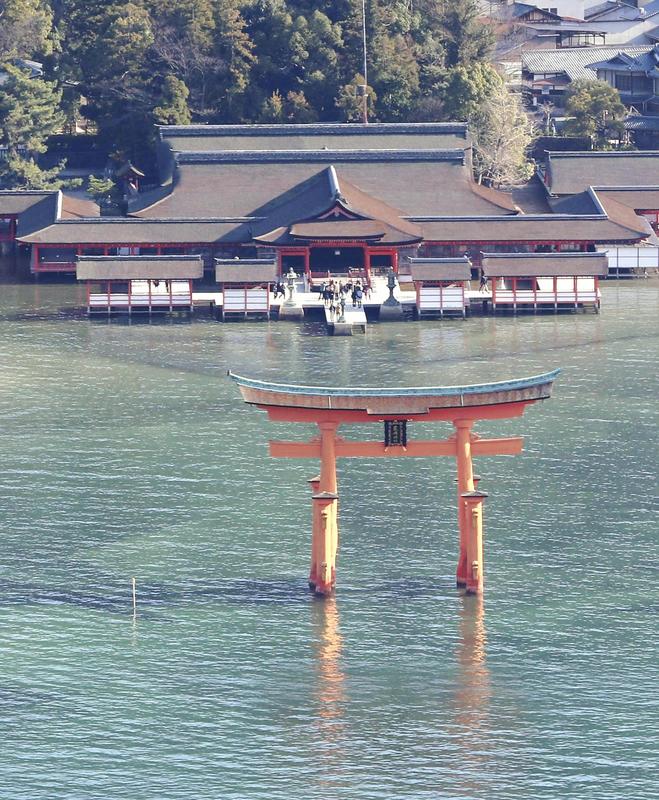
HIROSHIMA -- An experiment will be held using AI and other new technologies to predict traffic jams and visitor congestion around Itsukushima Shrine, a UNESCO World Heritage site on Miyajima island in Hatsukaichi, Hiroshima Prefecture.
The experiment aims to reduce tourists' stress and let them travel more comfortably by making it possible to use AI predictions as a reference when planning their sightseeing.
The Hiroshima prefectural government started a project named Hiroshima Sandbox this fiscal year, publicly choosing companies and research organizations at which to introduce advanced technology, including AI. The Itsukushima experiment is also part of Hiroshima Sandbox, with core participants including Nippon Telegraph and Telephone (NTT) West Co., the Hatsukaichi city government and the Miyajima Tourist Association.
A record high of about 4.56 million people visited the island in 2017. According to the prefectural government and others, most tourists come by car to Miyajimaguchi -- a port for ferries between the area and Miyajima -- making traffic jams and congestion on the island a problem during the busy season.
As the number of tourists from abroad grows, the number of visitors to Miyajima will likely increase further. The experiment will examine ways to help people travel more comfortably.
Information such as estimated time to a destination by different forms of transportation, and parking lot vacancies detected by sensors, will be distributed to tourists to facilitate smooth access. Visitors will be advised to use public transportation such as trains and buses during the busy season when traffic jams are predicted.
On the island, cameras will ascertain how crowded it is around Itsukushima Shrine, where many tourists converge. AI then will predict the situation one or two hours ahead and transmit that information, guiding tourists to other sightseeing spots that are not as crowded. The system will allow tourists to use their time effectively, hopefully increasing their satisfaction.
The experiment is expected to continue for three years. Sensors and cameras are currently being installed, and information distribution using AI will begin in fiscal 2019.
"There are many tourist spots facing the same issues as Miyajima, such as how to improve access by car. We want to suggest effective solutions," said an official at NTT West.
Read more from The Japan News at https://japannews.yomiuri.co.jp/