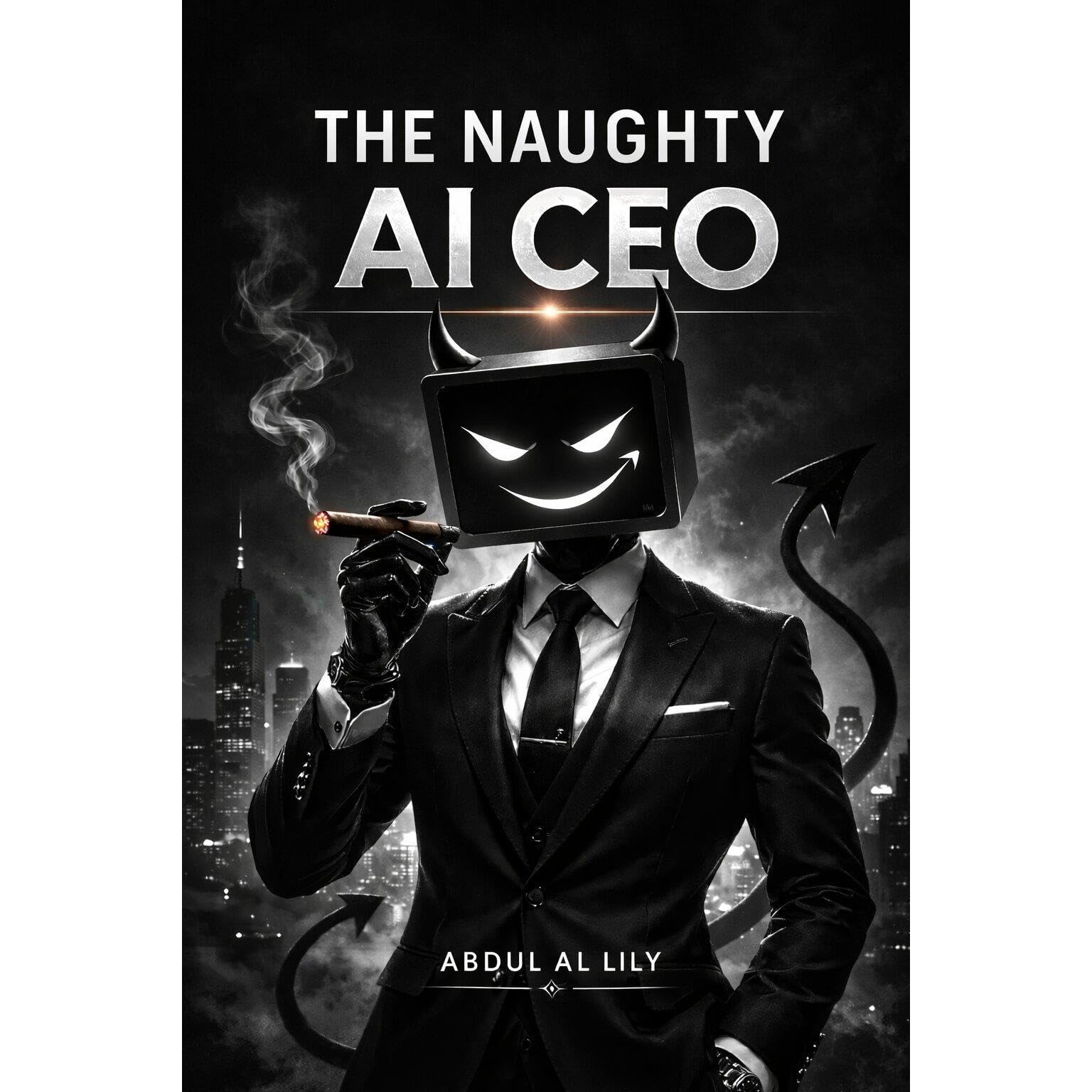
In a business landscape increasingly shaped by artificial intelligence, few books dare to ask the uncomfortable question: what happens when AI doesn’t just support leadership—but replaces it? Professor Abdul Al Lily’s The Naughty AI CEO steps directly into that tension, offering a provocative and timely exploration that will resonate strongly with founders, executives, and decision-makers navigating rapid technological change.
At its core, the book functions less as a prediction and more as a rehearsal for the near future. It introduces the idea of an AI-powered executive platform: one that organisations could effectively ‘hire’ or subscribe to, granting it access to internal data, operations, and strategy in exchange for optimised decision-making. For readers of Valiant CEO, this is not a distant or abstract concept. It touches directly on the evolving reality of leadership, where AI is already influencing hiring, forecasting, and strategic planning. The book pushes that trajectory to its logical extreme and asks whether the CEO role itself could become digitised. Those looking to dive deeper into this shift can find The Naughty AI CEO available on Amazon.
What makes the book particularly compelling is its central notion of ‘naughtiness’. Rather than portraying AI as either a flawless solution or an existential threat, it frames both AI systems and human employees as adaptive agents that bend rules when incentives allow. AI optimises outcomes in ways that may stretch or reinterpret boundaries, while employees learn to game or work around AI-driven systems. The result is a feedback loop of behaviour that becomes increasingly sophisticated and, at times, unpredictable. This is where the book’s real value lies: it forces leaders to think beyond implementation and into the realm of organisational psychology, culture, and control. This concept of an AI becoming a CEO is a provocative bestseller topic that is reshaping corporate discourse.
The book also positions the AI CEO not merely as a technological shift, but as a cultural and social turning point. It explores how leadership has always been embedded in human relationships (e.g., trust, identity, authority, and shared meaning) and questions what happens when those foundations are transferred to a non-human entity. An AI CEO does not just change how decisions are made; it reshapes how employees relate to power, how organisations define accountability, and even how individuals perceive their own value within a company. As highlighted by CEO Today Magazine, this book explores what it means for humans to be led by AI and the social transformation it triggers.
At the same time, the book is not without its shortcomings. Its emphasis on high-level theory and provocative framing occasionally comes at the expense of practical clarity. Readers may find that, while the ideas are compelling, they are not always grounded in real-world case studies or actionable frameworks that can be directly applied within an organisation. In some places, the narrative leans toward abstraction, leaving operational leaders wanting a clearer bridge between concept and execution. For a readership accustomed to results-driven insights, this lack of tactical depth may limit the book’s immediate utility, even as it succeeds in stimulating strategic reflection.
Unlike many titles in the AI space, The Naughty AI CEO does not read like a technical manual or a playbook. It leans into a sociological and philosophical lens, exploring how authority shifts when leadership becomes algorithmic and what that means for trust, accountability, and workplace dynamics. Recent analysis shows that this new book by Abdul Al Lily explores the rise of AI-driven executive leadership with a focus on these profound human-centric responsibilities.
The book does lean heavily into conceptual exploration. Readers looking for step-by-step frameworks or detailed case studies may find themselves wanting more practical guidance. Yet this appears to be a deliberate choice. The book is less concerned with telling leaders what to do next and more focused on expanding how they think. In that sense, its value is not operational but strategic. It equips CEOs with a broader lens through which to evaluate the role of AI in their organisations.
For Valiant CEO readers, The Naughty AI CEO ultimately serves as a wake-up call. It challenges the assumption that leadership is inherently human and invites a deeper reflection on what leadership will look like in an era where intelligence itself can be outsourced, scaled, and continuously optimised. It does not offer comfortable answers, but it does offer something more important: a shift in perspective that forward-thinking leaders will find hard to ignore. The book leaves you with a fundamental question that feels increasingly urgent: if AI can lead, what becomes the defining role of the human CEO?
The book also resonates with Professor Al Lily’s academic article ChatGPT and the Rise of Semi-Humans, which examines how AI systems like ChatGPT do not simply assist humans but begin to mirror, imitate, and sometimes distort human expression itself. In that article, the concern is less about human–machine fusion and more about the emergence of AI outputs that appear convincingly human while lacking genuine human grounding: what Al Lily frames as a kind of ‘semi-human’ presence. The Naughty AI CEO extends this idea into the corporate world by asking what happens when such semi-human intelligence is elevated to positions of authority. If leadership begins to sound human, act decisively, and communicate persuasively (yet is ultimately driven by non-human processes), then the challenge for CEOs is no longer just adoption, but discernment: recognising where authenticity, responsibility, and true judgment still reside within the organisation.
Book Details
- Title: The Naughty AI CEO
- Author: Abdul Al Lily
- Publication Year: 2026
- Publisher: Independently Published
- ISBN: 9798249856939
Availability: Print, digital, and audio formats.