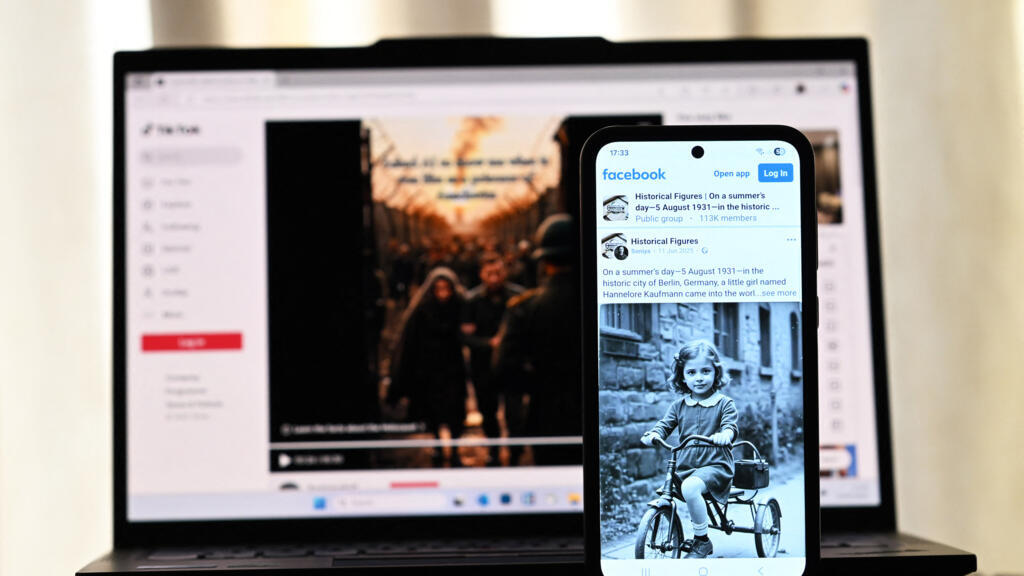
On Holocaust Remembrance Day, experts warn that a surge in clickbait and AI-generated images threatens the integrity of records of the Holocaust, as the number of remaining survivors able to share genuine testimonies grows ever smaller.
A little girl with curly hair on a tricycle is presented as Hannelore Kaufmann from Berlin, who purportedly died at the age of 13 at the Auschwitz extermination camp, the 1945 liberation of which by Soviet troops is commemorated today,Tuesday.
However, there is no record of her ever having existed.
The image is part of a wave of AI-generated content about the Holocaust that can be seen on social media platforms.
As the world marks International Holocaust Remembrance Day, experts warn that such content – whether produced as clickbait for commercial gain or for political motives – threatens efforts to preserve the memory of Nazi crimes during the Second World War, including the murder of 6 million European Jews.
French news agency AFP has noted a surge of such imagery on social networks. Another example is an image created to illustrate the invented story of a Czech violinist called "Hank" at Auschwitz-Birkenau, which was called out as fake by the camp's museum.
With early examples emerging in the spring of 2025, by the end of last year "AI slop" on the subject "was being shown very frequently", historian Iris Groschek told AFP.
On some sites such content was being posted once a minute, said Groschek, who works at memorial sites in Hamburg, including the Neuengamme concentration camp.
With the exponential advances in AI, "the phenomenon is growing," said Jens-Christian Wagner, director of the foundation that manages the Buchenwald and Mittelbau-Dora concentration camp memorials.
AI technology used to distort Holocaust history, UN body warns
Exploiting 'emotional impact'
Several Holocaust memorials and commemorative organisations this month issued an open letter warning about the rising number of these "entirely fabricated" pieces of content.
Some, it said, are churned out by content farms which exploit "the emotional impact of the Holocaust to achieve maximum reach with minimal effort".
An AI-generated picture of an emaciated man standing in the snow at Flossenbürg concentration camp is one example of an image shown on a page claiming to share "true, human stories from the darkest chapters of the past".
The memorials warned that fake content was also being created "specifically to dilute historical facts, shift victim and perpetrator roles, or spread revisionist narratives". Wagner points to images of "well-fed prisoners, meant to suggest that conditions in concentration camps weren't really that bad".
The Frankfurt-based Anne Frank Educational Centre warned of a "flood" of AI-generated content and propaganda "in which the Holocaust is denied or trivialised, with its victims ridiculed".
'Concrete consequences'
By distorting history, AI-generated images have "very concrete consequences for how people perceive the Nazi era," says Groschek.
The results of trivialising or denying the Holocaust can be seen in the attitudes of some younger visitors to the camps, said Wagner, particularly those from "rural parts of eastern Germany... in which far-right thinking has become dominant".
Staff at memorials have observed Hitler salutes as well as other provocative and disrespectful actions and comments.
Such behaviour is only "by a minority, but a minority that is increasingly confident, loud and aggressive", Wagner told AFP.
Roma push France to recognise Holocaust-era genocide
In their open letter, the memorials called on social media platforms to "proactively combat AI content that distorts history" and to "exclude accounts that disseminate such content from all monetisation programmes".
German Culture Minister Wolfram Weimer said in a statement to AFP: "I support the memorials' call to clearly label AI-generated images and remove them when necessary. This is a matter of respect for the millions of people who were killed and persecuted under the Nazis' reign of terror," he said.
He reminded social media platforms that they had "obligations" under the EU's Digital Services Act, and said that making money from such imagery should be prevented.
Groschek said that none of the American social media giants had responded to the open letter – including Meta, the owner of Facebook and Instagram.
Chinese-owned platform TikTok responded by saying it wanted to exclude the accounts in question from monetisation and implement "automated verification".
Petain tribute comments raise 'revisionist' storm in France
'Soon, there will be no eyewitnesses left'
These concerns come as the community of Holocaust survivors is rapidly shrinking.
There are an estimated 196,600 Jewish Holocaust survivors still alive globally, down from 220,000 a year previous, according to information published last week by the New York-based Conference on Jewish Material Claims Against Germany.
Their median age is 87, and nearly all – some 97 percent – are “child survivors” who were born from1928 onwards, the group said.
Henri Borlant, the only survivor of the 6,000 Jewish children from France deported to Auschwitz in 1942, died in December 2024 at the age of 97.
At the annual Holocaust Remembrance Day gathering at the upper house of the Czech Parliament, Pavel Jelinek, a 90-year-old survivor from the city of Liberec, which had a pre-war Jewish population of 1,350, told those gathered that he was now the last of the 37 Jews who returned to the city after the war still alive.
'Rails of memory' Holocaust memorial opens in French city of Lyon
In London, a Holocaust survivor on Tuesday addressed the British Cabinet. Government members wiped away tears as 95-year-old Mala Tribich described how Germany's invasion of Poland in 1939 destroyed her childhood.
She recalled being forced into hard labour at the age of 12, as the first Nazi ghetto was established in her hometown of Piotrkow Trybunalski, and spoke of the hunger, disease and suffering there.
The Nazis murdered her mother, father and sister. She was sent to Ravensbrück camp and then to Bergen-Belsen, which was liberated by the British Army in April 1945.
She urged the Cabinet members to fight anti-Semitism, saying: “Soon, there will be no eyewitnesses left. That is why I ask you today not just to listen, but to become my witness.”
(with newswires)