
Nearly 9 million workers could potentially be affected by generative artificial intelligence (GenAI), according to estimates by the National Economic and Social Development Council (NESDC).
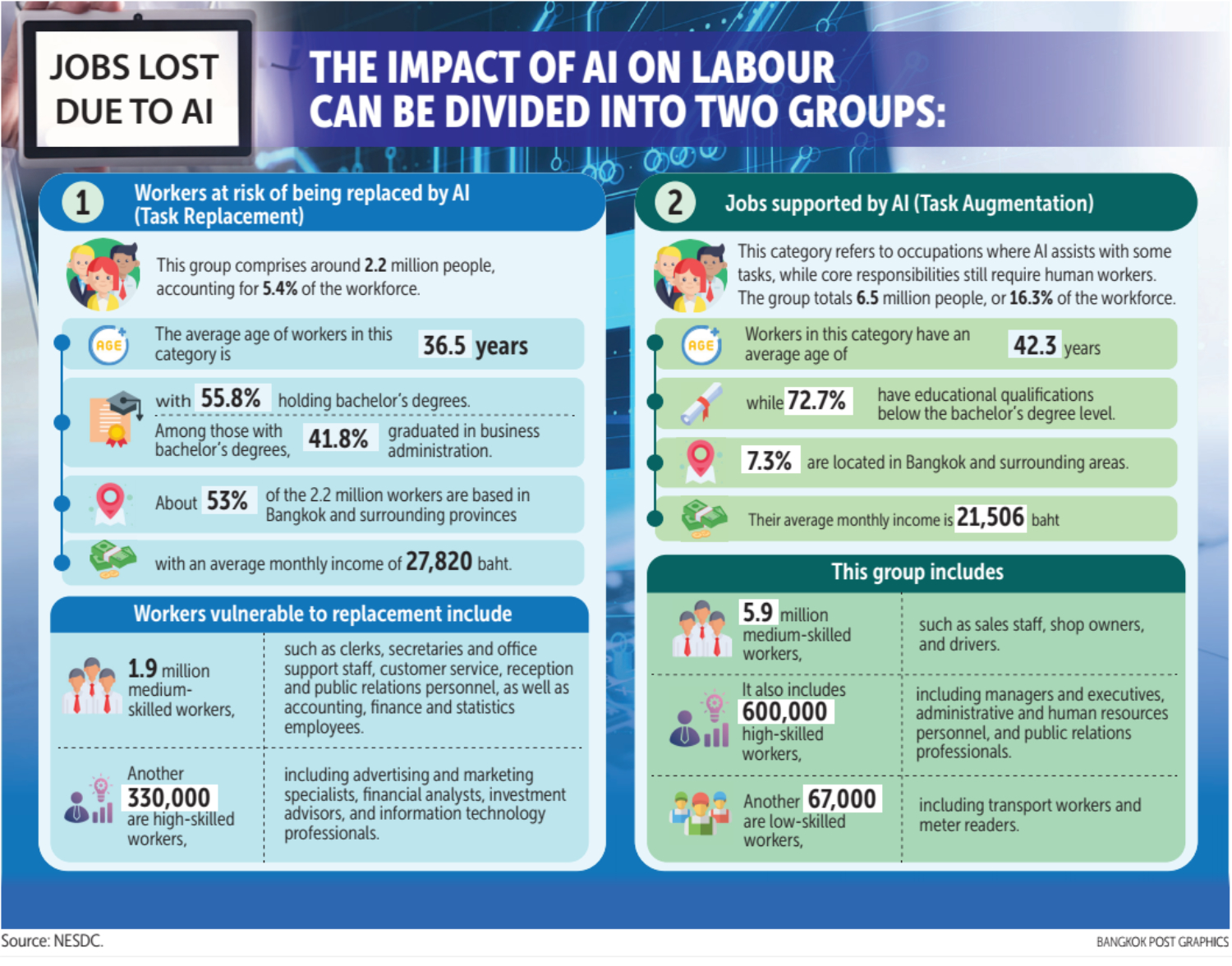
Speaking during a briefing on Thailand's social conditions in the first quarter of this year, Danucha Pichayanan, secretary-general of the NESDC, said the council applied the occupational risk assessment model for GenAI developed by Gmyrek et al (2025), using data from the Labour Force Survey for the fourth quarter of 2025. Out of Thailand's total workforce of 40.1 million people, around 8.7 million workers, or 21.8% of the national labour force, were identified as being at risk of being affected by GenAI.
He said it was undeniable that some professions will be impacted by AI, and that the government has been implementing upskilling and reskilling programmes for workers. Universities have also adjusted their curriculums to mitigate the impact of AI on new graduates entering the workforce.
Thailand's unemployment rate in the first quarter of 2026 stood at 0.94% of the total labour force, equivalent to 390,000 people, up by 9.9% from the same period last year.
Nevertheless, employment in the first quarter expanded by 4.6%, driven by a recovery in the agricultural sector and continued growth in non-agricultural sectors.
Wholesale and retail trade recorded the strongest employment growth, followed by transportation and warehousing, and manufacturing. Meanwhile, average wages declined by 0.6% to 16,145 baht per person per month.
According to the latest available data for the fourth quarter of 2025, household debt rose by 0.05% to 16.4 trillion baht, equivalent to 86.7% of GDP. Data from the National Credit Bureau showed that non-performing personal loans overdue by more than 90 days totalled 1.31 trillion baht, representing 9.59% of total loans, up from 9.45% in the previous quarter.
Mr Danucha said that the household debt burden stems more from consumers' inability to restrain spending desires than from their actual financial limitations.
"We should avoid taking on debt at this time, given the economic constraints and uncertainties ahead," he said, adding that the emergence of virtual banks may also require close monitoring over the risk of rising debt levels, citing China as an example where some borrowers were found to have fallen into debt cycles more easily, while in the Philippines digital banks were reported to have higher non-performing loan (NPL) ratios than traditional banks.
MICRO ENTREPRENEURS
Charnwit Boonchuay, president of the Artificial Intelligence Entrepreneurs Association of Thailand, said the projection that AI could affect up to 9 million jobs is reasonable and consistent with global trends, particularly as agentic AI increasingly helps automate routine and procedural work while improving efficiency.
He said that Thailand cannot rely solely on large corporations to absorb displaced workers, as businesses are not expanding quickly enough or creating sufficient new jobs. Traditional sectors such as manufacturing and agriculture are also unlikely to accommodate such a large labour shift.
Instead, Thailand should focus on creating a new generation of micro-entrepreneurs.
"AI is dramatically lowering barriers to entry, allowing small businesses run by just one or two people to generate income beyond that of traditional full-time employment," he said.
To support this transition, the government should provide free AI infrastructure, particularly AI inference servers, to allow people to experiment, learn and build AI-driven businesses without high upfront investment.
He compared the idea to how global technology companies provide free cloud credits to startups.
Mr Charnwit said building AI-driven micro-businesses does not necessarily require formal expertise in science or artificial intelligence, as AI tools can increasingly assist with coding and technical tasks. Instead, success depends more on personal interest, adaptability and willingness to learn.
For older workers aged 45 and above, he said their key advantages are deep industry knowledge and soft skills.
They could adapt by using AI to scale their existing expertise, partnering with younger workers or moving into consulting roles. Some may also transition into emerging sectors such as training AI models using accumulated professional knowledge -- an approach already gaining traction in China.