Dozens of Projects Scrapped Amid Grid Strain, Community Pushback, and Regulatory Pressure
The United States is building AI data center infrastructure at a pace not seen since the interstate highway program, and the strains are beginning to show.
Sixty-one major AI data center projects have been cancelled or placed on hold across the country over the past 15 months, according to the data from Blackridge Research’s data center project database. The figure reflects growing pressure from grid capacity limits, local opposition, and regulatory requirements that are beginning to complicate timelines across key markets.
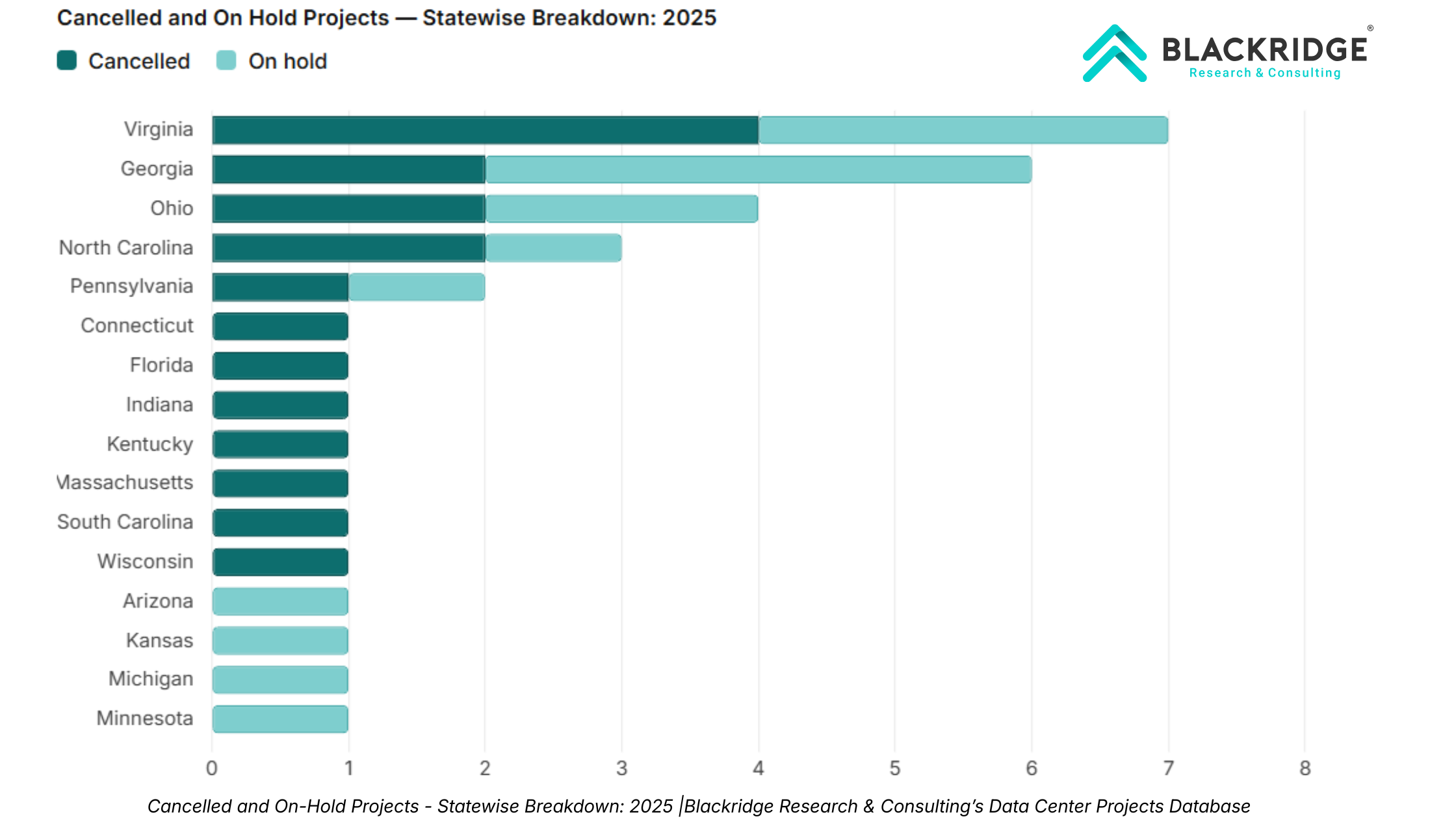
In 2025, Virginia led all states with seven disrupted projects, including four cancelled and three on hold, as the state's data center market ran up against transmission limits. Georgia and Ohio followed. By the first quarter of 2026, the disruptions had widened, with Illinois recording five cancellations in a single quarter, the highest of any state in either period. Georgia continued to accumulate delays while Texas, long viewed as a favorable market for large-scale projects, saw three cancellations tied to interconnection backlogs at ERCOT.
2025: STATE-BY-STATE DISRUPTIONS
Virginia and Georgia led cancellations in 2025, driven primarily by grid saturation and concerns over residential rate increases. Ohio and North Carolina followed, while a number of other states recorded one project disrupted each across both categories.
Virginia's situation reflects the scale of its buildout. The state hosts nearly 600 announced or developing data center facilities and has seen projected residential electricity bill increases tied directly to the infrastructure costs of accommodating large-scale data center load. State legislators responded with HB 2084, which introduced cost transparency requirements and special utility rate structures.
Q1 2026: DISRUPTIONS SPREAD TO SECONDARY MARKETS
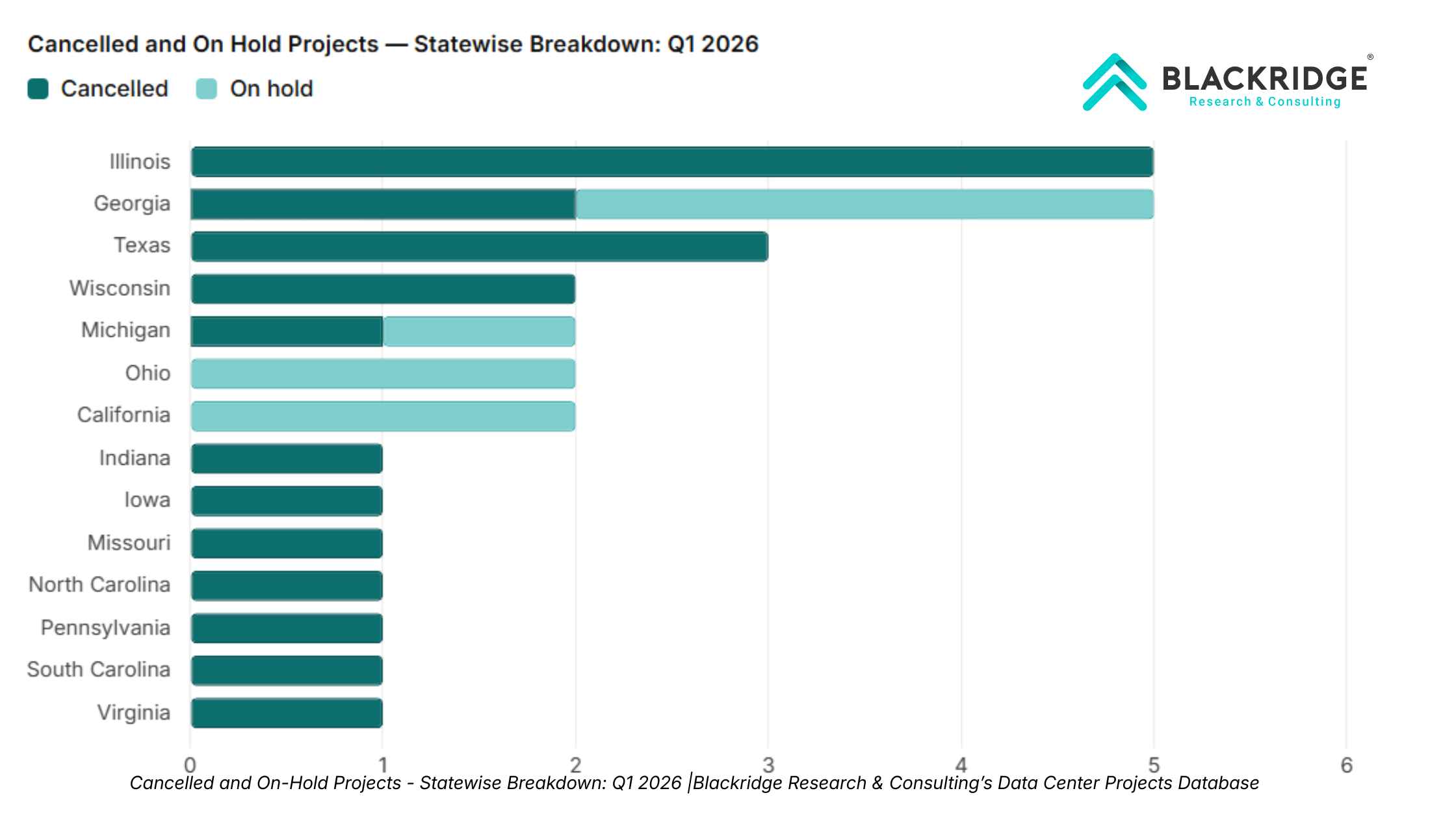
The first quarter of 2026 brought a notable shift. Illinois, which had been considered a growth market with 142 announced developments and projections of 240,000 construction jobs, recorded five cancellations in three months. Community opposition in suburban counties, water use regulations in the Chicago area, and utility interconnection complications each contributed.
Texas recorded three cancellations tied almost entirely to ERCOT interconnection delays. California and Ohio each had two projects placed on hold, linked to grid impact review requirements and water efficiency mandates introduced by state legislation. The pattern across both periods points to a broadening of disruptions beyond the most saturated coastal and mid-Atlantic markets.
MARKET STRUCTURE: CONCENTRATION AT THE TOP
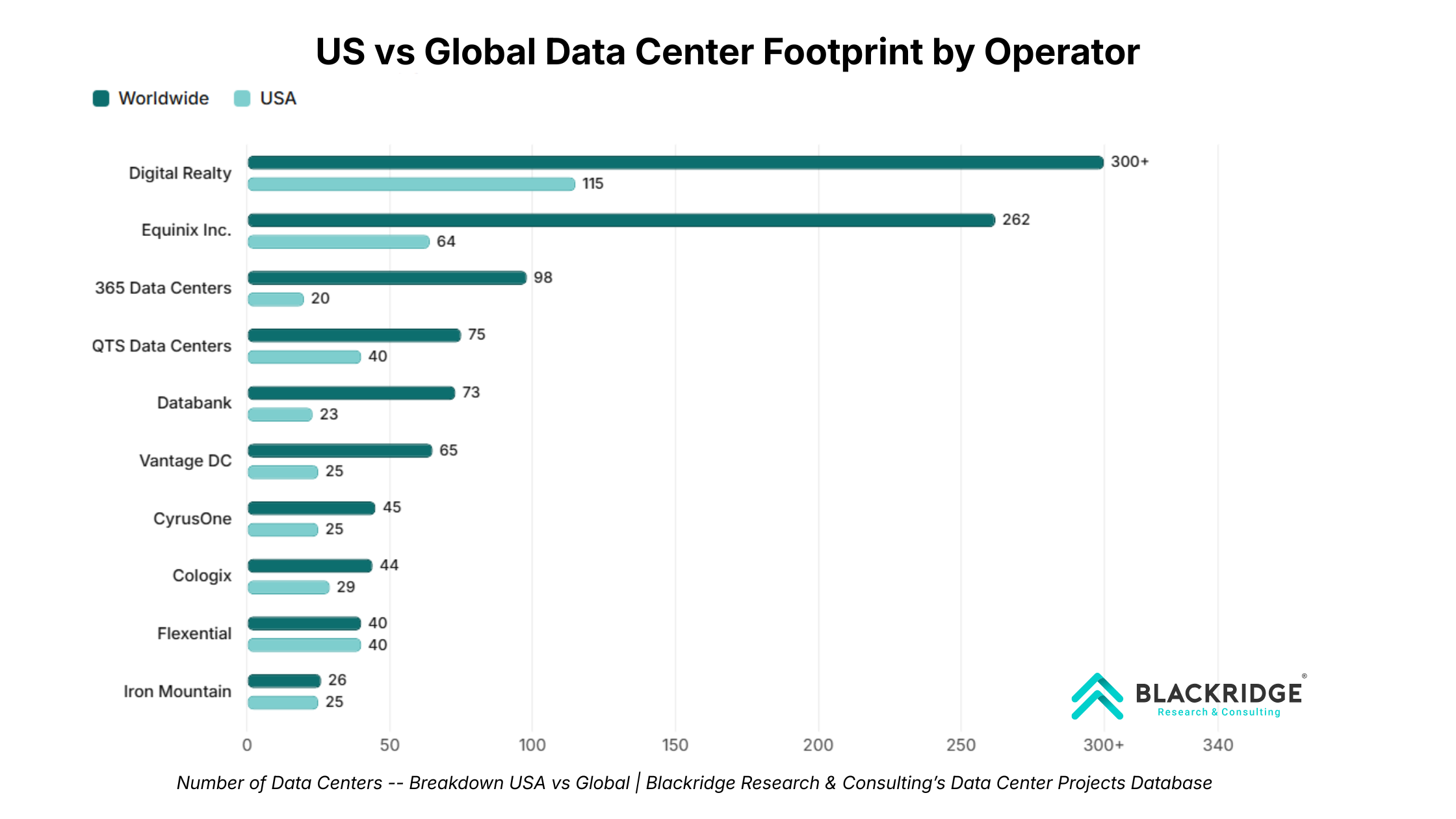
The disruptions are taking place against a backdrop of significant market concentration. According to Blackridge Research's data center facility database, Digital Realty operates more than 300 facilities globally, with 115 in the United States. Equinix Inc. follows with 262 worldwide and 64 domestic locations. Together they represent the largest share of colocation capacity in the country.
Below that top tier, the market segments by domestic concentration. Flexential operates all 40 of its facilities within the United States, making it among the most domestically exposed operators relative to its size. Cologix and Iron Mountain also maintain high US-to-global ratios. QTS Data Centers, with 40 of its 75 global facilities in the US, sits at a similar level. These operators carry proportionally higher exposure when domestic regulatory or infrastructure conditions tighten.
THE ENERGY ARITHMETIC BEHIND THE SLOWDOWN
The scale of the buildout explains why the grid is under pressure. There are more than 2000 active data centers in United states which represents around USD 120 billion dollars in planned capital expenditure across construction, manufacturing, and supply chains.
AI workloads are the primary driver of increased power demand. High-performance GPUs used in AI applications consume between 700 and 1,200 watts per unit, compared to 150 to 200 watts for conventional server processors. Because AI inference runs continuously rather than in periodic bursts, these facilities create a base load that does not fluctuate across the day. A single large-scale AI model training run can consume more than 1,000 megawatt-hours.
FEDERAL AND STATE RESPONSES
The federal government has moved to streamline the permitting and interconnection process. Executive Order 14318, signed in July 2025, designated large data centers as priority projects under the FAST-41 framework, targeting interconnection timelines of under 12 months rather than the current three to five years. The Department of Energy's AI Infrastructure Task Force and proposed FERC reforms are backed by approximately 10 billion dollars in loans and grants to support clean energy connections to new facilities.
At the state level, the approach has been more varied. Virginia, Georgia, and Texas have all enacted measures to prevent grid upgrade costs from being passed to residential customers. Minnesota, New Jersey, California, and Oregon are tying project approvals to grid impact studies, renewable energy commitments, and water efficiency benchmarks. The general pattern is federal policy accelerating development while state policy attempts to manage the costs for existing ratepayers.
On the corporate side, major technology companies including Google, Microsoft, Meta, Amazon, Oracle, OpenAI, and xAI signed a White House-backed Ratepayer Protection Pledge, committing to fund new electricity generation and grid upgrades directly rather than drawing on public infrastructure. Google has signed contracts for more than 10 gigawatts of new clean energy capacity, though its renewable matching rate was approximately 64 percent in 2024 as demand growth outpaced new clean supply additions. Microsoft reports full renewable matching since 2023 and has committed over USD 10 billion dollars toward clean energy and advanced nuclear projects.