Over the past decade, AI chatbots have evolved from simple scripted responders into sophisticated digital assistants capable of understanding context, interpreting intent, learning from interactions, and delivering human-like conversations at scale. Today, AI chatbot development services play a crucial role in helping companies automate customer support, streamline operations, increase sales conversions, and reduce operational costs across industries.
With generative AI, natural language processing (NLP), large language models (LLMs), and multi-turn conversational systems, modern chatbots are no longer limited to pre-defined responses. They can analyze customer behavior, remember user history, personalize responses, and even complete end-to-end tasks — from booking appointments to handling internal workflows.
As organizations continue to move toward digital-first operations, the demand for AI chatbot development services is skyrocketing. In this article, we’ll explore everything businesses need to know before investing in chatbot solutions: how they work, what benefits they deliver, popular use cases, how to select the right development partner, and even more.
What Are AI Chatbot Development Services
AI chatbot development services refer to the end-to-end process of designing, building, training, deploying, and maintaining intelligent conversational agents for business use. These services typically include:
- Strategy & requirements definition
- Conversational design & UX
- AI model selection (NLP, LLM, hybrid approaches)
- Custom chatbot development
- Integration with existing systems (CRM, ERP, LMS, HRIS, etc.)
- Testing, optimization, analytics & monitoring
- Ongoing improvements and model retraining
Unlike traditional rule-based bots, modern AI chatbots use advanced technologies such as:
- Natural Language Processing (NLP)
- Machine Learning (ML)
- Large Language Models (GPT-4, Claude, Llama, Gemini, etc.)
- Sentiment analysis
- Multilingual understanding
- Recommendation engines
- Automated workflows
This makes them capable of handling complex queries, understanding user intent, and providing intelligent, personalized responses.
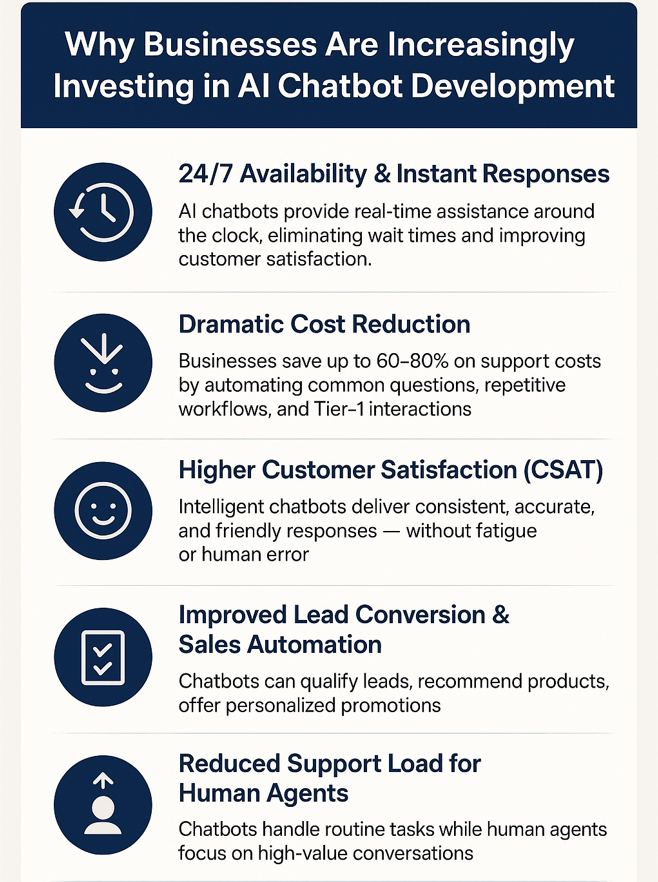
Why Businesses Are Increasingly Investing in AI Chatbot Development
The shift toward automation is not slowing down. Companies seek faster support, lower operational costs, and scalable customer engagement. AI chatbots deliver exactly that.
1. 24/7 Availability & Instant Responses
AI chatbots provide real-time assistance around the clock, eliminating wait times and improving customer satisfaction.
2. Dramatic Cost Reduction
Businesses save up to 60–80% on support costs by automating common questions, repetitive workflows, and Tier-1 interactions.
3. Higher Customer Satisfaction (CSAT)
Intelligent chatbots deliver consistent, accurate, and friendly responses — without fatigue or human error.
4. Improved Lead Conversion & Sales Automation
Chatbots can:
- Qualify leads
- Recommend products
- Offer personalized promotions
- Guide users through buying decisions
Studies show chatbot-assisted conversions can increase sales by 20–35%.
5. Reduced Support Load for Human Agents
Chatbots handle routine tasks while human agents focus on high-value conversations.
6. Immediate ROI Through Automation
Most companies recover chatbot investment within the first 3–6 months due to reduced support load and improved retention.
7. Enhanced Internal Operations
AI chatbots are not only for customers; they streamline internal workflows by supporting HR, IT, finance, and employee training.
Types of AI Chatbots You Can Build
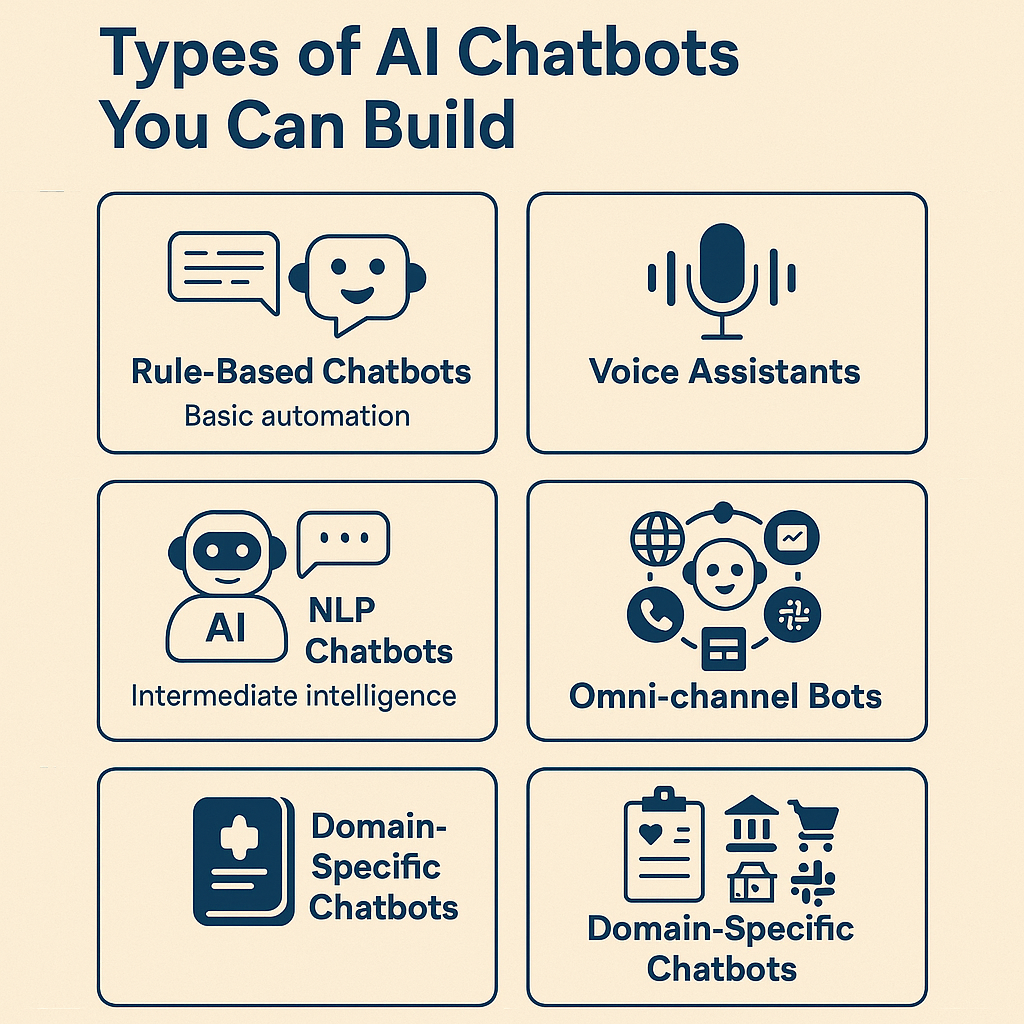 Depending on complexity and business workflows, companies can choose from several chatbot categories.
1. Rule-Based Chatbots (Basic Automation)
These bots follow predefined flows and are ideal for FAQs and simple decision trees.
2. NLP Chatbots (Intermediate Intelligence)
They understand natural language inputs, making them suitable for customer support, product recommendations, and more.
3. LLM-Powered Chatbots (Advanced Intelligence)
Built on models like GPT-4, Claude, Gemini, or Llama:
- They understand context
- Engage in multi-turn dialogue
- Personalize interactions
- Answer open-ended questions
- Reason and solve problems
Perfect for enterprise-grade automation.
4. Voice Assistants
AI chatbots integrated with speech recognition and text-to-speech for hands-free interactions.
5. Omni-channel Bots
Chatbots built to operate seamlessly across:
- websites
- mobile apps
- WhatsApp, Messenger, Telegram
- Slack, Teams
- CRM/ERP platforms
6. Domain-Specific Chatbots
Examples include:
- Healthcare symptom checkers
- Banking virtual assistants
- E-commerce shopping bots
- EdTech tutoring bots
- HR onboarding assistants
These are extremely powerful when integrated with internal systems.
Top Use Cases for AI Chatbot Development in 2025
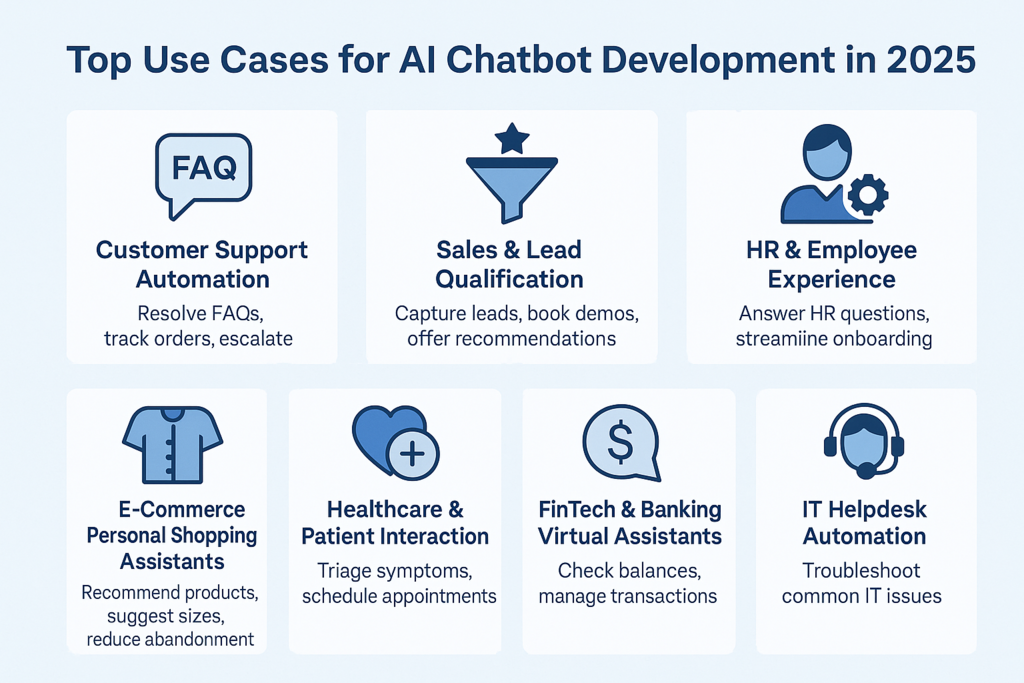
AI chatbots can support nearly every operational area. Below are the most impactful use cases for modern organizations.
1. Customer Support Automation
AI chatbots can:
- Resolve FAQs
- Manage refunds
- Track orders
- Troubleshoot product issues
- Escalate complex cases to human agents
This drastically reduces support tickets and response times.
2. Sales & Lead Qualification
Chatbots help sales teams by:
- Capturing leads
- Asking clarifying questions
- Scoring prospects
- Booking demos
- Offering product recommendations
This increases conversion rates and shortens sales cycles.
3. E-Commerce Personal Shopping Assistants
AI bots can analyze browsing patterns and purchase history to:
- Recommend products
- Suggest sizes
- Detect intent (buying vs. exploring)
- Reduce cart abandonment
Retailers using AI chatbots have reported a 25–40% lift in ecommerce conversions.
4. HR & Employee Experience
Internal HR bots assist employees with:
- Leave balances
- Policy questions
- Onboarding workflows
- Job applications
- Training support
Companies save a significant amount of HR support time.
5. Healthcare & Patient Interaction
AI chatbots in healthcare can:
- Triage symptoms
- Schedule appointments
- Provide medication reminders
- Answer general health questions
All while remaining compliant with security standards.
6. FinTech & Banking Virtual Assistants
Chatbots help customers:
- Check account balances
- Manage transactions
- Dispute charges
- Understand financial products
And deliver personalized financial advice.
7. IT Helpdesk Automation
Bots can troubleshoot:
- Password resets
- Network issues
- Common software problems
How AI Chatbot Development Services Work (Step-by-Step Process)
.png)
Here is how a typical development workflow looks:
1. Discovery & Strategy
Identify business goals, user needs, and automation opportunities.
2. Conversational UX (CUX) Design
Design the dialogue flows, intents, responses, and escalation logic.
3. AI Model Selection
Choose NLP engines or LLMs such as:
- OpenAI GPT
- Claude
- Google Gemini
- Llama
- Custom ML models
4. Development & Integration
Build chatbot logic + connect backend systems.
5. Training & Fine-Tuning
Use real conversation data to train models and improve accuracy.
6. Testing & Quality Assurance
Simulate real-world interactions to ensure reliability.
7. Deployment
Launch across channels: web, mobile, messaging platforms, support tools.
8. Monitoring & Optimization
Analyze conversations, refine responses, and improve performance continuously.
Benefits of Custom AI Chatbot Development vs. Off-the-Shelf Tools
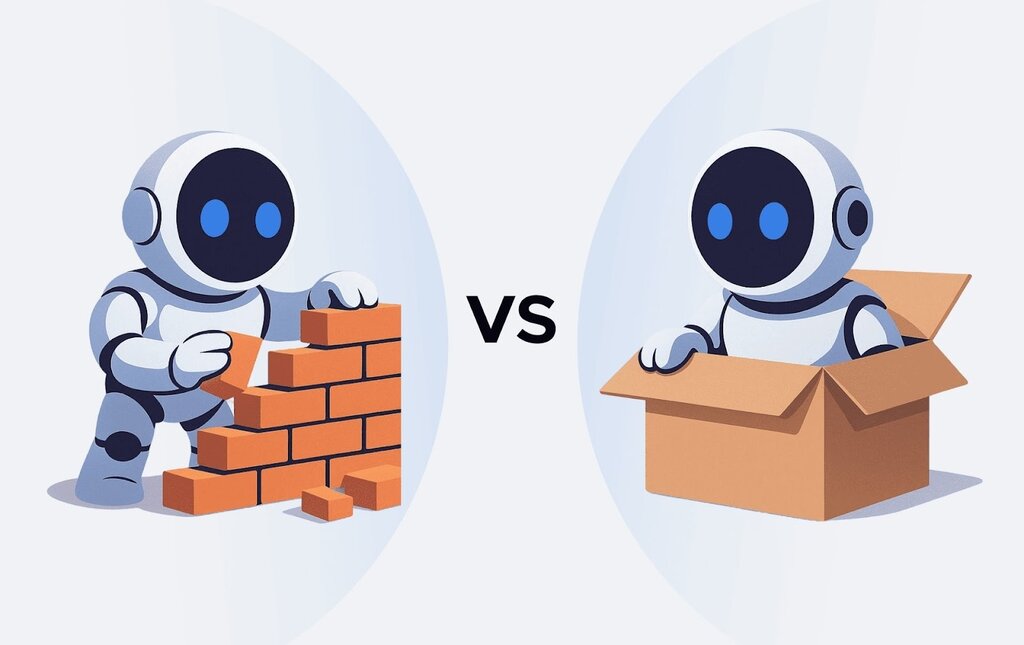
Custom Development
- Tailored to your workflow
- Higher accuracy and flexibility
- Full control over data
- Scalable and future-proof
- No dependency on external vendors
Off-the-Shelf Tools
- Quick setup
- Lower initial cost
- Limited customization
- Performance declines at scale
- Risk of vendor lock-in
For businesses with unique processes, custom AI chatbot development almost always provides better long-term ROI.
Conclusion: Why AI Chatbot Development Services Are a Strategic Investment
AI chatbots are no longer experimental tools, they’re mission-critical assets for modern businesses. Whether your goal is to reduce support costs, improve customer satisfaction, automate operations, or accelerate sales, chatbot technology delivers measurable results.
Companies that embrace AI-driven conversational automation today will have a significant competitive advantage tomorrow.
If you're exploring ways to integrate AI chatbots into your customer experience or enterprise operations, partnering with an experienced AI development team will help you deploy the right solution, avoid costly mistakes, and achieve ROI faster.