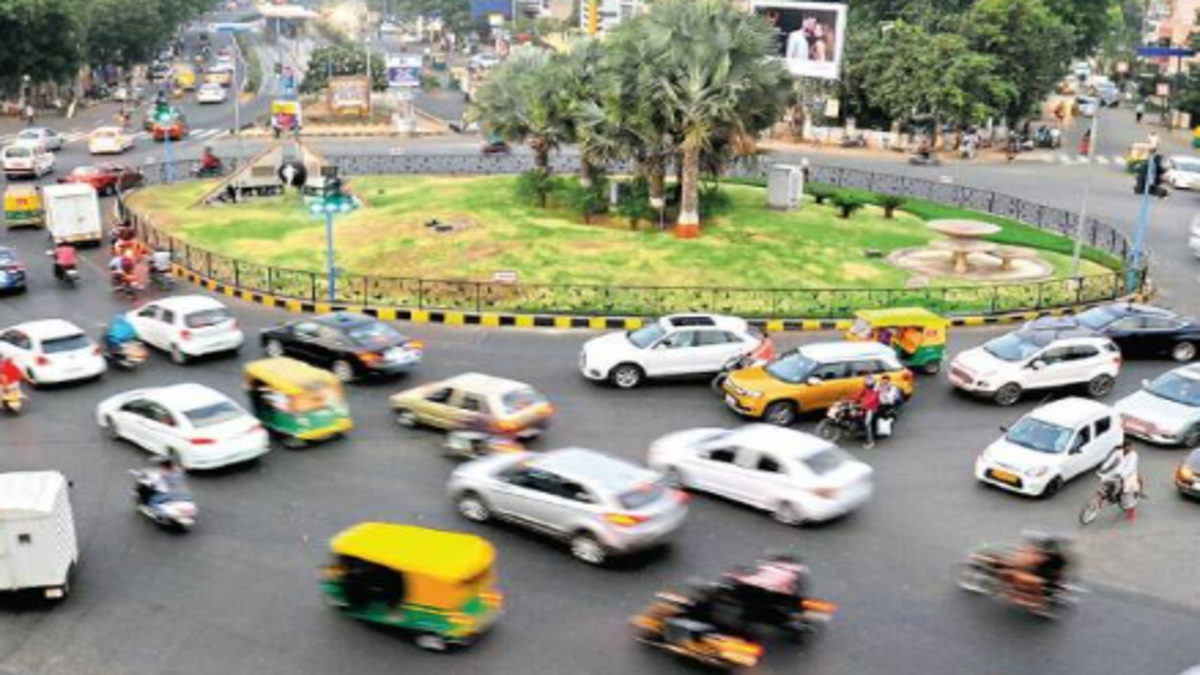
AHMEDABAD: On a busy Monday morning, while you are calibrated to run on the rush hour mode, it appears that the traffic lights are against you. The light at junction after junction flashes red.
Your plight, shared by all Amdavadi commuters, is not karma but the result of the lack of calibration of traffic lights. Cycle length is the time in seconds that it takes a signal to complete one full sweep of indications for all sides.
DCP traffic Tejas Patel admitted that the calibration of cycle lengths of various junctions in the city are yet to be done and that an analysis is underway. While police are on the job, an insightful study by three researchers studied five junctions on the 2.5km Nehrunagar Crossroads to Vijay Crossroads stretch. That is one of the busiest thoroughfares in the city.
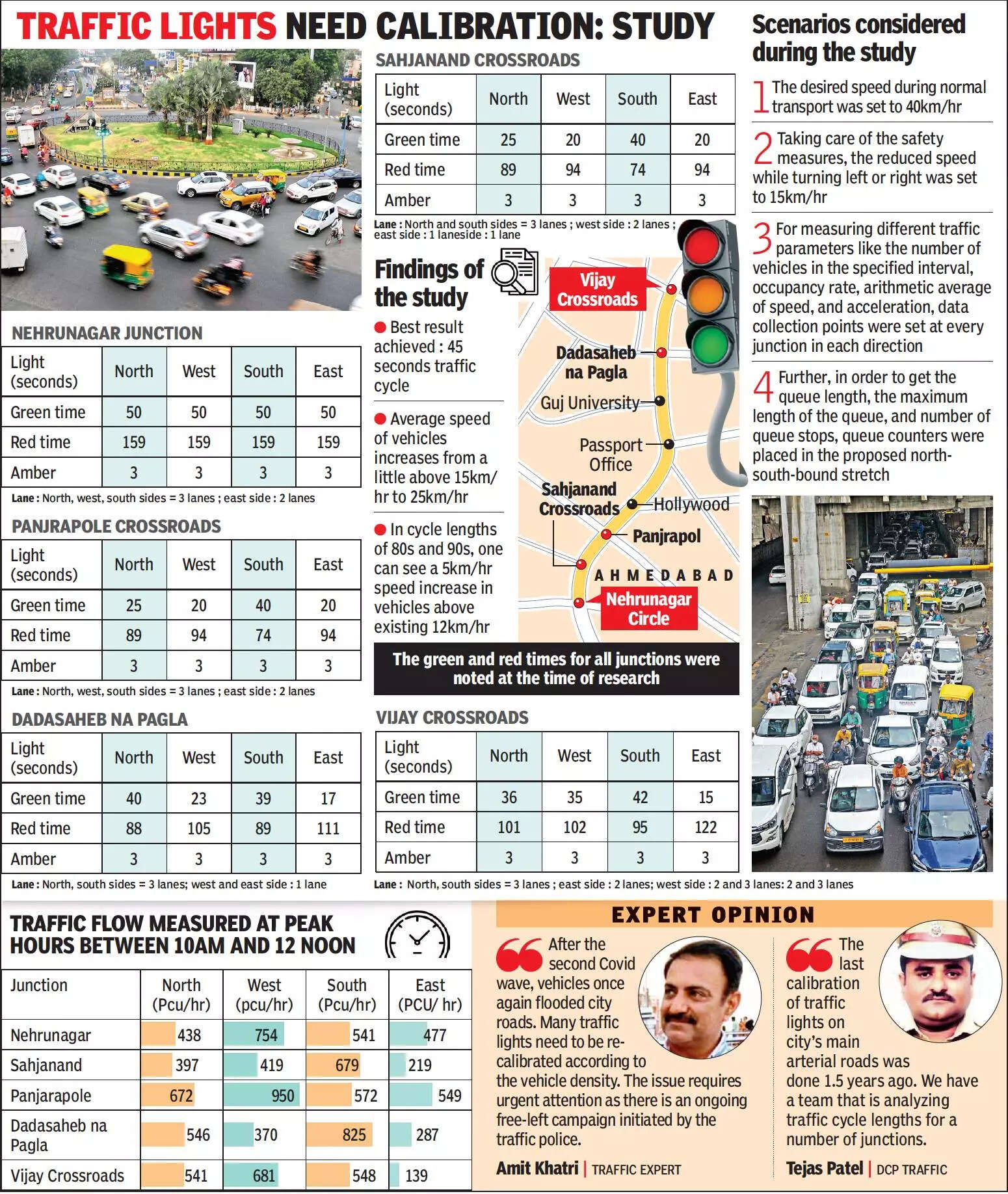
The study found that the green-time and the red-time either differed between junctions, or differed within the same junction.
The study was carried out by Maryam Kaveshgar, Nishant Patel, and Parishi Naik of the School of Engineering and Applied Science of Ahmedabad University in collaboration with the city traffic police.
The study found that if Nehrunagar Crossroads had green-time of 50 seconds and red-time of 159 seconds for each of the four directions, the cycle lengths differed greatly when one reached Sahjanand Crossroads. The green-time at Sahjanand Crossroads hovers between 20-25 seconds and 40 seconds for various directions, while the red-time ranges between 74 seconds and 89-94 seconds.
By the time one reaches Vijay Crossroads, the red-time goes as high as 122 seconds while the green-time varies between 15 seconds and 42 seconds.
The researchers spent hours measuring traffic flow at the junctions and even applied mathematical models such as the Webster’s algorithm and drew a time-space diagram based on the Kell method. The study found that the speed of vehicles past these junctions can significantly improve if each traffic cycle operates for 45 seconds. The average speed of vehicles increases from a little above 15 kmph to above 25 kmph. If one follows the Indian Road Congress Guidelines of traffic cycle lengths of 80 seconds and 90 seconds, one can see a 5 kmph speed increase in vehicles above the existing 12 kmph.
While elaborating on their study, the researchers said that optimizing the traffic cycle length will “improve various traffic parameters such as queue length, travel time, delay, fuel consumption, occupancy rate, and pollution.”
The researchers said: “We believe that this study is an important step towards the enhancement and increase in efficiency on busy central roads, which will help improve traffic conditions and therefore reduce economic wastage.”