AHMEDABAD: An indiscriminate disposal of city’s sewage and industrial waste into the Sabarmati has been turning the river into a cesspool of dangerous drug-resistant bacteria and toxic heavy metals that have contaminated sediments on the riverbed and harmed aquatic life in the Sabarmati.
Several private and government-run institutions since 1997 have published research on this toxic effect and warned citizens as well as policy makers of the disaster that the Sabarmati river is becoming. A simple search on “Sabarmati” and “pollution” among academic journals will yield 2,810 research works of which several research works involve government-funded organisations.
"River pollution is a complex issue and involves multiple stakeholders. For effective policies towards control of river pollution one requires varied data or research on the problem, contribution from multiple institutions as well as community members who are directly involved or affected by the problem. Incentives to curb pollution also needs to be put in place. For the past three decades, most government policies have failed to curtail the problem. A multi-pronged approach and transparency in dealing with the issue is the need of the hour.-TimesView"
The latest research led by IIT-Gandhinagar involved examination of the riverwater during Covid-19 pandemic, where increased consumption of antibiotics followed by its excretion into our civic systems, had also accelerated formation of drug-resistant bacteria in sewage systems that emptied into the river.
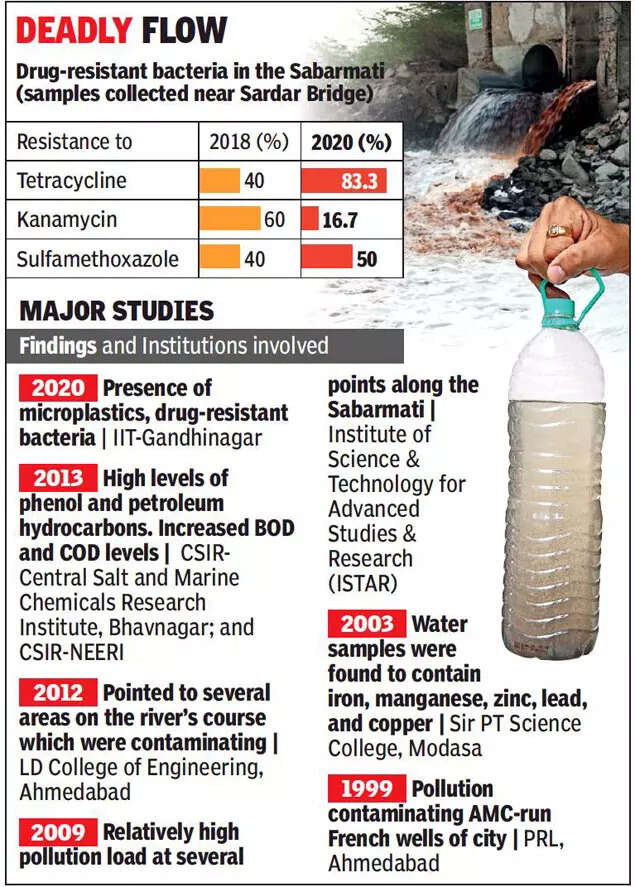
What worries scientists is human interaction with the bacteria at the riverfront, slums along lakes, and even wastewater farming downstream. Simply put, between 2018 and 2020, the presence of drug-resistant Escherichia coli (E. coli) or gut bacteria on two locations along the Sabarmati increased from 22% to 46%, while in one of the sewage treatment plants, the drug-resistant bacteria increased from 10% to 26%. The research was carried out by IIT-Gn, University of Ruhuna, Galle, Sri Lanka, Graphic Era Deemed University, Dehradun, NCERT, New Delhi and Encore Insoltech, Randesan, Gandhinagar.
Apart from this, the Physical Research Laboratory in 1999 had warned how pollution in the Sabarmati was leading to contamination of Ahmedabad Municipal Corporation-run drinking water French wells. Apart from these a number of research, almost 150, concentrated on heavy metal contamination in Sabarmati riverbed sediment as well as their presence in fish between 2012 and 2017. In 2018, the Indian Institute of Public Health (IIPH) had found how farmers using Sabarmati wastewater downstream of Ahmedabad were carrying E.Coli home and contaminating their water storage sources at home.