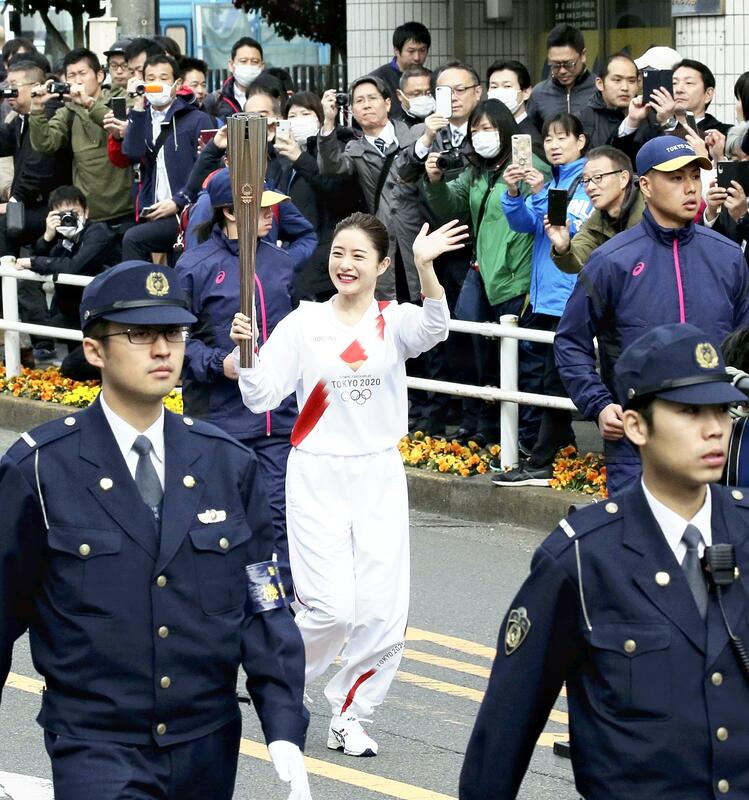
With the torch relay for the Tokyo Olympics set to start next month for its tour across the nation, local governments are puzzling over how to bring a festive mood to the event while preventing the spread of coronavirus infections.
Depending on the infection situation, the Tokyo Organizing Committee of the Olympic and Paralympic Games may consider canceling the running of the relay on public roads.
Local governments across the country will also have to cope with changes to relay routes, such as for celebrity runners and related events, to avoid crowding by spectators.
-- No guidelines?
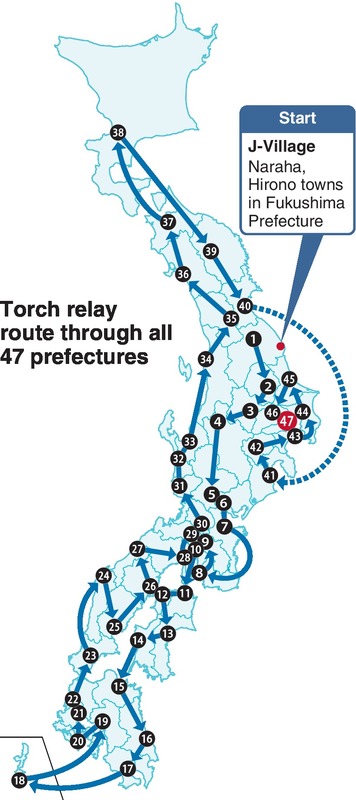
"I hope the relay starts this year as it's a good opportunity to bring attention to our recovery from the [2011] Great East Japan Earthquake," said Yasumasa Shoji, a member of the Olympic and Paralympic promotion office of Fukushima Prefecture, where the relay is scheduled to start on March 25.
In March of last year, two days before the relay was to begin, the decision was made to postpone the 2020 Tokyo Games to this year. By then, the prefecture had already spent about 250 million yen on relay preparations, including about 400 traffic control signboards and about 700,000 flyers distributed to all households in Fukushima.
This year, as the schedule has been moved a day earlier, the items had to be remade.
On Jan. 20, the Tokyo Games organizing committee said it plans to suspend the running of torchbearers on public roads if a state of emergency or a stay-at-home request is issued at the time of the event. However, no concrete infection prevention measures, which should have been finalized by the end of last year, have yet been decided.
"We've been pressed as there are no detailed guidelines, such as how much distance to keep between the runners and spectators," Shoji said.
Celebrities are among the runners scheduled for the relay because the organizing committee wants to liven up the event. The prefectural government is considering changing the routes celebrities are set to run from roads to stadiums where spectator numbers can be easily controlled.
-- No spectators?
The torch is scheduled to travel through all 47 prefectures over 121 days before igniting the cauldron at the National Stadium in Tokyo during the opening ceremony on July 23.
The current plan calls for about 10,000 runners to relay the torch. Some torchbearers will do something other than running, such as carrying the torch while riding a horse or swimming in a traditional Japanese style, in an effort to highlight cultures associated with each region.
Some local governments, not waiting for the organizing committee's delayed response, have begun planning their own COVID-19 control measures.
In the town of Motegi, Tochigi Prefecture, a steam locomotive is scheduled to run alongside the torchbearers. The prefectural government is discussing the possibility of restricting access to the roadside in expectation of a throng of railfans.
In Shiso, Hyogo Prefecture, canoes will carry the torch across a lake. Buses were to be chartered to transport 1,340 spectators, including Shiso residents, to the arrival and departure points among other sites, but the decision was made to hold the event without spectators.
The Tokyo metropolitan government has changed the viewing site from one side of the road to both sides to avoid crowding. The celebratory event to be held at each day's finish line in Tokyo will be broadcast on the internet in an effort to avoid congestion.
-- No clusters?
Miyagi Prefecture is planning to hold an event at an athletics stadium on the final day of the relay. Prospective spectators are asked to apply for a spot in advance and provide their contact information, which can be used to identify people in close contact with anyone who might be infected.
"The basic concept of the torch relay is to celebrate the Olympics with everyone," a prefectural official said. "We must come up with ways to have the audience still enjoy the event amid the pandemic."
In Miyakojima, Okinawa Prefecture, where the torch will be relayed in May during the Golden Week holidays, the number of new infections per 100,000 people reached about six times that of Tokyo in the week through Monday.
"We must prevent mass infections caused by the relay," said a Miyakojima official in charge. "We will talk with the organizing committee about rules for staff and spectators who travel across prefectural borders."
Read more from The Japan News at https://japannews.yomiuri.co.jp/