So far over the course of this series, we’ve heard from a climate scientist, a community alliance leader, an urban buildings expert, and an MTA engineer. Each is a vital player in what we’ve referred to as the “stormproofing network”. They are all invested in protecting New York City in the face of natural disasters. And in our conversations, they have all repeatedly referenced one private foundation as a major player – the Rockefeller Foundation.
To be honest, when I hear Rockefeller, I think of an old man with a monocle watching a train go by. I know the foundation supports important philanthropy projects … but I couldn’t name one. According to their website, “The Rockefeller Foundation maintains a portfolio of interconnected initiatives, each of which commits to specific, measurable goals.”
What does that mean? How does the Rockefeller Foundation’s work tie in with disaster-risk planning?
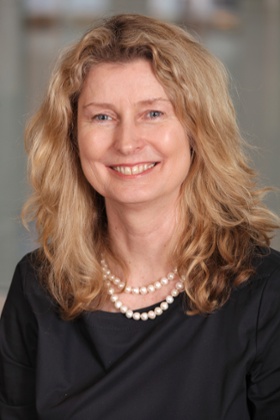
I contacted Nancy Kete, the foundation’s managing director, who leads their global work on resilience. She sat down with me in their Manhattan office to explain how they work with the city and country to prepare for scary climate unknowns. We sat at the end of a long, formal conference table, the midtown cityscape stretched out through the window – which was also the room’s entire wall. The presence of big names and big money hung in the air. Nancy ignored it. She described how federal agencies reroute their money into better, more innovative resilience projects nationwide, with Rockefeller’s help. But first, she told me why she didn’t like the name of my series.
Let’s start with how the Rockefeller Foundation’s work fits into this network of people keeping us safe from future storms.
What I’d really like to start with is to see if I can push you off the idea of “stormproofing” the city, though I’m not sure I have a different catchy name for you.
But “stormproofing” provides some tangible context for all this stuff.
Well, first of all, I don’t think we can stormproof New York City. Second, I think we miss a major opportunity by focusing too narrowly.
Over the past two years, everyone’s been focused on resilience in the context of Sandy-like storms, but that’s because we had a Sandy-like storm. But there are a lot of other potential and very likely things that could hit the city, and it’s equally important that the city be ready for those. For example, the natural event likely to hit New York next is a heatwave. Heat can be deadly. We need to think about this from the broader perspective of how we build our resilience overall.
Part of what the Rockefeller Foundation does was described to me by the scientist Klaus Jacob as spending smart money. I wonder if you can help me simplify that concept.
That’s nice of him. So the US Department of Housing and Urban Development (HUD) and the Army Corps of Engineers are very mature organizations, and what they can do is very tightly controlled by laws and appropriations from Congress and by oversight of the Office of Management and Budget, which has a responsibility to look carefully at how taxpayer money is being spent.
These federal agencies are also big bureaucracies that have done things a certain way for a long time. And they tend to keep doing things that way, because it takes a lot of effort to do things differently. So working at a foundation like Rockefeller gives you the obligation and the luxury to step back and think, “What needs to change, and how can we catalyze that change?” And that’s my best interpretation of what Klaus means. Because our money may seem big, but the problems that need to be solved are bigger, and can only be solved if we use our money to leverage other money or other, broader authority.
So what’s an example of how a little bit of the Rockefeller Foundation’s money can leverage a lot of someone else’s money?
A great example is the design competition we ran after Sandy, Rebuild by Design. Here we could spend a few million dollars at the front end in a way that brought in all this creativity, that really excited HUD, and that attracted these amazing multidisciplinary teams of designers, engineers, landscape architects, sociologists, and so on. It also included community needs in the design process – we got community groups to drop any cynicism they might have had about a big government project, and put in a huge amount of effort to articulate what they needed and why. The teams could then design that in. We organized this whole coalition.
So when it comes to spending recovery money, none of this is normal. And our money, along with some other foundations’, paid for that, because there’s no budget line that HUD could have used to pay for it. We had to be the smart money to catalyze it. That led us through a series of competition steps to six winning ideas, which HUD then did have the authority to fund with the billion dollars they set aside for this.
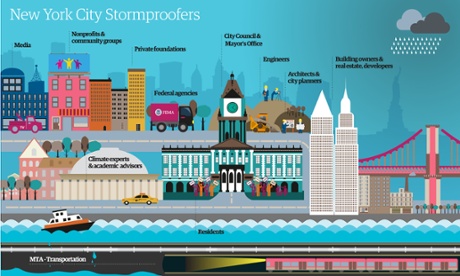
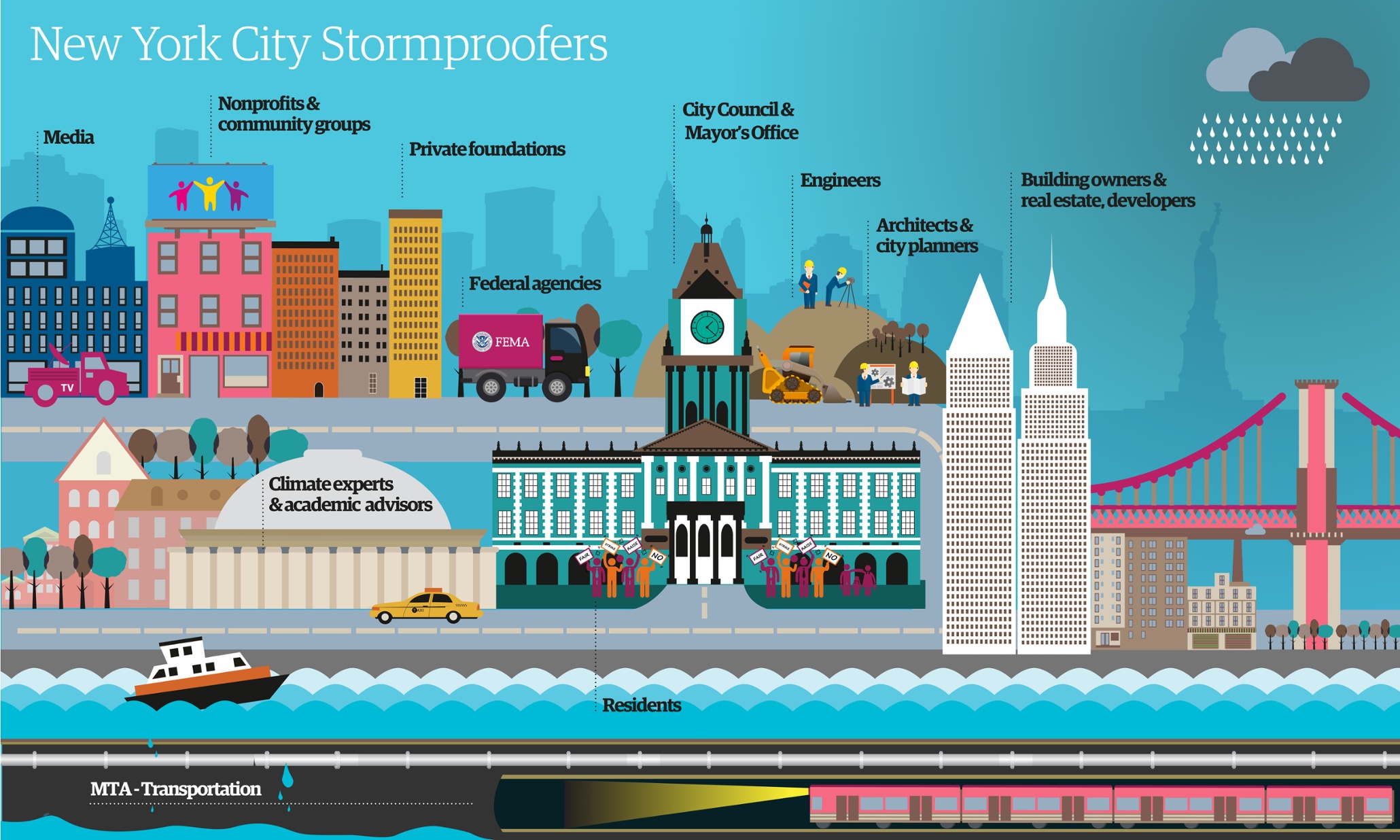
The network of New York City’s stormproofers. For a larger version of this image, click here.
So your money enabled the competition, and HUD’s will support the winners.
Exactly. Same goes for our new national disaster competition, The National Disaster Resilience Competition, which came out of the success of Rebuild by Design. It’s a nationwide grant competition open to areas that have had a declared national disaster from 2011-2013.
Again, we’ll put in a small number of millions toward training and technical assistance to help the eligible communities come up with good ideas for the competition. And HUD’s set aside another billion dollars to fund the winning ideas. This is a new approach. And through it, communities will learn a lot. Even if these places don’t get some of HUD’s money, they will be better equipped to use their own authorities and other budget lines to make themselves more resilient.
So we can move our money faster, and we can spend it in ways that restricted agencies can’t. But it’s not worth doing if that’s the end of it. We try to only do that if it’s going to leverage someone else’s big pool.
So, the fundamental questions I’m trying to get at is: are we safe? Are we safer? Are we getting safer? About two months ago, the Gotham Gazette and Adapt New York asked 70 residents in low-lying areas that were hit hard by Sandy, “Do you feel like you’re safer?”And the overwhelming majority said no. They also had no idea about the city’s large-scale resiliency plans, like those that came from Rebuild by Design. So I worry that millions of dollars later, people still don’t feel safer. How important is their perceived comfort?
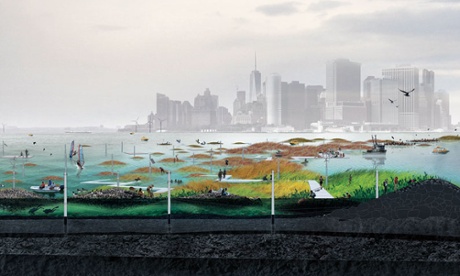
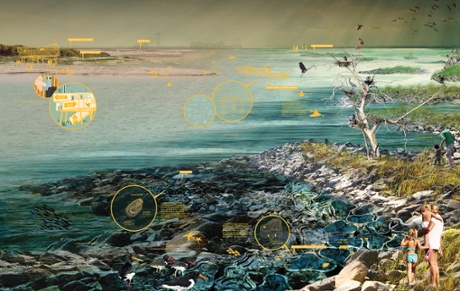
Well, plans are different than completed projects. For example, one of the Rebuild by Design winning designs is for rebuilding oyster reefs off the coast of Tottenville, in Staten Island, to reduce the strength of waves. It’s a cool design, and if it works I won’t be surprised to see the Army Corps replicate it in other places. But it’ll be quite a few years before we know if it works. So is Tottenville any safer right now because it was picked by Rebuild by Design? I don’t think so. Because the project hasn’t started yet. Tottenville might be safer because residents know to evacuate faster – the discussion alone as made them more aware. So I think it’s unfair to imagine that a lot of the built environment plans post-Sandy have done anything, because we haven’t had much time to start actually building.
What questions and aspects of this network do you think are most important for people to consider?
I think you do want to ask how resilient New York was to Sandy, and whether the different parts of New York were differently resilient. And I know the answer to that last part is yes.
You just have to look around. There are people in what we call back bay communities like Jamaica Bay, where low- and middle-income people live, and these communities are still not fully functional two years after Sandy. They’re still very vulnerable to flooding, and are also vulnerable from a socioeconomic perspective, whereas in lower Manhattan, the financial district and the hospitals are back up and running. So in a city as large as New York, it’s not a fair question to say, is the city resilient or back to normal? Because a lot of it is, but it’s not fully. There are serious equity issues. That’s going to be true in cities all over the world.
I honestly think New York is pretty resilient, but it’s unevenly resilient. It just needs to do better relative to itself.