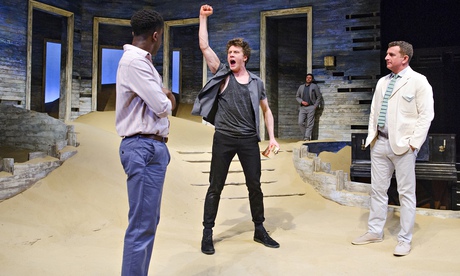
Eugene O’Neill wrote expressionist plays such as The Hairy Ape and Dynamo. He also wrote realist plays of which this “comedy of recollection” is emphatically one. By setting it on a sand-filled stage, however, Natalie Abrahami’s revival treats it as if it belonged in the former camp and the result, while visually seductive, works against the grain of O’Neill’s domestic specificity.
O’Neill wrote the play in 1932 as a relief from the strains of Mourning Becomes Electra, and the result is a mellow, tender play that precisely evokes American middle-class family life. The year is 1906 and, like O’Neill himself at the time, the hero, Richard Miller, is an anarchic rebel whose head is filled with the poetry of Swinburne and Fitzgerald and the plays of Shaw and Ibsen.
The play is full of a nostalgic evocation of a remembered time and place: in particular a Connecticut summer house, bright in the mornings and gloomy in the evenings, that was later to feature in Long Day’s Journey Into Night. Dick Bird’s design evokes this through an impressively ridged mountain of sand backed by five arched doorways. Furniture is sparse but Abrahami uses a white-suited, on-stage narrator (David Annen, resembling the mature O’Neill) to read out the stage directions. The advantages of this approach are obvious. It confirms this is a memory-play, creates pleasing stage-pictures and gives the action a dream-like fluidity. But certain scenes, such as a crucial one in which a lovelorn Richard seeks refuge in a back-room bar with a lady of the night, seem to be taking place in no-man’s land. Sand also muffles the sound of feet on floors, which a director once told me was the surest way of evoking a sense of period, and undermines O’Neill’s idea that American middle-class life is partly defined by its acquisition of concrete objects.
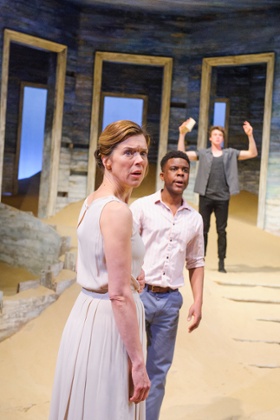
The acting, however, has sufficient emotional reality to make up for the sandy setting. George Mackay is excellent as Richard, conveying exactly the right tremulous, self-absorbed sensitivity. Martin Marquez as his father is a wonderful mix of bullying bluster and loving concern, Janie Dee beautifully captures the mother’s similarly contradictory blend of rigid conservatism and deep compassion, and there is first-rate support from Dominic Rowan as a soused uncle and Susannah Wise as an aunt, quietly frayed by her lack of emotional fulfilment.
It’s good to see such an unfamiliar, warm-hearted work but I can’t help feeling that, if O’Neill had wanted to create an expressionist play about family life, he would have written one.
- Until 23 May. Box office: 020-7922 2923. Young Vic.