Since the global food crisis of 2007-08, when the rising costs of staple foods sparked major political unrest across the world, governments have redoubled their efforts to tackle global hunger and rural poverty. An increasingly common approach has been to collaborate with the private sector, in order to leverage significant investment for agricultural programmes. The New Alliance for Food Security & Nutrition – which was launched by President Obama at the 2012 G8 Summit, and aimed to lift 50 million people out of poverty within 10 years – is perhaps the best-known within this new wave of agricultural public-private partnerships (PPPS).
Keen to understand how well such partnerships were working for smallholder farmers, earlier this year the Fairtrade Foundation undertook a study of four agricultural PPPs in Ghana, Malawi and Kenya. Overall, our findings were far from positive. We found PPPs failing to engage effectively with smallholders, making assumptions about their needs, and treating farmers as beneficiaries rather than equal partners. There were few opportunities for farmers’ representatives to sit around the table with government and business, or to input to the design or development of programmes intended to improve their position.
One example we looked at was the Ghana Commercial Agriculture Project, a $145m (£92.5) framework PPP established by the Government of Ghana, the World Bank and USAID. It aims to increase the productivity of smallholder farmers in the Accra Plains and SADA region, yet there has been just one occasion, in 2011, when smallholder farmers had an opportunity to express their views about the programme. Because the project is demand-driven, funds are allocated according to private sector applications, rather than assessment of farmers’ needs.
Chief Adam Tampuri is president of the Gbankuliso Cashew Farmers’ Association, the largest farmer-based organisation in the SADA region’s Bole district, with nearly 1,000 smallholder members. Commenting on the GCAP, he expressed dismay at the lack of participation of local farmers. “Being a farmer leader…and having direct contact with other producers across the country and the continent – I think that we should be the ones who add value to reshaping the way a project can work for the benefit of producers. This project has come to change and improve the lives of farmers. But you cannot make a change if you do not have people working together,” he said.
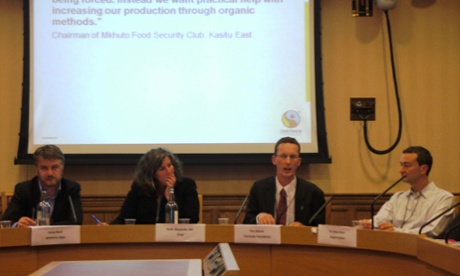
Last week, the Fairtrade Foundation brought businesses and NGOs together at a House of Lords event to discuss the opportunities and risks of agricultural public-private partnerships, and how they might be implemented in a way that benefits smallholders. Sharing Oxfam’s recent research on agricultural PPPs in Africa, David Bright, the NGO’s head of economic justice programming, said that ‘mega-PPPs’ can result in African governments changing policies to make conditions more favourable for their investment. This means the risks for companies are reduced, but the risks for those living in poverty are not. For example, smallholders might end up losing title to their customary land to make way for PPPs.
“The important question is, who shares the risks and who receives the benefits?” Bright asked. “In the case of mega-PPPs, often the benefits are bypassing the poorest. Secondly, you have to consider the cost of investing in these partnerships instead of other programmes that could address poverty alleviation. A critical check and balance is having an accountability framework explaining how this investment will reduce poverty and create transparency mechanisms for the communities concerned.” He said the private sector has a crucial role to play in driving poverty eradication and food insecurity improvements in Africa, but there are more effective, tried and tested approaches for donor aid that are more likely to reach those who need it most.
Ewan Reid from Matthew Algie, a coffee roasting company that has a long history of sourcing its beans from Fairtrade certified cooperatives, explained that his company had been seeking to go beyond ethical certification, to work in partnership with smallholder farmers on development projects for more than a decade. Although Matthew Algie had initially considered the possibility of investing in large-scale PPPs, it decided that as an SME its priorities might be ignored, just as the priorities of smallholder farmers often appear to be.
Instead, Matthew Algie has worked with ethical trading organisation, Twin to establish its own development projects on three continents, including a climate change adaptation project with the San Juan del Oro coffee cooperative in Peru. “The farmers are supported to become more resilient to the impacts of climate change and to deal with climate change-related disease such as coffee leaf rust, which helps them to continue producing coffee and earning a living, but as a company we also benefit from security of supply and longevity”, Reid said. Other programmes have targeted the most marginalised groups, including women farmers and those living in conflict zones, such as the Democratic Republic of Congo, where Matthew Algie supported farmers to gain organic and Fairtrade certification.
The coffee company has also turned down offers to work on projects where they do not take into account the smallholders’ needs and context. “There was a project in Rwanda that proposed installing washing stations for coffee, which would divert much-needed water away from growing other crops, in a community affected by food insecurity. We couldn’t get involved with a project like that”, Reid said. Despite being a relatively small business, Matthew Algie has lobbied on issues of concern, such as proposed changes to EU organic regulations, which would prevent smallholders from inter-cropping if the second crop is not organic. Such a move could have serious consequences for organic coffee farmers in the global south, who rely on inter-cropping for food security and additional income. Reid also points out that the proposed EU rule change runs contrary to PPP initiatives, often funded by the EU or EU governments, which encourage organic production.
For two decades now, the Fairtrade Foundation has been working with businesses to bring about change for smallholders and their communities, so we know that there are many companies like Matthew Algie, that genuinely want to engage with farmers and work in true partnership. This approach can lead to benefits for both parties – the business can strengthen the sustainability of its supply chain and the smallholder farmer can be supported to work towards a more sustainable future. Problems arise when commercial interests are put front and centre, and when profits are allowed to be prioritised ahead of people.
If agricultural PPPs are to be effective, we need to add another ‘P’, to stand for the participation of smallholders. Admittedly, getting participation from a large number of smallholder farmers, who may be geographically dispersed across a sizeable area, is a challenge, but the onus should be on the donor to find ways to support farmer engagement. Without it, PPPs may overlook farmers’ real needs and misunderstand the local context. As a result, genuine opportunities to transform the lives of the rural poor and tackle food insecurity may be lost.
Tim Aldred is head of policy and research at the Fairtrade Foundation
More from the Fairtrade partner zone:
- The future of Fairtrade: let’s not be afraid to dream big
- Fairtrade pioneer Clipper Tea visits India to assess impact after 20 years
- Fairtrade Access Fund offers up-front finance to farmers who need it most
Content on this page is paid for and provided by Fairtrade Foundation supporter of the supply chain hub