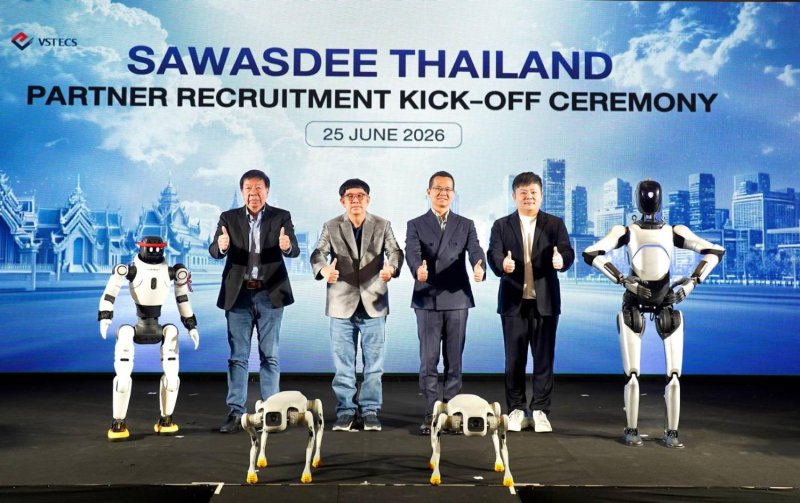
AgiBot, a Chinese embodied artificial intelligence (AI) and foundation-model company, is expanding into Thailand by establishing an Asia-Pacific sales office.
The company also partnered with leading IT distributor VST ECS (Thailand) to accelerate humanoid robotics adoption and develop new use cases for local markets in the era of physical AI.
A Roland Berger study projects the global humanoid robotics market could generate US$300-750 billion in annual revenue by 2035, with long-term potential to reach $4 trillion by 2050.
"We selected Thailand for the first batch of overseas markets when we launched international operations in the fourth quarter last year. Thailand will function as the company's Asia-Pacific regional headquarters," said Abel Deng, president for Middle East and Asia-Pacific at AgiBot Innovation (Shanghai) Technology Co.
Founded in February 2023, AgiBot claims to be the fastest-growing company in AI and robotics history, and recently produced its 10,000th robot unit.
The company has a local team covering sales, after-sales, solutions and marketing, and is registering for Board of Investment incentives.
Thailand is considered the digital hub of Asia-Pacific, leading in 5G, fibre deployment, Internet of Things and AI data centres, said Mr Deng.
There are massive robot application scenarios across the service sector, from malls to the industrial sector, he noted. The company's hardware ranges from half-sized interactive robots to heavy-duty robot dogs used for monitoring and patrols.
The embodied AI and humanoid industry is still in its infancy, with the biggest challenges acquisition of better algorithms and sufficient data to train the models, said Mr Deng.
AgiBot plans to overcome this obstacle by creating a "data flywheel": customising more application scenarios generating real-world data, which trains the robots to be more capable and develops more use cases.
However, the company needs partners to help collect data and utilise local data centres to train its models. AgiBot intends to build a general purpose robot system in Thailand, he said.
The company's platforms are open source to make the technology accessible for partners' developers.
AgiBot seeks more solutions developers to customise robots for specific vertical industries and local data centres, said Mr Deng.
The company aims to make robots cost-effective, easy to purchase, open for local development, and scalable through strong partnerships, he said.
"AI-driven transformation is the next journey, positioning Thailand as an intelligence hub," said Mr Deng.
By embracing this technology, Thailand can enhance its productivity, with robots taking over tasks ranging from heavy industrial manipulation to elderly care, he noted.
HUGE INVESTMENT
"After 38 years operating primarily as an IT wholesaler, we are investing in humanoid and intelligent robots to create new markets and opportunities for our reseller partners," said Somsak Pejthaveeporndej, chief executive of VST ECS (Thailand) Co Ltd.
This new market diversifies beyond IT, which is limited by rising memory prices and a supply shortage, he said.
The company invested more than 10 million baht for demonstration robots, building a dedicated team for maintenance and spare parts inventory to ensure reliable service.
VST ECS will offer multiple business models, including one-time sales, short- and long-term rentals (weekly, monthly, yearly), and lease-to-own, said Mr Somsak.
"We will target services, entertainment, healthcare, retail, and events including security sectors," he said.
Organisations can leverage the flagship AgiBot A2 Ultra humanoid robot to elevate their customer experience, welcoming visitors and creating interactive brand activities at stores and events, said Mr Somsak.
The company wants to build a community of local developers who can program and customise these robots, such as integrating security systems, radar or satellite communications to meet the needs of different Thai industries.
"These robots are not meant to take away human jobs. They are designed to handle tasks humans cannot do and to increase industrial productivity," he said.
"I expect the humanoid robot market will widen into a massive opportunity in Thailand within 3-5 years."