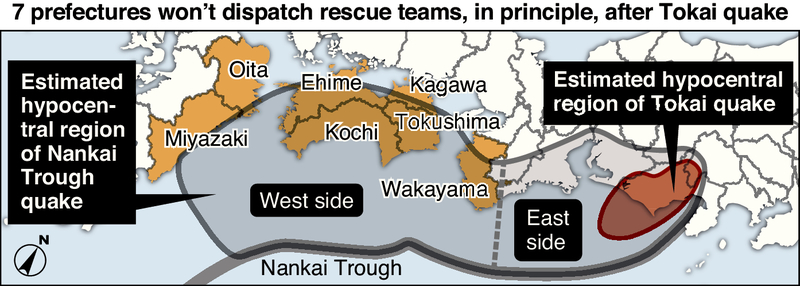
To prevent a shortage of rescue staff, authorities have decided that if a Tokai earthquake occurs in the eastern section of the envisioned hypocentral region of a megaquake along the Nankai Trough in the Pacific Ocean, emergency fire response teams (see below) will not be dispatched, in principle, from seven prefectures in the western part of the hypocentral region.
In the past, quakes have occurred in the western part of the hypocentral region immediately after a huge quake on the east side. The Fire and Disaster Management Agency therefore decided not to send emergency fire response teams from the seven prefectures, including Wakayama and Kochi, The Yomiuri Shimbun has learned.
Members of the emergency fire response teams normally act as firefighters in cities, towns and villages nationwide. In cases of major disasters, they rush to the scene with special equipment and machines at the request or direction of the agency commissioner.
For the 2011 Great East Japan Earthquake, a total of about 110,000 emergency fire response team members were mobilized for about three months after the quake, rescuing about 5,000 people. They were also dispatched for rescue operations in the disaster caused by heavy rain in the northern Kyushu region in 2017.
Megaquakes have occurred repeatedly at intervals of 100 years to 150 years along the Nankai Trough stretching from Shizuoka Prefecture to the Pacific side in Kyushu.
In the past, subsequent earthquakes linked to the first tremor have occurred across the entire hypocentral region. When a huge quake, such as a Tokai quake, has occurred on the east side, related quakes have occurred at intervals on the west side. In a case 160 years ago, the time difference between the one on the east side and the connected quake on the west side was 32 hours.
According to the action plan for emergency fire response teams compiled by the agency in 2005, rescue team staff from up to 40 prefectures, including the seven prefectures on the west side, were to be dispatched to affected areas in a Tokai quake. However, locations on the west side of the Nankai Trough, including the Shikoku region, could be hit by a huge quake after their teams were dispatched to the rescue operation in a Tokai quake. The agency therefore made a comprehensive review of the action plan.
In the new plan, seven prefectures, including Wakayama, Kochi and Miyazaki, will not dispatch their emergency fire response teams, while up to 36 prefectures will send teams to the four prefectures -- Yamanashi, Shizuoka, Aichi and Mie -- that are expected to be hit by a Tokai quake.
If a quake occurs first on the west side of the hypocentral region of the Nankai Trough quake, the agency will discuss whether to send rescue teams from the east side to the affected area on the west side, judging from the seriousness of the disaster.
Emergency fire response teams in prefectures will be divided into first to third categories according to the distance from the affected area. They will be sent to the scene in stages starting from the first-category teams, based on the seriousness of the disaster.
Teams in Hokkaido and the Tohoku region were previously categorized into a group that would be dispatched last. But in the new action plan, they are sorted into the second group.
-- Emergency fire response teams
Established in June 1995, to address the delay in rescue and relief operations after the Great Hanshin Earthquake in January that year. In 2004, they became an organization based on the fire and disaster management organization law. As of April 1, about 24,000 members of 5,978 teams were registered nationwide.
Read more from The Japan News at https://japannews.yomiuri.co.jp/