

It’s been 15 years since the U.S. women’s national team has faced off against the Italian women’s national team, and a lot has changed since then. But on Nov. 28 and Dec. 1, the two sides will face off in two friendlies in Florida to end the year.
Since their last meeting, the U.S. women’s national team has won two World Cups and two Olympic gold medals, but Le Azzurre have not found the same success on the international stage. If the Italians have anything to say about it, that’s all about to change—and these friendlies against the U.S. are part of the strategy.
“The United States remain one of the most iconic teams in world football and for Italy the real victory is being on that stage, competing against the very best and showing that we belong in these environments,” says Alessandro Orlandi, an Italian FIFA agent and founder of Assist Women, the agency representing Italians Sofia Cantore and Lisa Boattin who have recently joined National Women’s Soccer League teams.
“For an Italian, seeing our players face the U.S. is already a milestone, a signal of how far the movement has come. The result will speak for itself, but the message is bigger than the scoreline. Because once you step into arenas like this, there is no going back. Rise to the level, and the level rises with you.”
With the recent hiring of manager Andrea Soncin, the Italians have started to rise to that level. Their storybook run to the semifinals in last summer’s Women’s Euro catapulted them onto the national stage. It was the first time that Italy made the semifinals in 28 years, a marked improvement for the storied side. In the intervening months, many players have begun to find playing opportunities abroad when previously, leaving Serie A Women was seen as a rarity.
OH MY GOODNESS!! 😱
— FOX Soccer (@FOXSoccer) July 22, 2025
ITALY TAKES THE LEAD OVER ENGLAND in the UEFA Women's EURO 2025 semis! 🇮🇹
Barbara Bonansea with the goal 🤌 pic.twitter.com/o3yOq1idXV
“This matters because football, especially in the women’s game, grows through cross-pollination,” says Orlandi. “When Italian players move abroad, they are exposed to new training methods, different tactical cultures and higher levels of competition. They come back stronger, more complete and more confident. In the long term, this elevates the entire Italian system.”
This summer, Cantore and Boattin joined the NWSL at the Washington Spirit and Houston Dash, respectively. These new journeys are aimed at not only growing their own games, but bringing new elements to Italy’s game during a big growth moment for the team. Of the 28 players on the Italian roster this international break, four currently play outside of Italy—a number that continues to grow.
“They want to challenge themselves,” Orlandi says. “Many of them are driven by curiosity and the desire to test their limits in the most competitive environments. They want faster rhythms, more intensity, bigger stadiums and a stronger global spotlight. Others are attracted by the lifestyle, the structure of the leagues and the opportunity to grow outside their comfort zone.”
The players themselves—like star striker Cristiana Girelli at Juventus, Arianna Caruso at FC Bayern Munich, Elena Linari at the London City Lionesses and Aurora Galli at Everton—are keenly aware of the moment in which they find themselves. After their success at the Women’s Euro, they know the sky is the limit, and challenging themselves against big competition like the USWNT will be necessary in the team’s ability to seize the moment.
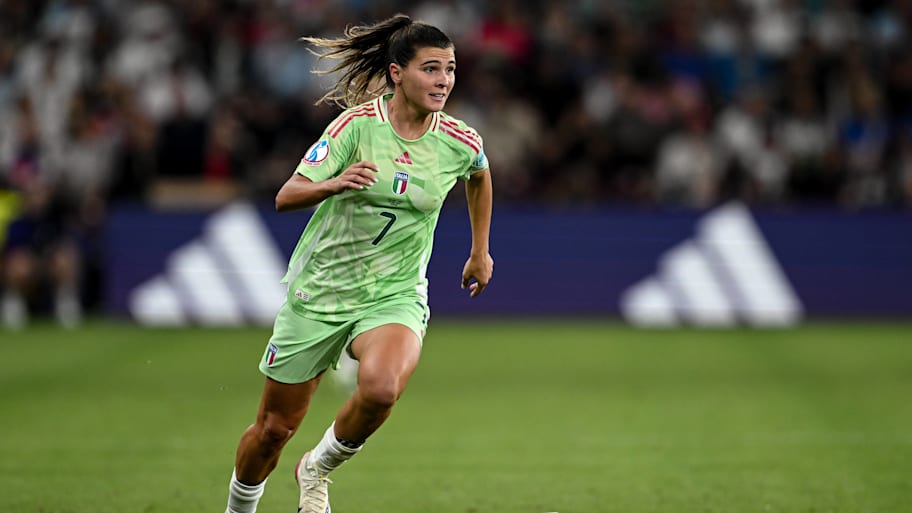
“We have been on a journey since the new head coach [Soncin] arrived, he believed and made us believe that we can compete against even the strongest teams,” said Boattin to Equalizer Soccer earlier this year after joining the Houston Dash. “Obviously we were disappointed with how the [semifinal game] against England went, but I must say it left us with this internal understanding that we have grown, worked hard, and have a strong ground.
“We were sad, but we believe we’re on the right track. We have to keep working. Overall, I especially hope that in Italy they can understand that there’s a need to invest—we can’t do everything on our own.”
As the program continues to grow, the conversation around the team has grown right along with it. In Italy, women’s sports have struggled to find the same foothold as men’s, even with the sport of soccer being somewhat of a religion for the country whose men’s team brought home the glory of a World Cup in 2006.
“The narrative has definitely evolved,” says Orlandi. “A few years ago the conversation was mostly about potential, now it is about performance, investment and long-term planning. Media attention is growing, clubs are becoming more structured and fans are increasingly engaged. We are not at the finish line yet, but the tone is more positive, more ambitious and more aligned with what the players truly deserve. There is a cultural shift underway and it is irreversible.”
As the U.S. prepares to take on the Italians, they will be a unfamiliar opponents. Even so, the USWNT has demonstrated success against Italy, notching 11 wins, one draw and only four losses against Le Azzurre. There is also a bit of history between the two sides with Italy being the USWNT’s first international match in history in 1985, resulting in a 1–0 win for the Italians.
Arrivate a Orlando 🇺🇸😌#Nazionale 🇮🇹 #Azzurre #LeAzzurreSiamoNoi pic.twitter.com/OYCXC4iP51
— Nazionale Femminile di Calcio (@AzzurreFIGC) November 25, 2025
Italy’s playing style has certainly evolved since that first matchup in 1985. Culturally, both the men’s and women’s side have been known for catenaccio, quite literally a door-bolt, locking things down defensively. The USWNT is used to playing teams who employ a low block, but Italy is not so one-dimensional.
With the attacking duo of Girelli and Cantore, both of whom were 2025 Ballon d’Or Féminin nominees, plus dynamic midfielders like Roma’s Manuela Giugliano, the USWNT will face a side hungry to prove itself on the international stage to end the year on a high.
For Orlandi, seeing the players he represents succeed for both club and country is all part of growing the larger ecosystem around women’s soccer in Italy.
“Players who experience top environments abroad bring back a mentality shift,” Orlandi says. “They raise standards inside their clubs, influence younger teammates and expand the expectations around professionalism. Their success stories create a cultural wake behind them. Italy benefits twice, because these experiences fuel both the national team and the domestic league. It’s a chain reaction that pushes everyone forward.”
More Women’s Soccer on Sports Illustrated
This article was originally published on www.si.com as After Women’s Euro Success, Italy Is Ready to Test Its Mettle Against USWNT.