Aside from Simon Gray, few dramatists have lately taken an axe to academia. But Steve Waters's After The Gods is a refreshingly bilious satire on the dehumanising aspects of the humanities; and, even if it goes a bit soft in the second act, it is written with accuracy and wit. Behind the play lurks the spectre of Louis Althusser: the Marxist philosopher committed to a mental hospital in 1981 after strangling his wife. In his place Waters creates a composite Breton intellectual, Michel Beaudricourt, invited to give a lecture at the University of Aberystwyth.
Everyone is in awe of the great man, which gives Waters licence to puncture the pretensions and faddish theories of his earnest campus followers. But when it is learned that the visiting guru has apparently killed his wife, under the influence of drugs, real life enters the protected world of academe. Satire strikes me as Waters's strongest suit, and he is at his best in contrasting the pseudo-scientific jargon of Eng Lit crit with the speech of everyday life. Putting his characters on the rostrum he sends up everything from the contextual pieties of the new historicists to the gender fixations of the post-feminists. But when Beaudricourt finally arrives and asks them, over drinks, to say what Shakespeare means to them, they suddenly start to speak like spontaneous human beings. It is a vivid demonstration of the way academic criticism has become a form of linguistic protection-racket.
The play goes off the boil only when Waters suggests the characters have learned something from Beaudricourt's tragic experience. Improbably bringing everyone to Aberystwyth, he shows a working-class lesbian, an unfulfilled gay lecturer and a pair of Beaudricourt groupies shedding their inhibitions while the French hero sheds his clothes in an echo of Lear's attempt to reach "unaccommodated man". Hard satire turns into a slightly soggy homily about the need to confront our real selves.
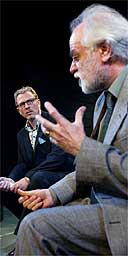
But Waters deserves credit for taking on an academic industry that elevates secondary criticism above pure text. And Gemma Bodinetz's production contains a peach of a performance from Tom Smith as a Malvolio-like puritan who has reneged on his early enthusiasm for Beaudricourt: every movement suggests a man ill at ease in his own body. There is also good work from Fred Pearson as the agonised intellectual himself, from Conor Mullen as the academic embodiment of unrealised promise, and from Amita Dhiri as a queer theorist guilty of the life half lived. You can pick holes in Waters's dramatic structure but what is encouraging is to find someone laying into the closeted world of critical theory with such palpable relish.