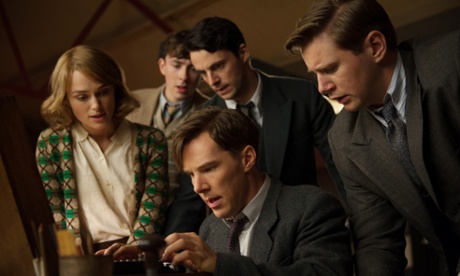
Most of us know about Station X, the code name given to Bletchley Park, home of the group of brilliant mathematicians, former chess champions, and crossword puzzle solvers, who cracked German Enigma codes during the second world war.
Thanks to The Imitation Game and the belated recognition of Alan Turing's unique contribution, even more have an idea what went on in that country estate in Buckinghamshire, home of the Government's Code and Cypher School (GC&CS), forerunner of GCHQ.
There were others, elsewhere. The Real Enigma Heroes (The History Press) by Phil Shanahan, describes how three young sailors on HMS Petard – Tony Fasson from Jedburgh, Colin Grazier from Tamworth, and teenager Tommy Brown from North Shields, retrieved Enigma codebooks from the sinking German submarine, U-559, in the Mediterranean on 20 October 1942.
Fasson and Grazier drowned during the operation which ended a ten-month blackout that had prevented Bletchley Park codebreakers from reading U-boat messages after the Germans introduced a new four rotor Enigma machine.
And few are likely to have heard of Q Central.
Q Central was code for the communications hub of Britain's war effort which played a vital part in all major operations, including the Battle of Britain, and D-Day.
Described as "the largest telephone exchange in the world", it was based at Oxendon House, a mansion in Leighton Buzzard, the small Bedfordshire market town, not far from Bletchley Park.
How thousands of people in and around the town were engaged round the clock in running Britain's wartime communications, some in camouflaged buildings, is described in the first full account of their secret work.
The Secrets of Q Central, How Leighton Buzzard Shortened the Second World War (Spellmount, an imprint of The History Press) describes how, unbeknown to the regular inhabitants, the country's "communications powerhouse" was in constant touch with Bletchley Park, carried out black propaganda operations, set up links with resistance fighters and members of the Special Operations Executive dropped behind enemy lines.
What became RAF No 60 (Signals) Group of Fighter Command was also the centre of Britain's radar operations. "There is no doubt that without No 60 Group directing our fighters in the Battle Of Britain the survival of the country would have been unlikely", the authors claim. 5,000 enemy aircraft were shot down as a result of information supplied by radar stations run from Leighton Buzzard, according to the RAF.
Propaganda was devised in nearby Woburn Abbey's riding school, and recorded at Whaddon Place, a large manor house near Milton Keynes.
Journalists, including Harold Keeble of the Daily Mirror and Sefton Delmer of the Daily Express, were recruited for black propaganda operations and proved to be very good at it.
Big country houses around Britain were safe places for secret wartime work. Leighton Buzzard was chosen because it was well away from the existing headquarters of Britain's radar operations on the Essex coast. The government feared it had been spotted by German airships and would be bombed, even attacked by paratroopers.
At the other end of the secret world, were those engaged in traditional espionage, as close as they could get to the world of James Bond. They operated, not through the air waves, or under the sea, but firmly on the ground.
In The Secret Agent's Bedside Reader (Biteback) the author Michael Smith brings together stories, both fact and fiction, by well-known writers who worked for MI6 or military intelligence. They include a plan concocted by Ian Fleming, an officer in naval intelligence, to steal an Enigma machine for the Bletchley Park codebreakers.
Contributors include Erskine Childers, author of The Riddle of the Sands, John Buchan, Compton Mackenzie, and Somerset Maugham.
The book includes a passage from Tales of Aegean Intrigue (first published by EP Dutton) by John Lawson, an MI6 officer. "The ethics of secret service in wartime do not permit the furtherance of schemes whose object is homicide, but neither do they prohibit enterprises from which the risk of incidental homicide cannot be excluded".
Lawson suggests MI6 officers, if not "licensed to kill", would do so in extreme circumstances.