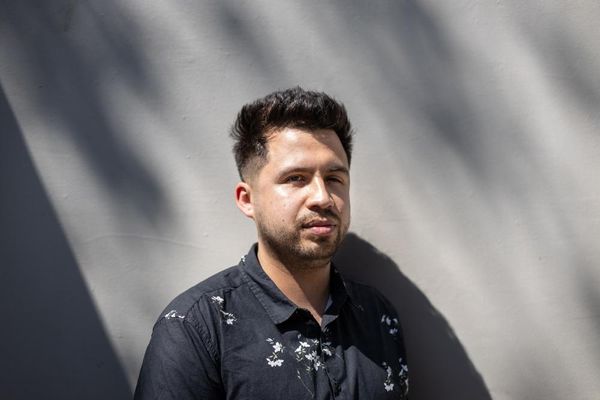
FRESNO, Calif. — After working for three months as a tutor at Fresno City College in 2016, Khoi Quach got a call that he needed to go to the campus police station.
"As soon as I heard that, I knew there wasn't going to be any good news," the now 28-year-old said.
At the station, he was told his background check came back, showing a conviction. He was fired.
When Quach was 17, a shooting at a party put him behind bars just a month before his high school graduation. Although he hadn't pulled the trigger, his gang affiliation with the shooter landed him in prison for six years under California laws aimed at cracking down on gang violence.
He was eager to put the episode behind him when he enrolled in college after serving his time.
Quach became a star political science student at Fresno City College, landing him an invitation from his instructor to tutor other students. But his firing proved to him it was going to be difficult to shed the stigma of being formerly incarcerated.
"It really woke me up to the reality of what that label attached to my name meant," he said.
Quach's rocky start at college is frustratingly typical for students trying to navigate college while having a criminal record, according to several formerly incarcerated people who spoke with The Bee.
Feelings of isolation and anxiety and lack of a support system are just a few of the obstacles people face when deciding to pursue higher education after imprisonment.
So when Quach found Project Rebound, a program that helps formerly incarcerated people integrate into society through higher education, he knew he would fit in.
"We get to share struggles and accomplishments," he said, "and that's the one thing that really helped push me towards the goal I set for myself of graduating. Because with Project Rebound, you get to see other people like me constantly doing amazing things."
Quach, who immigrated from Vietnam with his family when he was 10, was a Dean's Medalist when he graduated from Fresno State in 2019. He is now a graduate research assistant studying sociology (and educational inequalities, such as the ones he faced) at UC Berkeley.
Quach is just one of many that Project Rebound seeks to help by providing mentorship, support, and individualized resources.
"The goal is ultimately to reverse the school-to-prison pipeline," according to founding director Emma Hughes, who is also a criminology professor at Fresno State.
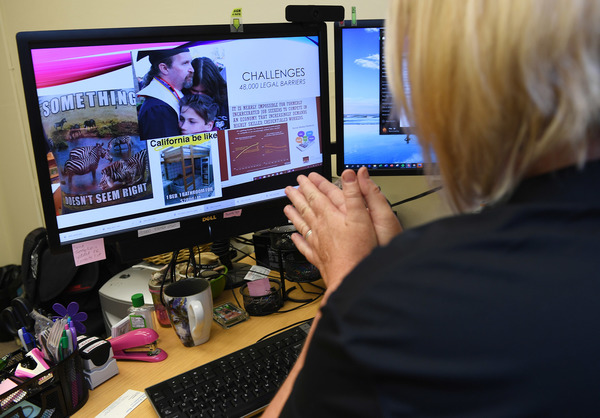
She hopes the program can change society's view about people who have been to prison and help students who fall into the justice system at a young age by creating a prison-to-school pipeline.
Project Rebound began at San Francisco State University in 1967 by John Irwin, a professor who served time in prison for armed robbery in the 1950s. But it wasn't until five years ago that the organization's leaders tried expanding it, first to eight other campuses.
In 2016, Hughes was tasked with duplicating the successful program in the Central Valley with grant money set to expire in only a few years.
"I had been doing research on education programs in prisons for many years," Hughes said. "I believe very firmly in the transformative power of these programs, and to have an opportunity to put this into practice was just really exciting."
From there, the program impressed legislators, earning a budget line from Gov. Gavin Newsom in 2019 — $3.3 million that covers the CSU-wide programs.
In 2021, five more CSU campuses are joining the consortium, making 14 total: San Francisco, Fresno, Bakersfield, Fullerton, Humboldt, Long Beach, Los Angeles, Pomona, Sacramento, San Bernardino, Northridge, San Marcos, San Diego, and Stanislaus.
Although Project Rebound only tracks recidivism rates while students are enrolled, the data is noteworthy. Since 2016, no Project Rebound student has reoffended while in the program, according to the organization's annual report.
The recidivism rate for California, defined as reoffending within three years of release, remains stuck at around 50%, according to the state.
When someone chooses higher education, they are less likely to reoffend, making increased safety one of the benefits to the community, according to Leahy.
The program also offers pathways to resolving conflicts and addressing life problems.
"Education opens people's minds in general," she said, "and these are skills that most of my students were never taught prior to their incarceration, and they certainly didn't learn it while they were incarcerated."
Retention and success rates are also higher for students in the program than for the general CSU population: In spring 2019, 93.7% of Project Rebound students continued with their education, compared to 84.3% of the general population.
But what about when students graduate or otherwise leave the program? That tracking does not happen, according to Hughes. Although it could provide meaningful information, there's a reason the program is hesitant to collect this data.
"We don't want our Project Rebound alumnae to feel that they are monitored differently than other CSU graduates," Hughes said. "We are currently exploring new areas for research and evaluation of Project Rebound, and there may be small scale studies that look at this in future, but again, we don't want to be labeling our graduates in the very way that we are trying to move beyond."
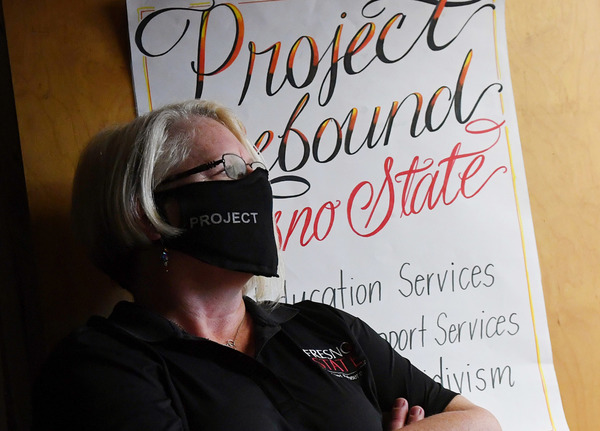
In addition, since California public college applications don't ask students to disclose convictions or incarcerations, there is no real way to find how many formerly incarcerated students are on campuses.
In 2016, 180 students were enrolled in Project Rebound CSU-wide. For the 2019-2020 school year, that number jumped to 454. There are about 31 Project Rebound students enrolled at Fresno State, and 52 who are not yet enrolled at the university, Hughes said.
Jennifer Leahy, the current program director, says as soon as she makes contact with someone in the community, they become part of the Project Rebound family. Many of those community contacts are not yet ready for college because they are navigating mental health or substance abuse issues, homelessness, or finding difficulty with childcare.
Also included are students who are attending community colleges but will soon be ready to attend a university.
Then there are the many letters that staff members receive each week from currently incarcerated people. Staff and student assistants write back an individual response to every person.
Since there aren't computers inside prison or jail to apply for college, the staff helps facilitate that process, so when a person is released, they have something to look forward to.
Project Rebound takes a holistic approach to getting participants what they need to be successful. Many students find themselves behind on technology because they've been incarcerated so long and need to find out how to use Google or other school-related programs.
Project Rebound offers help with gas, food, legal advice referrals, and sometimes housing, too, Leahy says. Group events and classes help students feel connected and motivated.
But even with its flexible approach, there are some limitations as to what Project Rebound can do, leaders say. It's still challenging to find a job with a criminal conviction. So finding a major that fits is sometimes difficult, according to Leahy.
"If you get a felony conviction for drug abuse, you're not going to be a pharmacist, for example," she says. "There are going to be some unrealistic pathways for education. But that doesn't mean that every pathway is closed."
And although staff aims to help participants get ready for college, they can only do so much if the person is not yet ready.
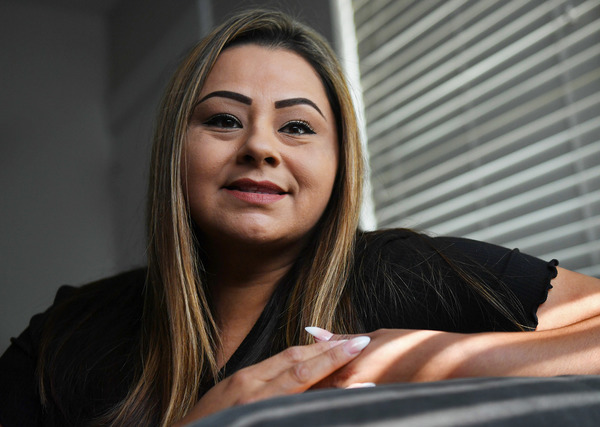
Victoria Rocha, a 37-year-old social work student, said even though she was slightly older than the average college student when she started her journey, "I started at the time I was ready to start. I wouldn't have accomplished all that I accomplished (if I had tried before.) I wasn't in the right state of mind."
As student Chevelle Parks was conducting outreach for Project Rebound at the Fresno County Jail one day, the 52-year-old could sense that the woman she was talking to needed a hug. Even though touching wasn't exactly allowed, "she shook my hand, and she cried," Parks recalled.
When the guard asked what was going on, the woman told him that Parks "reminds me of my aunt, she reminds me of someone I wanna be."

Finding other African Americans like herself is important, Parks says, because she "felt like an outcast right off the bat, especially going to a school like Fresno State," where there are fewer African Americans.
And that's the centerpiece of Project Rebound's mission and model: to recruit staff and student assistants who have incarceration experience as well as experience navigating a university.
Parks says she inspires people who realize that she's "been on the other side of the fence" and has now turned her life around.
Participants mentor youth who've been referred from the parole and probation departments. They also go into local prisons and places such as the Fresno Rescue Mission.
Before Parks served two years for fraud at the Central California Women's Facility in Chowchilla, she had already earned her associate degree at Victor Valley College. She had plans to pursue her education, but said a public defender convinced her it wasn't likely after her conviction.
After a talk with Leahy, Parks realized she could go back to school for her bachelor's degree.
"I pushed forward, I was resilient, and with the help of Project Rebound, they helped me navigate through there. I thought (Fresno State) was just a dream someday."
Parks, who will graduate from the university next spring, said she's a "people person" and plans on using her sociology degree (with a minor in cross-cultural competency) to counsel people in prison.
Breaking generational cycles of incarceration
When Project Rebound students succeed, so does their inner circle, according to Hughes.
"It can have a ripple effect on others around them in their home and in the community," she said. "They want their children and their grandchildren to have a different life than they had, and they see any opportunity as a beautiful opportunity to help people get out of that lifestyle."
Parks, who has four adult children and 13 grandchildren, has had several follow in her college footsteps, including her husband and her oldest grandson, who just graduated from Hoover High School. He is studying criminology at Fresno City College.
"Just by him seeing me and where I was in my life before, it's a motivation for him."
"I would say they're helping our kids because they're helping us become better," said Rocha, the social work student who is set to graduate in 2022.
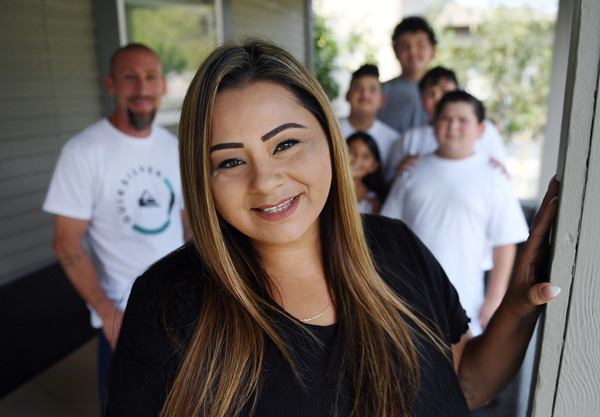
Rocha was "in and out" of prison for the better part of 15 years due to drug addiction. But about seven years ago, she came out for the last time, she says.
She has five children, two of whom are taking college classes while at Design Science Middle College High School.
"I wasn't always the best mother," she said, "and now my boys, they're teenagers, and they're good kids compared to what I was doing, and I'm thankful for that."
Rocha and Alex Banda, also a Project Rebound student at Fresno State, are now attempting to recreate what the program does, but at the community college level.
Recruited to lead Rising Scholars at Fresno City College, the pair have a wealth of knowledge about what works to help formerly incarcerated people succeed.
Rising Scholars got off the ground in late 2019, and even though its success has been hampered by the coronavirus pandemic, Rocha and Banda are still working to make participants feel welcome in the academic world, even if it's from a computer screen.
"We're trying to adapt and adjust to everything being virtual, and we're trying to figure out ways in which we can keep engaged with the students virtually," Rocha said.
Rocha understands now what initially drew her into Project Rebound, and she wants to provide that to community college students.
"I was looking for people who were like me," she said, "people who have made mistakes, people who have a rough past, people who were trying to change their lives through education. For a formerly incarcerated student, you need that."
Banda, 49, says there are many formerly incarcerated students on campus — he just needs to find them.
He remembers his first time at school after being in prison for 15 years and said it's tough reaching people who have criminal backgrounds because some would rather remain in the shadows.
"I was afraid to be on campus," he said. "I didn't know anybody. I wasn't comfortable around people. I had serious anxiety. I wasn't used to being around crowds. It was hard for me."
The two hope to get a permanent office on campus when the college opens to more students and staff, hopefully, next year. The program is also running on grant money and can't yet provide as much financial support as Project Rebound.
But Banda, who aspires to become a lawyer, understands how critical just having a support system can be. He started a campus club, All of Us or None, and runs the nonprofit Hope Beyond 4 Walls, which helps formerly incarcerated people assimilate back into society.
Project Rebound leaves such a lasting impression on its participants that Rocha doesn't see herself saying goodbye.
"I wouldn't be where I am today without the support of Project Rebound, without their encouragement," she said. "Even when we graduate, I still see ourselves being a part of it. It's a family. I don't think we actually ever leave."