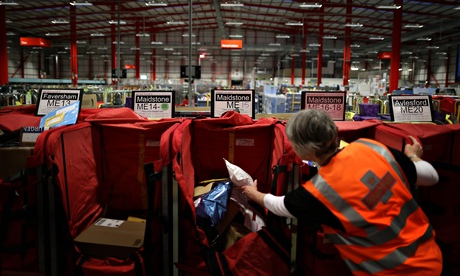
Only two views are required to make a market, so we are now spoilt for choice about the size of the undervaluation of Royal Mail at flotation, or IPO. Were taxpayers short-changed by £750m, as the National Audit Office suggested in April. Was the figure £1bn, as the MPs on business select committee believed in July? Or is £120m-£180m a truer estimate, as Lord Myners’ report argued on Thursday?
Prefer Myners’s lower range. It’s the sober one. First, no seller in a big IPO ever expects to squeeze out the last drop of value. Second, the £750m-£1bn guesses rest heavily on the wild trading that occurred after Royal Mail’s listing at 330p in October last year, which pushed the price as high as 600p in January (versus 405p today).
But, as Myners argues, nobody could have predicted that Chris Hohn’s hedge fund would turn up and, briefly, try to buy every share it could gets its hands on. Hohn’s fund, incidentally, sold the lot within months for a large profit.
Myners thinks the government might have got the float away at 350p-360p. That seems about right. No underpricing is good for taxpayers, of course, but a 6%-9% miss is not a hanging offence. Business secretary Vince Cable has taken a political beating over Royal Mail. He is entitled to revel in the finding that the sale was “a complex exercise executed with considerable professionalism”.
That’s the politics out of the way. Far more important is Myners’s conclusion that the standard book-building process – the City technique of taking orders for shares at various prices – is full of holes. Or, more politely, it has “inherent limitations”.
You bet it does. The worst flaw – painfully obvious at Royal Mail – is that so-called “pilot fish” are not incentivised to bid hard for shares. These marine creatures are actually City fund managers recruited at an early stage to test demand for stock and to debate price.
They have their uses as it’s generally good to have investors who know what they are buying. But there’s a glaring drawback from the point of view of the seller: the people who are debating-cum-advising on the correct price are the very people who you are planning to sell to.
Worse, the pilot fish are promised preferential allocations of stock at the end of the process. Worse still, the City convention is to announce a pricing range for a flotation, which amounts to setting a maximum before all interested parties have shown their hand. No auction house would operate that way.
“The lack of motivation for pilot fish in the Royal Mail IPO to show price leadership during bookbuilding contributed significantly to the deficiencies of the process,” says the report.
Myners’s solutions include injecting more automation into bookbuilding to make it more like an auction; being more flexible on the price range; and giving independent analysts access to information so they can write decent research. The last, in particular, seems critical. Current City practice too often involves hiring a full brigade of advisers, with the effect that those firms’ analysts are gagged for a month and the quality of debate about price suffers. It’s a nonsense.
Cable could not have been expected to reinvent the IPO process for the 21st century, which is why he is semi-vindicated by this report. But the more one sees of the business of floating companies, the more it looks like a cosy private club in which City advisers deploy unnecessary secrecy in order to justify their princely fees. A blast of transparency is long overdue. Bring on electronic auctions. They work in the gilt market and they could work in the stock market.
Walsh may get BA
Willie Walsh, IAG chief executive, does not want to buy Aer Lingus, his former employer, for old times’ sake. He wants the Irish carrier’s landing slots at Heathrow. The airport is operating close to capacity and a new runway, if it is ever approved, is at least a decade away.
Would Heathrow’s dominant carrier be allowed to become even more dominant? Actually, it probably would. Lufthansa and Air France-KLM are even more dominant in their own backyards.
The bigger obstacles – assuming Walsh is prepared to put a decent bid on the table – are the Irish government, with a 25% stake in Aer Lingus, and Michael O’Leary’s Ryanair, which has 29.9%.
The Irish government might be persuaded with a few guarantees over flights to Ireland. O’Leary is less predictable given that his own pursuit of Aer Lingus, in the face of objections from Europe, has been something of an obsession. But O’Leary is also commercially minded. He might regard a sale to IAG at a whizzy price as a neat escape from the Brussels bureaucrats. It won’t be straightforward, but Walsh has a decent chance of winning if he’s prepared to pay up.
Rouble trouble
Bad news for Russian oligarchs: if you want to convert your roubles into Swiss francs, you’ll pay for the privilege. Negative interest rates have arrived in Switzerland in an attempt to dampen demand for the safe-haven currency. The fee is only 0.25% and it applies only to balances over SFR10m (£6.5m) deposited by commercial banks at the central bank.
One assumes the charge will be passed onto wealthy customers. But one also assumes the average oligarch these days would be happy to take a 5% haircut to get his roubles out.