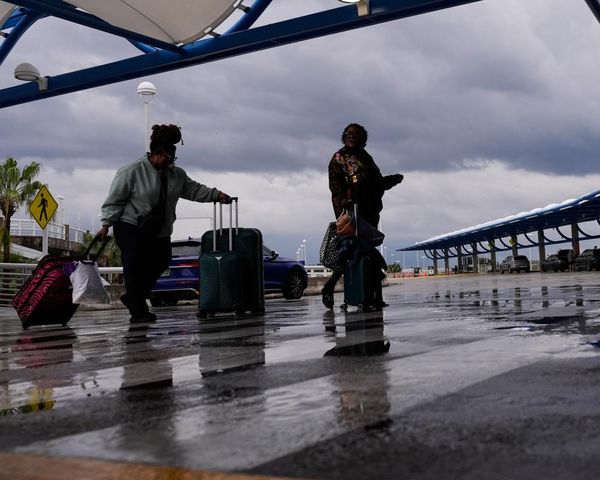
DALLAS _ As Laura moved across the U.S. as a weakened tropical depression Friday, two new disturbances have developed in the Atlantic Ocean _ right on cue for the peak of hurricane season.
Although tree and structural damage from Hurricane Laura was reported in three Texas counties, the Lone Star State was largely spared from the brunt of the massive Category 4 hurricane _ the strongest storm in the Gulf of Mexico since Hurricane Katrina. It made landfall early Thursday in Cameron Parish, La., about 30 miles from the Texas border
So far, Texas has reported no loss of life from Laura. Louisiana reported six deaths and extensive damage in the Lake Charles area.
In some ways Hurricane Laura was a dress rehearsal for how to handle a hurricane during a pandemic.
Because of the COVID-19 pandemic, Texas sought to avoid using places like convention centers as shelters for evacuees. Instead, to prevent the spread of the virus, the state was successfully able to shelter about 8,500 evacuees in more than 3,000 hotel rooms across the state, according to Abbott.
About 2,200 evacuees were sheltered in hotel rooms across Dallas, Richardson, Mesquite, Irving and Farmers Branch, Dallas County Judge Clay Jenkins said Friday.
The Atlantic hurricane season officially runs from June through November, and historically the season peaks from mid-August through October, according to the National Hurricane Center.
The two disturbances in the Atlantic are unlikely to develop into a tropical cyclone over the next two days, but those chances increase over the next five as they drift farther east, according to the center.
The next two Atlantic storm names are Nana and Omar.
This hurricane season has been more active than usual. Usually by the end of August, there have been five named storms in the Atlantic, according to the National Oceanic and Atmospheric Administration, or NOAA. This year there have been 13.
NOAA in early August updated its hurricane season outlook, calling for 19 to 25 named storms, of which seven to 11 could become hurricanes, and three to six could become major hurricanes like Laura _ with winds of 111 mph or greater. The previous outlook by NOAA forecast 13 to 19 named storms.
Though Laura, which reached land as a Category 4 storm, devastated some areas of the coast, officials said it could have been much worse.
Texas Gov. Greg Abbott on Thursday credited local officials for issuing evacuation orders and the residents who followed them.
"By people getting out of harm's way at an early time, that's one of the reasons why the loss of life was minimized," Abbott said. "Preparation paid off."
Earlier forecasts had shown Laura could have hit the Houston-Galveston area or that the storm surge could affect the area, which is why evacuation orders were in place in Galveston and voluntary evacuation orders were issued for portions of Harris County, southeast of Houston.
"Laura was the strongest recorded hurricane to ever hit the Louisiana coast," Harris County Judge Lina Hidalgo said. "It would have devastated us. We got lucky. This was a reminder that vigilance is the cost of living in this beautiful place we call home."
Hidalgo on Thursday called on Congress to help expedite flood projects and fund a coastal barrier for Galveston Bay.
"This week, many of us watched the meteorological projections with anguish," Hidalgo said. "But the reality of it is, we don't have to cross our fingers and hope that major storms miss us. We have the power to protect our region. This isn't new, it just requires will."