CHICAGO _ From the early days of his candidacy in 2015 through his presidency, Donald Trump has used public platforms across the world to push his agenda while criticizing Chicago and its Democratic leadership.
Now he has the chance to do it in person.
Dogged by a House Democratic-led impeachment inquiry, Trump is scheduled to arrive Monday in a city beset with its own problems of gun violence, financial uncertainty and an ongoing teachers strike.
The trip presents the prospect of political theater mixing a brash, headstrong president and a city whose activism against government, including its own City Hall, recently has shown itself in almost daily protests and marches.
Chicago also symbolizes the nation's great political divide between diverse urban, mostly Democratic areas opposed to Trump, and the rural areas where the president captures most of his populous support as he blasts the city-living "elites."
"He goes right into the teeth of the enemy and gets in their face. That's very much his style," David Yepsen, a veteran national political observer and the former head of the Paul Simon Public Policy Institute at Southern Illinois University at Carbondale, said of Trump.
Trump is expected to attend a closed-door, big-dollar fundraising luncheon set for his namesake hotel, and also make his first public remarks as president in Chicago at the annual gathering of the International Association of Chiefs of Police at McCormick Place.
Trump is expected to further trumpet a foreign policy success amid questions about his Syrian policy with the death of Abu Bakr al-Baghdadi, the leader of the Islamic State, during a U.S. military raid in Syria.
"He was a sick and depraved man, and now he's gone," Trump said in making the announcement Sunday at the White House. "He died like a dog, he died like a coward."
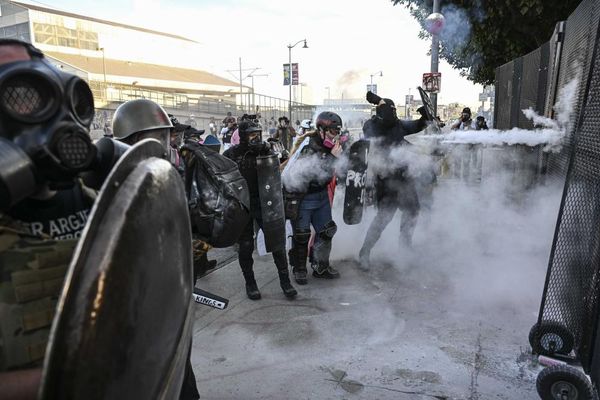
With major protests planned, the city's downtown and South Loop are expected to face major disruptions as several streets are shut down amid a heightened level of security and the tensions caused by the visit of a chief executive to a city where he is vastly unpopular.
The Chicago Police Department has canceled the regular days off of 1,800 officers to add extra personnel around McCormick Place and Trump Tower on Monday. The officers will be paid overtime.
Police are bracing for upward of 20,000 protesters based on social media, media reports and community feedback, department spokesman Anthony Guglielmi said.
"We are monitoring all of that in real time," he said.
Several hundred officers already had been assigned to the policing conference that Trump plans to address at McCormick Place, Guglielmi said. In addition, the department can redeploy officers from other units, such as the detective division or the organized crime unit, to areas of concern.
Though specialized units will be deployed, most officers assigned to the protests won't be wearing any tactical gear.
Groups such as Indivisible, formed as an outgrowth of Trump's 2016 presidential victory, are being joined by Rainbow/PUSH Coalition, Chicago Women Take Action and others for a scheduled noontime protest near Trump Tower.
"We're inviting everyone to join the effort to help change the narrative and actions coming from President Trump and the White House that are endangering people's lives, our democracy, and the survival of the planet," said Jacky Grimshaw, formerly a top adviser to the late Mayor Harold Washington who now chairs Chicago Women Take Action.
Trump's list of grievances against the city are legion but focus primarily on the city's violence _ a likely topic of discussion at the chiefs of police convention where he faces a supportive audience.
Trump regularly has worked to make the city a poster for his tough-on-crime stance.
At one of his 2016 presidential debates against Hillary Clinton, he asked if Chicago is "a war-torn country." At a postelection visit to Youngstown, Ohio, he asked, "What the hell is going on in Chicago?" In Pensacola, Florida, he told rallygoers, "There are those who say that Afghanistan is safer than Chicago." And in Seoul, South Korea, he said, "Chicago is a disaster, a total disaster."
Through mid-October, both homicides and shooting incidents have fallen by 11% in Chicago this year, according to official Police Department statistics. Those numbers continue the double-digit declines seen in both 2018 and 2017 after the disastrous 2016 results when more than 760 people were killed and in excess of 4,300 were shot in Chicago.
Trump also has regularly used rallies to incorrectly say Chicago has "the strongest gun laws in our nation" in trying to appeal to a base that includes gun rights advocates.
The president also has criticized Chicago and its sanctuary city status as part of his hard-line stance against illegal immigration. Under Illinois law, police cannot detain someone for immigration authorities because of their citizenship status without a court-issued order.
"If you look at Chicago, they're fighting it. If you look at other cities, they're fighting it. Many of those cities are high crime cities and they're sanctuary cities. People are tired of sanctuary cities and what it does and the crime it brings," he said in June after delaying a threatened nationwide sweep by immigration authorities.
Given Trump's previous public appearances, including telling the visiting Stanley Cup champion St. Louis Blues in the Oval Office of a successful stock market, a tough-on-trade attitude toward China and dismissing talk of impeachment, the president could turn his speech to the police chiefs into a lengthy list of attacks against the city.
"If he does one of his rants, he could drift into all kinds of stuff _ race, immigration," said Yepsen, currently the host of "Iowa Press" on Iowa Public Television. "Chicago is a backdrop for his show to appeal to his base."