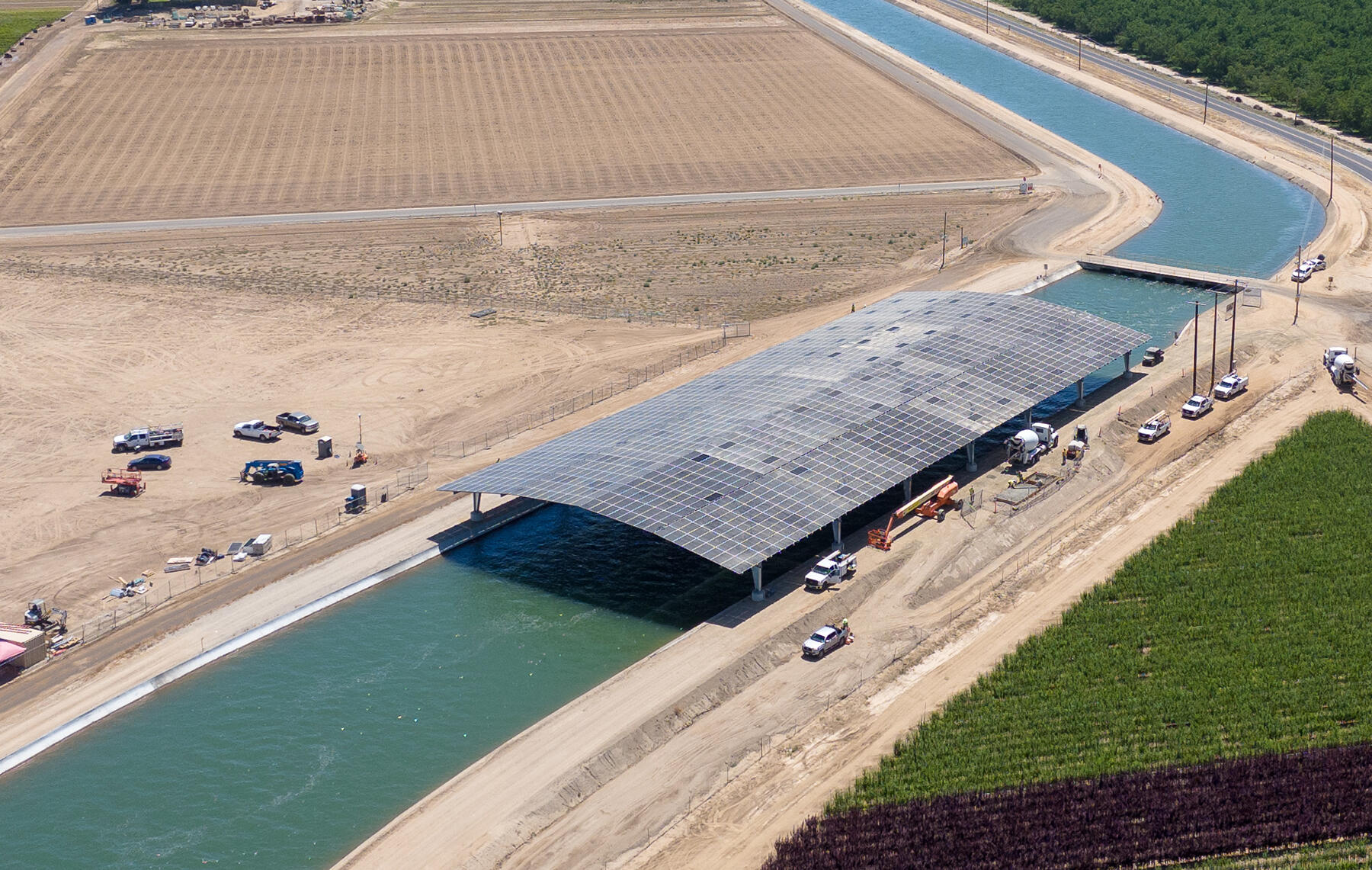
California's extensive canal network delivers water to farms, communities and cities across the state, playing a central role in California's water distribution system for both agriculture and urban areas. However, because the waterways are open to the sun, considerable amounts of water can be lost through evaporation, particularly during periods of high temperatures and prolonged dry weather.
Get breaking news anytime, anywhere. Download the TOI app now!
A study published in Nature Sustainability , titled Energy and water co-benefits from covering canals with solar panels , explored whether a single approach could help address multiple challenges at once. The study examined the potential impact of installing solar panels above what the researchers described as California's approximately 6,350-kilometre (roughly 4,000-mile) canal network. Their analysis suggested that canal-top solar installations could generate renewable electricity while reducing water lost through evaporation and making better use of infrastructure that already exists.
Rather than proposing that canal-top solar replace conventional solar farms, the study evaluated how it could complement other forms of renewable energy while avoiding the need for additional land in many locations.
Why researchers looked above the canals instead of beside them
California has invested heavily in both water infrastructure and renewable energy over recent decades. At the same time, prolonged droughts and rising temperatures have increased concern about water security, while demand for clean electricity continues to grow.
Instead of placing solar panels on agricultural land or undeveloped open spaces, the researchers evaluated the potential of installing them above existing canals.
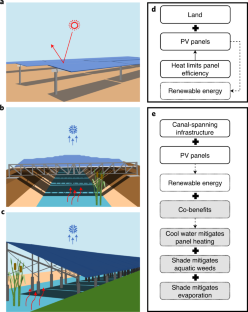
According to the Nature Sustainability study, the researchers found that shading from the panels could reduce evaporation and may also help limit the growth of aquatic weeds in some canals. The flowing water beneath the panels could also help cool the solar panels. Because solar panels generally become less efficient at higher temperatures, this cooling effect could improve electricity generation under certain conditions.
According to the Nature Sustainability study, the researchers estimated that covering California's canal network with solar panels could save about 39,000 cubic metres of water per kilometre each year. Because the supporting structures would be built above existing canals, the approach could also reduce the need to convert additional land for renewable energy projects.
The study suggests canal-top solar could offer benefits beyond electricity production. By making greater use of existing infrastructure corridors, the approach could help reduce competition for land in areas where agriculture, wildlife habitat and renewable energy development overlap.
The researchers emphasised, however, that these findings were based on modelling and engineering analysis rather than large-scale deployment across California. Practical implementation would depend on construction costs, engineering design, site-specific conditions, maintenance requirements and other operational considerations.
From research to a working demonstration
Project Nexus, a 1.6-megawatt solar-over-canal pilot in California's Central Valley, was completed and commissioned in 2025 to evaluate the performance of solar panels installed above active canals. California highlighted the project in an announcement published in April 2026
According to the governor’s office, Project Nexus is backed by a $20 million investment and will be evaluated with partners from the California Department of Water Resources, Turlock Irrigation District, SolarAquaGrid LLC and UC Merced. The pilot is designed to measure electricity output, evaporation savings, possible water-quality gains and maintenance reductions, including lower vegetation growth along the canal.
According to the California Governor's Office, Project Nexus will evaluate electricity generation, water savings from reduced evaporation, potential improvements in water quality and the feasibility of installing solar panels above active canals. Such projects allow engineers to compare real-world performance with earlier modelling and assess whether the technology could be expanded more widely.
It evaluates the concept as one option that could contribute to broader efforts to improve water management while increasing renewable electricity generation.
As a result, not every canal would necessarily be suitable for overhead solar installations. Decisions about future projects would need to consider engineering feasibility, maintenance access, local electricity demand and the characteristics of individual waterways.
The Project Nexus pilot will help researchers and project partners assess how canal-top solar performs outside computer models, including its ability to generate electricity, reduce water losses and operate alongside existing irrigation infrastructure.