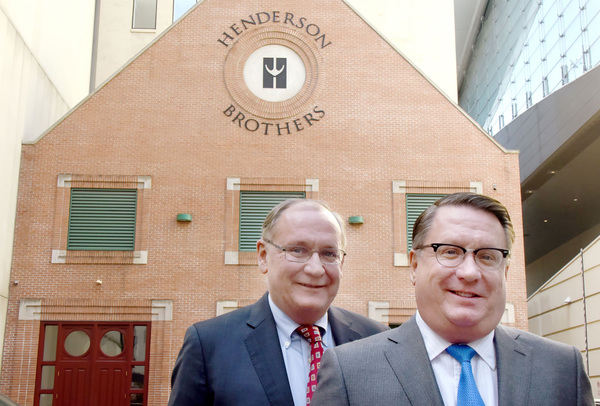
PITTSBURGH _ The losses that Henderson Brothers Inc. sustained in 1986 are the stuff of textbooks, with pages missing.
The story begins in 1956, when Thomas E. Grealish went to work at Henderson, a venerable property and casualty insurance company with offices in downtown Pittsburgh. He bought the independent agency in 1961 and ran it until his death from bone cancer in April 1986. He was 62.
At the funeral home, Henderson president Dan Grealish, now 60, remembers a competitor slipping him a business card with an offer to buy the company. That was before things got worse at Henderson.
Three months later, in July 1986, Grealish's close associate and vice president Tony Michael died from lymphoma, cancer of the immune system. Then, Henderson vice president Leon Zinger died suddenly in October from a heart attack while playing golf. He was 49. He had been with the company since 1964.
The losses weren't over yet. Grealish's wife, Margaret, died from a heart attack in November 1986 while she was attending morning Mass at a church. Grealish, 57, was president of Henderson.
"It was really frightening," said Grealish's son, now 55, also named Tom, who works as president at Henderson. "It was all such a haze at the time. You had to hope that you make the right decisions."
Henderson, which traces its roots to 1893, is among Pittsburgh-area companies that have survived more than a half century, through management losses, market turbulence and periods of torrid growth. The secret? Diversify sources of revenue, adapt to new markets and hire the right people.
It's not an easy mix to achieve for family-owned businesses, only 30 percent of which survive to the second generation and just 12 percent to the third, according to JSA Advising LLC, a Edina, Minn., consultant. At Henderson, three generations of the Grealish family have worked at or managed the insurance brokerage.
Dan Grealish was 30 years old _ Tom was just 25 _ the year their parents and other company executives died. The brothers had to prove their mettle to senior employees who had grown up in the business with their father, to banks that fed the company with working capital and to clients.
The insurance carriers that Henderson represented "didn't want to deal with podunk companies, mom-and-pop agencies," Dan Grealish said.
The brothers quickly adopted a strategy to expand, diversify revenue and, above all else, stay independent in a feeding frenzy of mergers and acquisitions. Independence continues to be a Henderson mantra, something that has turned into a draw for job candidates who increasingly shun big carriers, Dan Grealish said.
The result: revenue has grown by 14 times at Henderson as the number of employees rose seven-fold to 145 people since 1986. The pace of growth spiked during the past three years with 20 employees being added annually to the payroll.
In fact, booking revenue in a month today at Henderson exceeds the sum booked in all of 1986, Dan Grealish said. Henderson is privately held and did not release its financials.
"We had to decide: are we going to grow or are we going to go?" he said. "That was an adjustment. There were some skeptics out there, but 1986 forced us to do something."
Foresight _ and a little luck _ eased the difficult leadership transition triggered by the death of the senior Grealish in 1986: the company had no debt, and with their father's counsel, the Grealish sons were able to map out a succession plan when he became terminally ill.
After the decimation of the leadership team, Dan Grealish buried himself in agency business. The company moved quickly, deciding in January 1987 to add a health care benefits line of products, which included health, group, group life and long-term disability insurance.
Henderson's days of being an exclusive property and casualty insurance broker were over.
Today, property and casualty insurance and health care benefit sales each make up about 40 percent of Henderson's book of business. Another 20 percent comes from retirement and 401(k) benefit products, a line added about 10 years ago to meet changing employer preferences.
In the early days after his father's death, Dan Grealish proved himself by hustling, arriving at the office before anyone else in the morning and leaving after everybody else at night. He was intuitive in his management style, making decisions from his gut, whereas brother Tom was more systems oriented.
"I'm a salesman who had to learn the administrative side," Dan Grealish said.
The result was a complementary managerial team that drove growth through the early 1990s. But involvement in every aspect of the business created a problem for Dan Grealish: "I couldn't let go," he said.
The company was getting too big for any one or two people to shoulder the bulk of the responsibility, he said.
Henderson responded by reorganizing its management structure, creating divisions and delegating authority to newly appointed managers. The evolution continues today with recruitment efforts for the next generation of managers, a strategy that includes an internship program. Up to 10 interns are working at Henderson at any one time.
Discussions continue about alternate work arrangements, preferred by younger employees. A plan to create a common computer environment for a more mobile and tech savvy workforce has begun with the hiring of an outside information technology consultant. Such changes will enhance the company's draw as a preferred place to work, said William Beale, manager of retirement plan services at Henderson.
"It makes us a far more interesting as a future employer for someone just coming out of school," Beale said.
In the meantime, Henderson stresses the importance of work-life balance and added a tuition reimbursement benefit in recent years to help create an environment where employees can feel they're more than a number.
"This is a very family friendly workplace," said Maggie Boucher, a Henderson consultant for 12 years who has a 2-year-old son and is pregnant with her second child. "That is the world to me. I can do my job and still be a mom."