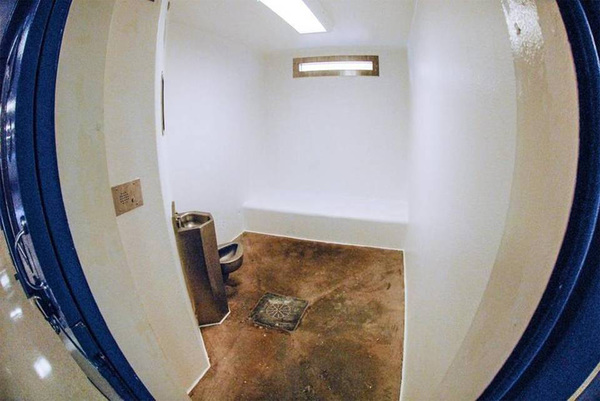
CHARLOTTE, N.C. _ A North Carolina inmate has been moved back to solitary confinement after getting a brief reprieve from his 13-year stretch in isolation.
Inmate Shawn Minnich had been moved in November to Central Prison's "therapeutic diversion unit," where inmates receive intensive mental health treatment as an alternative to solitary confinement.
But Minnich, 49, said he was moved back to solitary in early February after he was cited for threatening to injure prison staff. He is serving time for armed robbery, having sex with a minor and other offenses.
He said he began a hunger strike on Feb. 1 to protest the way he has been treated. He said he ended his strike seven days later after officers threatened him with violence and physical harm if he refused to eat.
Researchers have found that prolonged solitary confinement can cause and worsen psychiatric problems. For that reason, state prison leaders say they are trying to dramatically reduce their use of solitary.
Recent letters from Minnich, however, provide an unusual look at the difficulties that prison leaders face in trying to do so. The letters also show how years in solitary can scar inmates in ways that make it harder for them to transition back to a less restricted life.
Last year, the Charlotte Observer reported that Minnich was one of seven inmates who had been held in solitary for more than 10 years. Another was Jason Swain, who suffers from bipolar depression and had also been in solitary confinement for more than 13 years. Swain has repeatedly swallowed razors, ripped open his surgical incisions and plunged sharp objects into his open wounds.
Minnich was moved from solitary to the therapeutic diversion unit (TDU) soon after the Observer wrote about him.
There, he began taking an astronomy class and was able to spend much of his day out of his cell.
But in a letter sent to an Observer reporter on Feb. 10, Minnich said he had lost the privileges he enjoyed in the TDU. After he was moved back into solitary, he was initially allowed out of his cell only for showers, he said. And it was not until Feb. 9 that he was allowed out of his cell for a full hour, he said.
Minnich said he has been diagnosed with post-traumatic stress disorder _ a condition that he attributes to the 13 straight years he spent in solitary.
"It's just bogus that this guy is in solitary confinement and not in a treatment setting," said Susan Pollitt, an attorney for Disability Rights NC, a nonprofit advocacy group. "It's obvious that if you spent 12 or 13 years in solitary confinement, you would come out with anger and adjustment issues.
"I'm not saying (prison officials) have an easy job. But throwing him back in solitary is not going to help."
State prison leaders refused to discuss Minnich's allegations. But in an email to the Observer, spokesman Keith Acree said prison leaders and mental health clinicians thoroughly reviewed his case.
Acree said that it's sometimes necessary to move inmates from the diversion unit when they threaten the safety of staff or inmates. Those inmates may be reconsidered for participation in the program "at a later time," Acree wrote.
"It is important to note that staff have the responsibility to do all they can to maintain a safe and secure environment for staff and inmates," Acree wrote. "When an inmate who suffers from mental illness commits rules infractions that place staff or inmates at risk for harm, staff place the inmate in the least restrictive environment possible within the prison setting."
In his letters to the Observer, Minnich said his recent problems began on Jan. 31, when the director of the TDU told him he'd be leaving the program in 30 days and asked if he had any concerns. Minnich said that he was worried about being returned to the regular prison population at Central because he felt threatened by several officers.
Minnich said that he told the program director, "I fear for my life" because of officers who have threatened him in the past _ and who have a history of beating fully restrained inmates.
A federal lawsuit filed in 2013 by eight other inmates alleged that correctional officers at Central brutally beat shackled inmates in prison "blind spots," out of view of surveillance cameras. The state has reached settlements with all but one of the inmates. As part of its settlement, the state has installed more video cameras to cover the "blind spots" where beatings reportedly happened.
A disciplinary report dated Feb. 6. said that Minnich told the TDU director that if a particular prison officer walked on his unit, "I would not be able to control myself and would do everything I could to stab him in the eye."
Minnich contends he never threatened to stab the officer in the eye.
Minnich's father, Ed Minnich, questioned the prison leadership's commitment to reducing the use of solitary confinement.
"They're saying one thing and doing another," he said. "They're saying publicly we really want to do away with this kind of stuff. But they're not doing it."